Book
The Psychological Birth of the Human Infant: Symbiosis and Individuation
The book by Margaret Mahler, Fred Pine and Anni Bergman, published in 1975, is the first full theoretical account of normal separation-individuation. It grew out of the authors' observational research on mothers and young children in New York. It starts from the claim that the biological birth of a human infant and its psychological birth do not coincide. Biological birth is a single visible event; psychological birth is a slow inner process that unfolds over the first three years. Separation is the child's emergence from a symbiotic fusion with the mother. Individuation is the child's taking on of characteristics of its own. After an introduction and a history of the research setting, the book describes the forerunners of the process, normal autism and symbiosis. It then takes up the four subphases one by one: differentiation and the development of the body image; practicing; rapprochement; and the consolidation of individuality together with the beginnings of emotional object constancy. A further part follows five children, Bruce, Donna, Wendy, Teddy and Sam, through the subphases. Reflections follow on variations within the subphases, on the development of separation anxiety, basic mood and early identity, on core identity and the boundaries of the self, and on the significance of the rapprochement crisis. A final section sets out the research method: what data were collected, the reasoning behind the study and the strategies used to analyse the observations as systematic clinical research.
Main ideas
- The biological birth of the infant and its psychological birth do not coincide. Psychological birth is a slow inner process that unfolds over the first years of life.
- Separation is the child's emergence from symbiotic fusion with the mother. Individuation is the child's taking on of characteristics of its own.
- Normal autism and symbiosis come before separation-individuation and prepare for it.
- The process unfolds in four subphases: differentiation, together with the development of the body image; practicing; rapprochement; and the consolidation of individuality with the beginnings of emotional object constancy.
- The rapprochement crisis has a particular significance for later development.
- Studies of five children show how individual development moves through the subphases and how it varies within them.
- Separation anxiety, basic mood, early identity and the boundaries of the self take shape during the process.
- The theory rests on systematic observation of mothers and young children, and the book sets out the data and the methods used to analyse them.
What it shows
- 1975
Margaret Mahler collaborated with Fred Pine
Pine co-authored The Psychological Birth of the Human Infant (1975) with Mahler and Bergman. The book reports their observational research on separation-individuation.
- 1959
Margaret Mahler collaborated with Anni Bergman
From 1959 Bergman worked with Mahler on the observational study of infants and mothers at the Masters Children's Center in New York, and she co-authored the 1975 book on separation-individuation.
Margaret Mahler introduced Separation-individuation
Mahler formulated the theory from observing ordinary mothers and infants in New York, distinguishing the child's psychological birth from its biological birth. She set it out in papers from the late 1950s and 1960s and fully in the 1975 book with Pine and Bergman.
Margaret Mahler introduced Normal autistic phase
Mahler's name for the first weeks of life, when the infant is turned toward its own bodily sensations rather than toward the outside world. Later infant research, notably Daniel Stern's, contested the idea.
Margaret Mahler introduced Symbiotic phase
In Mahler's scheme, from about the second month the infant behaves as though it and the mother were a dual unity within one common boundary. Separation-individuation begins from this phase.
Show all 12 Show fewer
Margaret Mahler introduced Differentiation subphase
The first subphase of separation-individuation, from about five months, which Mahler described as the infant's hatching from the symbiotic orbit.
Margaret Mahler introduced Practicing subphase
The second subphase, from about ten to eighteen months. Newly mobile, the toddler explores away from the mother in what Mahler called a love affair with the world, returning to her to refuel emotionally.
- 1972
Margaret Mahler introduced Rapprochement subphase
The third subphase, from about eighteen months to two and a half years. The toddler, now aware of being separate, renews its demands on the mother, and the conflict between autonomy and dependence comes to a head in the rapprochement crisis. Mahler gave it a dedicated paper in 1972.
- 1975
Margaret Mahler developed Object constancy
Mahler made emotional object constancy the open-ended goal of the fourth subphase: a stable inner image of the mother that holds up despite frustration and absence. She took over the term, which Hartmann had coined, rather than inventing it.
- 1975
Fred Pine developed Separation-individuation
As co-author of The Psychological Birth of the Human Infant (1975), Pine helped systematise the separation-individuation theory from the observational data.
- 1975
Anni Bergman developed Separation-individuation
Bergman took part in the Masters Children's Center observations from 1959 and co-authored the 1975 book that set out the separation-individuation theory.
Normal autistic phase derives from Primary narcissism
Mahler framed normal autism in terms of Freud's primary narcissism: a closed, self-sufficient state of hallucinatory wish fulfilment that comes before any relation to an object.
Gallery
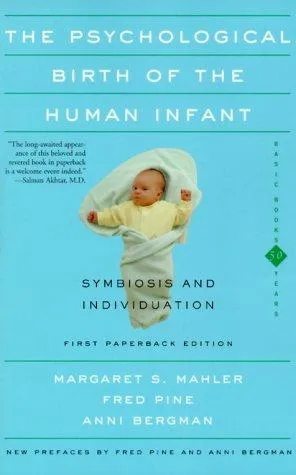
Cover of the first paperback edition of The Psychological Birth of the Human Infant, with new prefaces by Fred Pine and Anni Bergman, Basic Books, 2000 
Cover of The Psychological Birth of the Human Infant: Symbiosis and Individuation, Maresfield Library, Routledge, 2019