Otto Rank (1884–1939), born Otto Rosenfeld in Vienna, was an Austrian psychoanalyst who for some twenty years stood among Sigmund Freud's closest collaborators and then broke with him to found a therapy of his own. A self-taught young man without medical training, he brought Freud the manuscript of Der Künstler1, his essay on the psychology of the artist, and from 1906 served as secretary of the society that became the Vienna Psychoanalytic Society. He went on to edit Imago and the Internationale Zeitschrift für Psychoanalyse and was one of the seven members of the secret Committee around Freud. His early work carried psychoanalysis into myth and literature: The Myth of the Birth of the Hero2 extended the Family romance from the individual neurotic to collective legend, and The Double3 read the second self as a narcissistic defence against death. In the 1920s he turned to technique, first with Sándor Ferenczi in The Development of Psychoanalysis4 and then alone in The Trauma of Birth5, which made separation from the mother at birth the primal trauma of human life. The controversy that followed ended with his departure from Vienna in 1926. In Paris and New York he developed Will therapy, a time-limited treatment centred on the present relationship between patient and therapist, and the polarity of fear of life and fear of death. Through Jessie Taft his ideas entered American social work, and his biographers count him a forerunner of relational, humanistic and existential psychotherapy.
Person
Otto Rank
Austrian psychoanalyst, born Otto Rosenfeld in Vienna, who from 1906 was secretary of the Vienna Psychoanalytic Society and one of Freud's closest collaborators, editing the journals Imago and the Internationale Zeitschrift and applying psychoanalysis to myth, literature and art. His book The Trauma of Birth (1924), which traced anxiety to the separation of birth rather than to the Oedipal situation, led to his break with Freud. He then worked in Paris and New York, developing a 'will therapy' centred on the patient's creative will, the therapeutic relationship and the ending of treatment.
Life and training
Rank grew up in a poor family in Vienna and educated himself. Between about 1903 and 1905 he kept four diaries, which Jessie Taft later quoted at length in her biography of him6. They show him reading Schopenhauer, Nietzsche and Ibsen, working out ideas about the artist, and welcoming his discovery of Freud's writings as a revelation. E. James Lieberman's Acts of Will7 draws on the same adolescent diary and on Rank's letters, and likewise stresses how he taught himself through Nietzsche.
The essay that came of these years, Der Künstler: Ansätze zu einer Sexual-Psychologie, appeared in Vienna and Leipzig in 1907. It is a short book of some fifty-six pages that presents itself as built on Freud's teachings. Its introduction summarizes Freud's work up to 1905, and one footnote credits Alfred Adler. Its premise is that the artist differs from other people in degree, not in kind, so that art has to be understood alongside dreams, jokes and neurotic symptoms.
The artist, Rank argues, stands between the dreamer and the neurotic. The dreamer lets painful feelings discharge, the neurotic wants to free himself of them and cannot, and the artist frees himself through a work that is an unconsciously invented self-cure. The work also lets its audience lift their own inhibitions at little cost. Religion is the cure a people invents for itself, art the cure an individual invents, and science carries on from both in seeking to make the unconscious conscious. In the book's closing prophecy, this ends when an "unartistic, asexual superman" masters his drives.
The manuscript brought Rank into Freud's circle, and he later took a doctorate. The question of the artist, which opened his career, also closed it: Taft reads Art and Artist (1932) as his final summing-up of a lifelong attempt to understand genius and its relation to culture.
Secretary, editor and member of the Committee
From 1906 Rank was secretary of the Wednesday Psychological Society, later the Vienna Psychoanalytic Society. Freud drew him into his own projects. He suggested the subject of Der Mythus von der Geburt des Helden2, Rank's second book, which appeared in 1909 as the fifth number of Freud's series Schriften zur angewandten Seelenkunde. Rank's prefatory note of Christmas 1908 credits Freud with the idea, and Freud's own pages on the family romance of neurotics are printed inside the book.
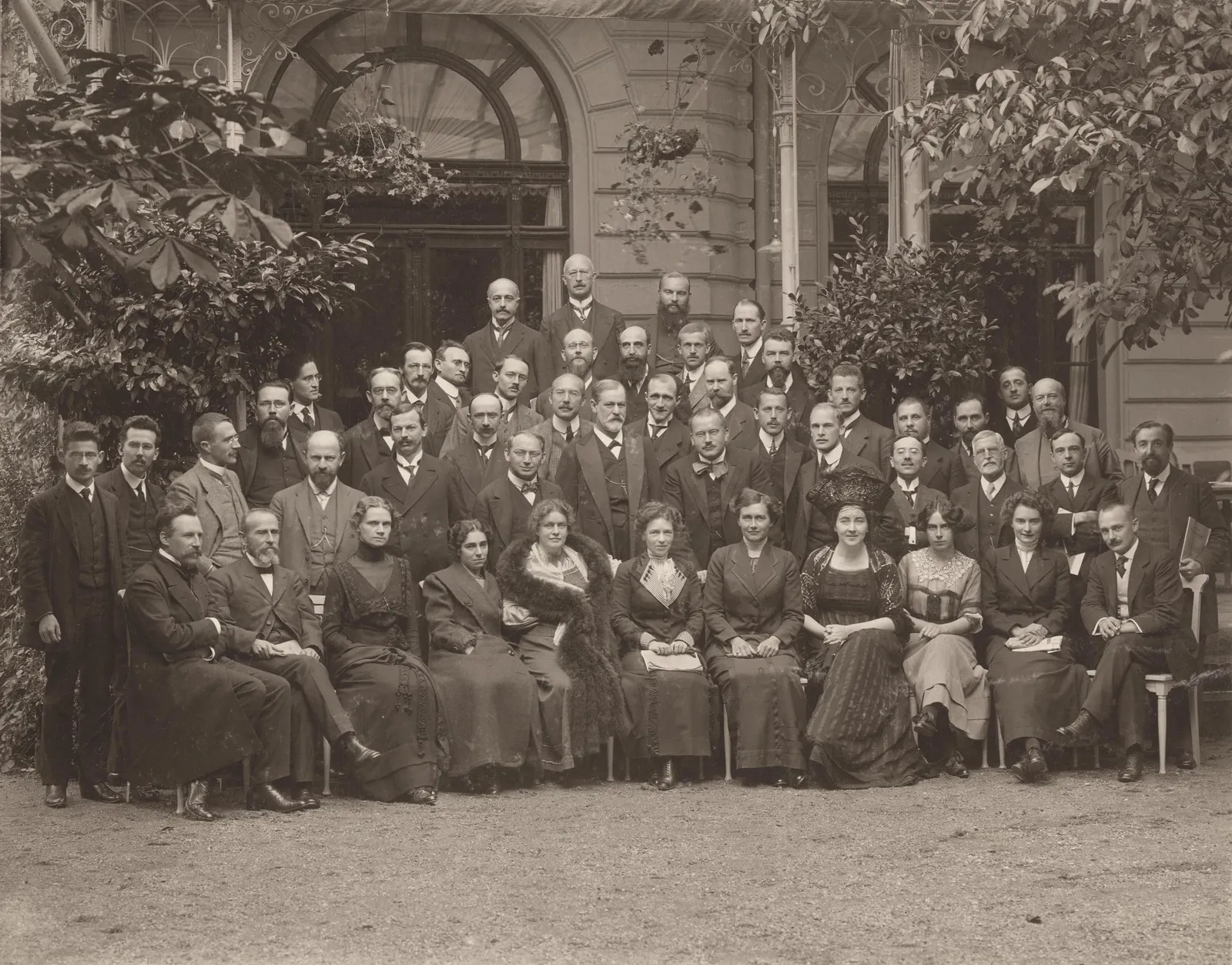
Rank went on to write studies of myth, the hero and the incest motif, and he served the movement as an editor and publisher. He edited its two main journals: Imago, which Freud edited with Rank and Hanns Sachs, and the Internationale Zeitschrift für Psychoanalyse. He appears in the group photographs of the congresses at Weimar in 1911 and at The Hague in 1920.
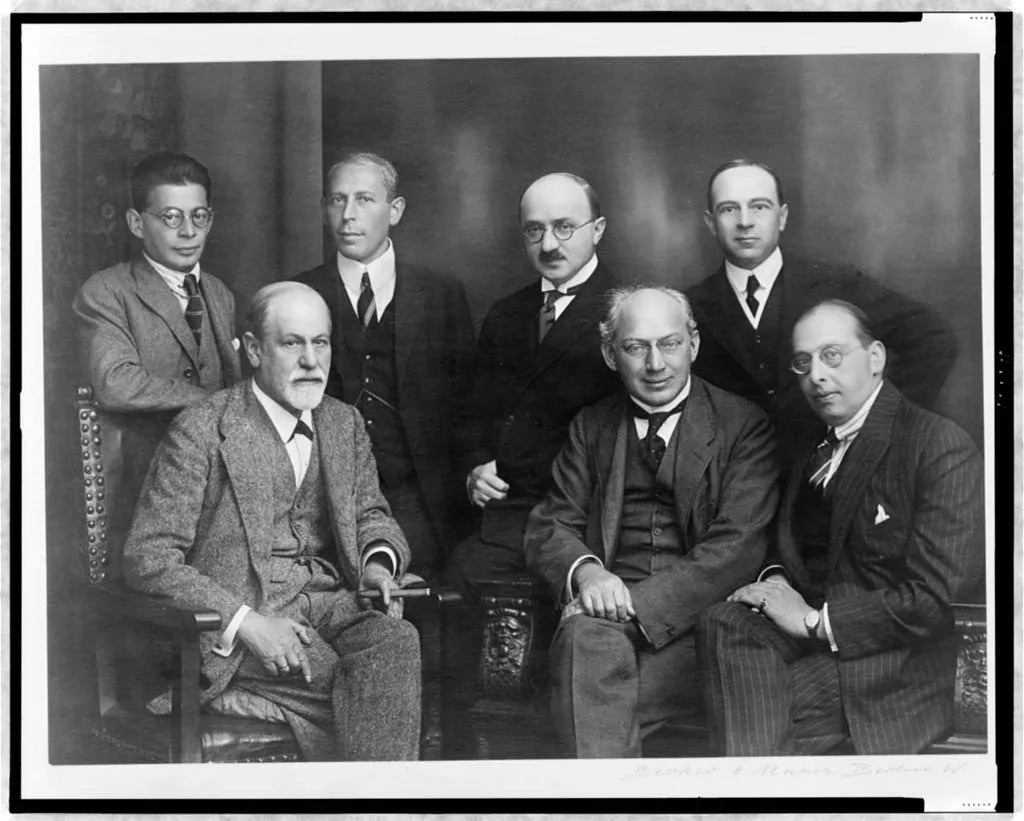
Lieberman describes him as one of the seven ring-holders of the secret Committee around Freud. A photograph taken in Berlin in 1922 shows him with Freud, Karl Abraham, Max Eitingon, Ernest Jones, Ferenczi and Sachs, and Lieberman traces a lasting rivalry between Rank and Jones.
Rank also taught and analysed. The first volume of his later Technik der Psychoanalyse grew out of a course he gave in 1921 and 1922 for English and American analysts. Susan Isaacs had a brief analysis of about three months with him in the early 1920s, although the sources disagree on whether it took place in Vienna or in Berlin.
Crisis and break, 1923–1926
In the summer of 1922 Rank and Ferenczi began the talks that grew into Entwicklungsziele der Psychoanalyse4 (1924), translated into English in 1925 as The Development of Psychoanalysis. The book was linked to the prize question Freud set at the Berlin congress of September 1922, though its authors withdrew from the competition. Ferenczi wrote the critical part and Rank the positive part, on the analytic situation.
In April 1923 Rank wrote Das Trauma der Geburt5 and dedicated it to Freud for his birthday on 6 May 1923. It appeared in 1924 as the fourteenth volume of the Internationale Psychoanalytische Bibliothek.
Lieberman sets the two books in a crisis that ran from 1923 to 1926 and had several strands: Freud's cancer, the breakup of the Committee, and Freud's own wavering. Karl Abraham led the inner circle's opposition to both books in 1924, and the book with Ferenczi became a point of contention among Freud's followers.
Freud's answer came in Inhibitions, Symptoms and Anxiety8 (1926). There he treats birth as the prototype of the helplessness from which anxiety arises, and he credits Rank with linking every danger situation to separation from the mother. But he rejects the claim that the severity of the birth trauma decides who becomes neurotic. In its place he names three factors: the long helplessness of the human infant, the interruption of sexual development between early childhood and puberty, and the ego's limited means of guarding against internal danger.
Rank left Vienna in 1926, for Paris and then the United States. Taft saw the bond with Freud as inwardly necessary to Rank's growth and the separation from the Freudian group as a personal tragedy. Lieberman reads the break both as an intellectual parting and as a drama between father and son. Freud returned to the matter late in life: in Analysis Terminable and Interminable9 (1937) he discussed Rank's attempt to shorten treatment alongside the time limit he had himself set with the Wolf Man.
Paris and America
Jessie Taft had met Rank in 1924, and she was in analysis with him in 1926 and 1927. Taft calls his years in Paris and New York the "years of fulfillment". He taught at the Pennsylvania School of Social Work, and Taft adapted his ideas for social work. He developed a psychology of the will and of creativity in which the neurotic appears as a failed artist, and he wrote Art and Artist (1932). The writer Anaïs Nin came to him as a patient and then worked as his assistant.
Taft translated Will Therapy and Truth and Reality, both published in English in 1936. Organised psychoanalysis ostracised him, and he died in New York in 1939, a month after Freud. Taft retired in 1950 partly to put his papers in order, which went to Columbia University, and in 1958 she published the first biography of him.
Myth, the hero and the double
The Myth of the Birth of the Hero rejects the nature and astral schools of mythology and treats myths as products of fantasy. In this it follows Freud's reading of Oedipus and Abraham's Traum und Mythus. From about two dozen legends, among them those of Sargon, Moses, Oedipus, Paris, Perseus, Gilgamesh, Cyrus, Romulus, Hercules, Jesus, Siegfried and Lohengrin, Rank draws a standard saga and then interprets its features.
The hero stands for the child's ego, and the hero's two couples of parents are the real parents and the imagined ones of the Family romance. Exposure in a box on the water represents birth, the box standing for the womb. The father's hostility toward the hero is the son's own hostility, projected, so that the myth is in this respect a "paranoid formation". Across the versions the conflict softens, as the persecutor passes from the father-king to a grandfather, a god, and finally an unrelated tyrant such as Herod.
Myths, on this account, are made by adults fantasizing back into their childhood. Rank compares them with the descent delusions of paranoiacs and with the anarchist who kills a king. The individual fantasy thus becomes the key to the collective legend. An English translation appeared in 1914, and a second, enlarged German edition in 1922.
The Double appeared in Imago in April 1914 and as a book in 1925. Rank starts from the film The Student of Prague (1913), written by Hanns Heinz Ewers. He then surveys the theme in Hoffmann, Chamisso, Andersen, Jean Paul, Heine, Musset, Maupassant's Le Horla, Poe's William Wilson, Wilde's The Picture of Dorian Gray and Dostoevsky's The Double. Certain features recur: the double obstructs the hero in love, and killing it is suicide, a picture of paranoid persecution. The authors themselves Rank finds to have been pathological personalities.
Turning to folklore, he notes that one word often serves for shadow, reflection and soul, and he follows the idea through the Homeric psyche, the Egyptian ka, the Roman genius and the myth of Narcissus. The closing section draws on Freud's work on narcissism and paranoia. The persecutor is the one once most loved, that is, the ego itself, and guilt is laid on a second self such as the devil or the conscience. Primitive narcissism knows no death: the first soul was a double of the body, a denial of death, which later returns as death's herald. Freud took up this argument in The Uncanny10 (1919), where, following Rank, he shows the double turning from an insurance against death into a harbinger of death.
Repetition and the analytic situation
In The Development of Psychoanalysis, Rank and Ferenczi gave repetition priority over remembering, reversing the weighting of Freud's Remembering, Repeating and Working-Through11 (1914). What was never conscious cannot be remembered, only repeated in the relation to the analyst, and the task of analysis is to turn that repetition into present memory. The Repetition compulsion thus becomes the ground of technique, and Acting out in the treatment is no longer only an obstacle. The authors also reject the collecting and translating of free associations, which in their view serve only to show where the operative affects lie.
The analyst acts as a catalyst in a libidinal process limited in time, and the transference neurosis revives the Oedipal "primal neurosis". A fixed end date and a phase of weaning bring the treatment to its close, and analysis passes from a phase of knowing (Erkenntnisphase) to a phase of experience (Erlebnisphase). The authors also held that a training analysis should be the same as a therapeutic one, and they foresaw analysts without medical training.
The trauma of birth
The Trauma of Birth carries this emphasis on the analytic situation back to the beginning of life. Rank's starting point is the end phase of analysis, in which patients' dreams represent leaving the analyst as a birth. The transference is at bottom maternal, and cure is the belated mastering of the trauma of birth.
Birth is the primal trauma (Urtrauma), the ultimate biological substrate of mental life. Birth anxiety is the first content of the mind and forms Primal repression, the first barrier against the striving to return to the womb. All later repression and all later anxiety, such as the child's fear of the dark and of being alone, reproduce it. Birth is also the "primal castration": weaning and castration repeat it, the Oedipus complex is a third repetition, and coitus is a partial return to the womb. Neuroses reproduce birth or the fetal state, and psychosis is a failed attempt at cure. The truly unconscious, Freud's id, is in Rank's words "the embryonic that lives on unchanged in the growing ego", which makes Carl Gustav Jung's appeal to phylogenetic memory unnecessary.
The book reads culture as symbolic adaptation to the loss of the womb, from house and temple to city and state. The hero overcompensates for a severe birth, religion moves from mother goddesses to a father god, and art goes back to the maternal vessel. Philosophy from Thales and Plato's cave to Kant is read in the same light, and Socrates, the son of a midwife, appears as the forerunner of therapy. The analyst, in turn, is a "midwife" who should uncover the trauma early and set an end to the treatment. Analysis changes the ego's attitude rather than the unconscious, and the neurotic is someone who "got stuck a little earlier, in the birth trauma".
In making the Birth trauma the origin of neurosis, Rank demoted the Oedipus complex from origin to third repetition. Freud's rejoinder of 1926 turned on exactly this point.
Will therapy and the fear of life
The three volumes of Technik der Psychoanalyse12 (1926–1931) record Rank's passage from a revised psychoanalysis to a therapy of his own. The first, Die analytische Situation (1926), relates everything in the treatment to the present relation with the analyst and finds a maternal tie beneath the father transference. It extends to every case the setting of an end date (Terminsetzung), a device Freud had used with the Wolf Man. Dreams are read as reactions to the analytic situation, the Wolf Man's dream among them, and Rank warns that analysis may project the present into the past.
The second volume, Die analytische Reaktion (1929), lays the foundation of Will therapy. Neurosis is now a conflict of will and guilt rather than of repressed sexual wishes. Resistance is counter-will (Gegenwille), and the fundamental rule becomes "say what you want". What heals is new experience in the present (Neuerleben). The patient should be able to separate from the therapist without a debt of gratitude, as neurotic guilt is turned into creative guilt. Here Rank criticises Adler and Jung as well as Freud.
The third volume, Die Analyse des Analytikers (1931), makes the analyst the remedy: an auxiliary ego (Hilfs-Ich) whose technique is to have none. Rank now sets ideological therapy, which applies general truths, the birth trauma included, against dynamic therapy, and finds that general truths help little. He distinguishes the fear of life, the fear of individuation and separation, from the fear of death, the fear of losing one's individuality; these are the two poles of Life fear and death fear. The end phase of treatment becomes an education to willing, the analyst an auxiliary reality, and the only therapy, finally, is real life. Taft's English version, Will Therapy, appeared in 1936.
Influence and reception
Ernest Jones depicted Rank as mentally ill. Lieberman rejects that picture in the part of his biography titled "History of a Libel", and he reads the break with Freud as a real intellectual parting. Taft's 1958 biography, written by a devoted follower, is partisan, but it was the first to tell Rank's side of the break from unpublished letters, and it remains a principal source. Lieberman's book of 1985 was the first full biography.
Within psychoanalysis Rank's ideas had a double fate. Freud's revision of the theory of anxiety in 1926 was worked out partly in argument with The Trauma of Birth, and his essay on the uncanny built directly on The Double. Yet Rank himself was shut out of the organised movement.
His later influence ran through other channels. Jessie Taft carried his ideas into American social work, which she taught at the Pennsylvania School of Social Work. Lieberman counts will therapy among the early forms of time-limited therapy and Rank among the forerunners of relational, humanistic and existential therapies. He also traces Rank's influence on Anaïs Nin, Henry Miller, Paul Goodman and Max Lerner.
Selected works
Rank's first book was Der Künstler1 (1907), followed by Der Mythus von der Geburt des Helden2 (1909; English translation 1914; enlarged edition 1922) and Der Doppelgänger3 (in Imago, 1914; as a book, 1925). With Ferenczi he wrote Entwicklungsziele der Psychoanalyse4 (1924), and in the same year published Das Trauma der Geburt und seine Bedeutung für die Psychoanalyse5. The three volumes of Technik der Psychoanalyse12 appeared in 1926, 1929 and 1931.
Of the books written after he left Vienna, Art and Artist appeared in 1932, and Will Therapy and Truth and Reality appeared in Jessie Taft's translation in 1936. The principal biographies are Taft's Otto Rank: A Biographical Study6 (1958) and Lieberman's Acts of Will7 (1985).
Ideas
developed
- 1909 Family romance
Rank extended the family romance from individual fantasy to the collective myths of the hero's birth.
- 1924 Repetition compulsion
With Ferenczi, Rank makes the repetition compulsion the ground of analytic technique. The decisive material was never conscious and can only be repeated, so repetition in the analytic situation is to be allowed and even provoked, then turned into present memory. Remembering itself is treated as one form of the repetition compulsion.
introduced
- 1914 Double
Rank's 1914 Imago study made the double a psychoanalytic theme, reading it as a narcissistic defence against death.
- 1924 Birth trauma
Rank set out the birth trauma as the root of anxiety and of the unconscious in Das Trauma der Geburt (1924).
- 1929 Will therapy
Rank named and laid out will therapy in the second volume of his Technik der Psychoanalyse (1929).
- 1931 Life fear and death fear
Rank opposed fear of life to fear of death in the third volume of his Technik der Psychoanalyse (1931).
reworked
- 1924 Acting out
With Ferenczi, Rank reverses the weighting of Freud's 'Remembering, Repeating and Working-Through' (1914), which treated the wish to relive in place of remembering as resistance: what cannot be remembered can only be repeated in the treatment, so repetition, actively encouraged and then turned into present memory, is given the main role in technique.
- 1924 Free association
With Ferenczi, Rank rejects analyses that collect associations and translate them one by one, as if they were the substance of the work. Associations only show where, and how deep, the operative affects lie. An analyst who merely lets the patient associate and interprets each association reduces the analysis to an association experiment.
- 1924 Repression
Rank roots the whole process of repression in the trauma of birth. The anxiety of birth is the first barrier set against the striving to restore the lost intrauterine pleasure, and in it he recognises the primal repression, which later repressions and the forgetting of earliest memories repeat.
- 1924 Primal repression
Rank gives Freud's primal repression a concrete content: it is the anxiety of birth, the first psychic act, which bars the newborn's intense striving to return to the womb it has just left.
Influence
Affinity
- 1907 influenced by Sigmund Freud
Rank's first book, Der Künstler (1907), presents itself as built on Freud's teachings.
- 1909 collaborated with Sigmund Freud
Rank worked closely with Freud from 1906 to the mid-1920s: Freud suggested and contributed to the hero-myth book, and Rank edited the journal Imago under him.
- 1924 collaborated with Sándor Ferenczi
Rank and Ferenczi co-wrote Entwicklungsziele der Psychoanalyse (1924), which argued for an analysis centred on present experience in the transference.
- 1936 collaborated with Jessie Taft
Taft translated Rank's Will Therapy and Truth and Reality (1936) and, after his death, wrote his first biography (1958).
Conflict
- 1924 disputed with Karl Abraham
Karl Abraham led the opposition within Freud's inner circle to Rank's Das Trauma der Geburt and to the book Rank wrote with Ferenczi in 1924.
- 1926 broke with Sigmund Freud
After the dispute over the birth trauma, Rank left Vienna and Freud's circle in 1926, settling in Paris and later in the United States.
Lineage
- 1926 analysed Jessie Taft
Taft, who met Rank in 1924, was in analysis with him in 1926–27 and went on to adapt his ideas for social work.
- analysed Susan Isaacs
A short analysis of about three months in the early 1920s. The sources disagree on the details: the Melanie Klein Trust says she went to Vienna hoping to be analysed by Freud and settled for Rank after a brief treatment with Flügel in 1920, while Psychoanalytikerinnen places the analysis in Berlin and before Flügel.
Works
- 1907
Der Künstler: Ansätze zu einer Sexual-Psychologie (The Artist: Approaches to a Sexual Psychology) is Otto Rank's first book, a short essay of some fifty-six pages published in Vienna and Leipzig by Hugo Heller in 1907. Rank wrote it as a young autodidact outside medicine. It is one of the earliest attempts to build a general psychology of artistic creation on Freud's theories, and it was the manuscript that brought Rank into Freud's circle. An introduction summarizes Freud's work up to 1905: Studies on Hysteria, The Interpretation of Dreams, The Psychopathology of Everyday Life, Jokes and Their Relation to the Unconscious and Three Essays on the Theory of Sexuality. It ends on Freud's view that sublimation is a third outcome of a strong constitutional disposition, beside perversion and neurosis, and one source of artistic activity. Rank's premise is that the artist's mental life differs from other people's in degree, not in kind, so that art has to be understood alongside dreams, jokes and neurotic symptoms. The first part, "The Sexual Basis", is a speculative natural history of the drives. Libido arises as a reaction to unpleasurable need and is in principle capable of every kind of pleasure ("all-sexuality"). It passes through polymorphous perversity and bisexuality to the differentiation of the sexes, and the drives that lose their libidinal premium along the way are stored up as the unconscious, the foundation of the psychical. From this progressive "sexual repression" Rank derives language, reason, fantasy, character, the virtues and culture. Pity, for instance, is cruelty turned into its opposite, and the drives are arranged in series running from active perversion through normality and virtue to passive perversion, neurosis and self-destruction. In this scheme woman personifies the inner resistances that libido creates for itself. The cultural history of peoples runs from a "primal state" toward hysteria and is accompanied by a progressive becoming-conscious of the unconscious, which the art of each period registers. The second part, "Artistic Sublimation", places the artist between the dreamer and the neurotic. The dream is the first compromise formation, myth a collective imitation of the dream, and art at first a communal product. The individual artist feels the conflict between the drives and their repression, which normal people discharge in dreams, too keenly for dreaming, but before it has become pathogenic. The work of art is a self-cure that forestalls the artist's neurosis. Through the pleasure of its form it also lets the audience lift their own inhibitions at little expense. On the model of Freud's account of jokes, aesthetic pleasure is only fore-pleasure that releases a deeper end-pleasure, and every work of art is the disguised fulfilment of a repressed wish. The artist can free himself from painful feelings, the neurotic wants to but cannot, and the dreamer lets it happen; the neurotic is a "feminine" artist, and the artist a "masculine" neurotic who has unconsciously invented his own cure. Religion is a psychotherapeutic cure that a people invents for itself, art one invented by an individual, and philosophy and science a further step toward making the unconscious conscious. Rank then ranks the arts by the drives they sublimate: looking in the painter, touch in the sculptor, hearing in the musician. He places the poet, and above all the dramatist, highest. Tragedy discharges affect through the spectator's identification with the hero, who is the idealized artist, and the actor mediates between poet and audience as the physician does in a cure. Shakespeare united poet and actor, Wagner's music drama is the summit of art, and Ibsen's analytic drama marks the point where art passes into science. The book closes on a prophecy. Because art arises and works unconsciously, it cannot complete the task of making the unconscious conscious. That task falls to science, by way of neurosis and its cure, "the basis of general knowledge", until, the whole unconscious having become conscious, an "unartistic, asexual superman" masters his drives.
- 1909
The Myth of the Birth of the Hero
The Myth of the Birth of the Hero: A Psychological Interpretation of Mythology (Der Mythus von der Geburt des Helden: Versuch einer psychologischen Mythendeutung), Otto Rank's second book after Der Künstler, appeared in 1909 as the fifth number of Freud's series Schriften zur angewandten Seelenkunde. In a prefatory note dated Christmas 1908 Rank credits Freud with suggesting the study. The book sets out to explain why the birth legends of heroes among many peoples resemble one another so closely. Rank begins by reviewing the explanations current in his day: the "elementary ideas" common to all humanity in Bastian's sense, descent from a shared ancestral stock, and the borrowing and migration of motifs. He leaves the question of transmission open and asks instead how such myths arise in the first place. He rejects the nature and astral mythology of his time, which read heroes as sun, moon or stars, arguing that these schools projected onto the heavens what was offensive in the myths, such as incest and parricide. Following Freud's reading of Oedipus in The Interpretation of Dreams and Karl Abraham's Traum und Mythus, he treats myths as products of human fantasy that were attached to celestial phenomena only secondarily. The central part is a comparative collection of birth legends retold from their sources: Sargon of Akkad, Moses, Abraham, Karna, Ion, Oedipus, Judas, Paris, Telephus, Perseus, Gilgamesh, Cyrus (after Herodotus, Justin and Ctesias), Kaikhosrav and Feridun, Romulus and Remus, Hercules, Jesus, Buddha, Habis, Wolfdietrich, Genovefa, Siegfried, Lohengrin, and Scef of the Beowulf poem. From them Rank distils a "standard saga". The hero is the child of distinguished, usually royal parents. His conception is preceded by difficulties such as continence, long barrenness or secret intercourse. A dream or oracle warns against his birth, usually as a danger to the father. He is condemned to death or exposed, most often in a box on water. He is saved by animals or by lowly people such as shepherds and is suckled by a female animal or a humble woman. Grown up, he finds his noble parents, takes revenge on his father, is acknowledged, and attains greatness and fame. The interpretation rests on a contribution by Freud, printed within the book, on what he calls the family romance of neurotics; it was later published in English as "Family Romances". As the child grows, comparison with other parents and feelings of being slighted lead it to imagine that it is a stepchild or adopted and that its real parents are of higher rank. Once it learns that paternity is uncertain while maternity is certain, the fantasy elevates only the father and imagines the mother in secret love affairs. Yet the exalted parents are drawn from memories of the real ones. The fantasy therefore expresses longing for the early years, when the father seemed the strongest of men and the mother the loveliest of women. Rank equates the hero with the ego of the child. The two couples of the myth correspond to the real and the imagined parents of the family romance, and at bottom they are identical. By the symbolism of dreams, exposure in a basket on water represents birth through its opposite: the water is the water of birth and the box is the womb, as the water dreams of Cyrus's mother and grandfather show. The father's hostility, announced by the oracle, is the son's own hostility, which arises from rivalry for the mother and is projected onto the father. This projection, together with the splitting apart of figures fused in fantasy, leads Rank to call the myth a paranoid formation. Rank traces a progressive softening of the conflict across the myths. First the father is himself the king and persecutor. Then the persecutor is the grandfather, often bound by jealous love for his daughter. In the virgin-birth myths the father becomes a god. Finally the persecutor is wholly unrelated to the hero, as Herod is to Jesus. Rank reconstructs an earlier form of the Moses legend and argues that the nurse who is in fact his mother points back to the humble couple as the real parents. The same mechanisms explain doubles such as Harpagus and Artembares in the Cyrus story, the helpful nursing animal, and twin and brother myths. Myths are not made by heroes. They are made by adults who, as Freud argued in "Creative Writers and Day-Dreaming", fantasize back into childhood and lend the hero their own childhood story. The myth thus justifies the ordinary person's childhood rebellion against the father while also expressing tenderness and gratitude toward the parents. Rank compares the myth with the delusions of descent of paranoiacs, who openly claim to be the hidden children of royalty. He also compares it with the anarchist who kills a king, a revolt against the father displaced onto a ruler. He ends at the border where childhood fantasy, neurosis, myth-making, insanity and crime meet. A second, enlarged edition appeared in 1922. An English translation in 1914 made the book a founding text of psychoanalytic mythology.
- 1914
Otto Rank's "Der Doppelgänger", published in the third volume of Imago in 1914 and later reissued in book form (1925), is a psychoanalytic study of the motif of the double. Rank starts from a recent film, Hanns Heinz Ewers's The Student of Prague (1913). In it a poor student sells his mirror image to a sinister stranger. The image takes on a life of its own: it appears at each stage of his courtship of a countess and kills his rival in a duel. When the student finally shoots at it, the shot kills him instead. The film's programme reads the double as the hero's inescapable past. Rank finds this allegory insufficient, because it does not explain why the double intervenes precisely at moments of love, or why losing it and attacking it are so fatal. He argues that the dreamlike imagery of cinema makes visible the deeper problem of a person's relation to their own ego. The study then proceeds in three steps. The first surveys literary treatments of the double: - E. T. A. Hoffmann: the lost mirror image of the New Year's Eve adventures, The Devil's Elixirs, Die Doppeltgänger and Kater Murr. - Chamisso's shadowless Peter Schlemihl, Andersen's "The Shadow" and Lenau's "Anna". - Jean Paul, who brought the double into Romanticism, and Raimund's Der Alpenkönig und der Menschenfeind and Der Verschwender. - Wilde's The Picture of Dorian Gray and Heine. - Maupassant's "Le Horla" and "Lui", and Musset's "La nuit de décembre". - Poe's "William Wilson" and Dostoevsky's The Double. Rank finds features that recur across these works. The double resembles the hero down to the smallest detail and often appears in a mirror. It thwarts him, above all in his relation to a woman. When the hero kills it, the act turns out to be his own suicide. In several cases the story amounts to a picture of paranoid persecution. The second step finds a common psychological type among these authors. Rank describes them as pathological personalities prone to mental illness, alcohol, drugs or sexual excess, intensely preoccupied with their own ego, and either incapable of love or driven by an overstrained longing for it. The third step turns to folklore and ethnology, drawing on Frazer, Tylor, Rochholz, Negelein and Rohde. It covers: - superstitions that tie the shadow and the mirror image to death; - taboos on shadows, mirrors and portraits among the peoples Rank calls primitive; - languages that use one word for shadow, reflection and soul; - the Homeric psyche, the Egyptian ka and the Roman genius as doubles of the person; - the myth of Narcissus, which joins the deathly and the erotic meanings of the reflection. In the closing section Rank interprets the double through Freud's recent work on narcissism, paranoia and animism. Love of one's own image coexists with a defence against it. That defence shows itself as fear and loathing of the reflection, or as persecution by a double that has become independent. Following Freud on paranoia, Rank traces the persecutor back to the once most-loved person, who here is the ego itself. Identification with a rival brother adds to the double's role as a competitor in love. A strong sense of guilt leads the hero to place responsibility for his condemned impulses on a second self: the devil, or in later versions a warning conscience. A threatened narcissism explains the fear of death, the wish to stay young and the suicide of the doomed heroes. Unable to destroy his beloved ego directly, the hero kills it in the shape of the hated double. Rank links this to the history of belief in the soul. He holds that primitive narcissism knows nothing of death. The first idea of the soul was therefore an exact double of the body, an assurance of survival that denied death. Yet the double, created to ward off annihilation, returns in superstition as a herald of death, just as the double that embodies self-love becomes a rival in sexual love.
- 1924
Otto Rank's *Das Trauma der Geburt und seine Bedeutung für die Psychoanalyse* (1924; English: *The Trauma of Birth*) was written in April 1923 and dedicated to Freud for his birthday on 6 May 1923. Rank presents it as a consistent extension of Freud's method. Following the analytic material down to its deepest layer, he arrives at the separation from the mother at birth. He calls it the "primal trauma" (Urtrauma) and the ultimate biological substrate of the psychical. His starting point is the analytic situation. In the dreams of the final phase of treatment, patients regularly represent the detachment from the analyst as a birth. The transference libido is at bottom maternal, and the cure is the belated, at last successful mastering of the birth trauma (Preface; "Die analytische Situation"). The anxiety the newborn experiences is the first content of perception. Once it is anchored in the psyche, it forms the primal repression (Urverdrängung) that bars the libido from striving back to the pleasurable intrauterine state. Every later anxiety reproduces it, beginning with the child's fear of the dark and of being alone. The middle chapters follow the birth trauma through the individual and through culture. Birth is the "primal castration" (Urkastration). Weaning and castration repeat the separation, and the Oedipus complex is its third repetition. Infantile sexual theories, the perversions and coitus itself are partial returns to the womb. The neuroses reproduce birth or the fetal state, as in hysterical conversion symptoms, phobias, obsessional brooding on origins and death, and the alternation of melancholia and mania. Psychosis is a failed attempt at cure. Under the heading of "symbolic adaptation", Rank finds the womb again in sleep and dreams and in the house, the temple, the city and the state. It returns in the hero, who overcompensates a severe birth, and in fairy tales and paradise myths. Religions move from mother goddesses and anxiety to a father god and guilt. Rank derives art from the sculptural reproduction of the maternal vessel and of one's own coming into being. Its Greek form idealizes the detachment of the human body from the animal mother (the Sphinx, the centaurs, Prometheus, the Trojan horse). Philosophy circles the same problem: Thales' water as the womb of all things, Plato's Eros and cave, and Kant's thing-in-itself. Socrates, the midwife's son, is in Rank's account the forerunner of analytic therapy. The two concluding chapters draw the theoretical and clinical consequences. Breuer's original discovery was that symptoms depend on forgotten traumas and on "conversion". Rank links it to the birth trauma, so that conversion becomes identical with the emergence of the psychical out of bodily innervation. The truly unconscious, Freud's Es, is "the embryonic that lives on unchanged in the growing ego". The primal fantasies (castration, the primal scene, Oedipus) have a real prenatal substrate. Rank therefore finds Jung's appeal to inherited phylogenetic memory unnecessary. The death drive and the compulsion to repeat aim at restoring the state before birth. Woman can reproduce the primal situation in pregnancy and childbirth. Man must compensate through identification with the mother and through cultural creation. From this Rank explains both the male character of culture and the social disparagement of women as consequences of primal repression. In therapy the analyst acts as a "midwife". The patient should not reproduce the birth trauma unconsciously at the parting from the analyst. Instead, the analyst should uncover it early in the transference and work it through, with a fixed end to the treatment. Analysis cannot change the unconscious itself, only the ego's attitude toward it. The neurotic has "got stuck a little earlier, in the birth trauma". Culture, art and above all psychoanalysis are more or less successful attempts to overcome it.
- 1924
The Development of Psychoanalysis
Entwicklungsziele der Psychoanalyse (1924; in English, The Development of Psychoanalysis, 1925) is a short programmatic book by Sándor Ferenczi and Otto Rank, issued as the first number of Freud's series Neue Arbeiten zur ärztlichen Psychoanalyse. According to its preface, it grew out of conversations in the summer of 1922: Ferenczi drafted the critical part and Rank the positive section on the analytic situation. The two revised the whole together after Freud, at the Berlin congress of September 1922, set a prize question on how analytic technique and theory had influenced each other. They adapted the text to that question but withdrew from the competition. The book argues that psychoanalysis had grown from a therapeutic procedure into a vast body of theory while its technique lagged behind, leaving many analysts disoriented and too closely bound to Freud's few technical papers. Starting from Freud's "Remembering, Repeating and Working-Through" (1914) and the repetition compulsion of Beyond the Pleasure Principle, the authors give repetition, rather than remembering, the leading role in treatment: the decisive unconscious material was never conscious, so it can only be reproduced in the relation to the analyst, where it must be understood and turned into present memory. Rank's section describes analysis as a time-limited process of libidinal flow, set going and carried by transference. The analyst stays largely passive and intervenes, like a catalyst, where resistance marks a neurotic deviation. Ego resistances give way to a transference in which the clinical neurosis is converted into a transference neurosis that revives the Oedipal "primal neurosis". Frustration keeps affects from discharging prematurely and drives the libido back to its points of fixation. A final phase of "weaning" dissolves the transference, and for it the analyst sets a fixed end date. Abreaction remains the healing agent, but its affects now run their course in the relation to the analyst rather than being tied to recovered memories. Ferenczi's historical-critical section reviews techniques that had stalled at earlier stages of psychoanalytic knowledge: collecting associations, dictionary-like translation of symbols, symptom analysis, "complex analysis", mechanically uncovering the stages of libido theory, speculative, phylogenetic and anagogic interpretation, lecturing patients, calling every stall a resistance, and both rigid passivity and "wild activity". It names the analyst's own narcissism as a source of error, and holds that the unconscious proper, never experienced, can only be relived piecemeal in the present, as a "fractionated catharsis". A chapter on theory and practice distinguishes intellectual knowledge from conviction gained through experience, and presents Freud's work as a "circulus benignus" in which each corrects the other. The authors see psychoanalysis moving from a phase of knowledge (Erkenntnisphase) to a phase of experience (Erlebnisphase). They conclude that a training analysis should not differ from a therapeutic one, that the patient's excess of knowledge should give way to the analyst's greater knowledge, and that technique will grow simpler, perhaps even readmitting hypnosis and suggestion, while psychoanalytic knowledge becomes common to all physicians and to therapists who are not physicians. Published in the same year as Rank's The Trauma of Birth, the book became a point of contention within Freud's inner circle.
- 1926
Technik der Psychoanalyse (Technique of Psychoanalysis) is Otto Rank's three-volume treatise on psychoanalytic treatment, published by Deuticke in Leipzig and Vienna between 1926 and 1931. Read in sequence, the volumes record Rank's passage from a reformer of Freudian technique to the founder of his own "will therapy". Volume I, Die analytische Situation, illustriert an der Traumdeutungstechnik (The Analytic Situation, Illustrated by the Technique of Dream Interpretation, 1926), grew out of a course on practical dream interpretation that Rank gave to English and American analysts in 1921–22. Volume II, Die analytische Reaktion in ihren konstruktiven Elementen (The Analytic Reaction in Its Constructive Elements, 1929), and Volume III, Die Analyse des Analytikers und seiner Rolle in der Gesamtsituation (The Analysis of the Analyst and His Role in the Total Situation, 1931, with a preface written in Paris in 1930), were written after Rank's break with Freud. Jessie Taft translated them into English as Will Therapy (1936). Volume I continues the programme Rank had set out with Sándor Ferenczi in Entwicklungsziele der Psychoanalyse (1924): no systematic technique had yet been published, and the curative agent is lived experience in treatment rather than intellectual recollection. Its central concept is the "analytic situation". Whatever the patient produces is to be related first to the present relationship with the analyst, not mined for history. Behind the Oedipal father transference Rank finds an earlier tie to the mother (Mutterbindung) that does not depend on the analyst's sex, so that for the patient's libido the analytic situation is essentially a mother situation. He therefore extends to every case a device Freud had used with the Wolf Man: fixing a date for the end of treatment (Terminsetzung). Set once the patient's libido has passed over to the analyst, the date lets the patient live the separation as a birth and a weaning, and so dissolves the transference. The analysis is described as a time-limited course of the libido, from detachment from the mother to identification with the analyst as father and ego ideal, and resistance is read as a gauge of that course. The practical part demonstrates the method through dream series from Rank's patients. The dreams are treated as reactions to the analytic situation and grouped by its phases. Motifs once read historically, such as a "family-tree" dream and even Freud's Wolf Man dream, are reinterpreted as images of the consulting room and of the patient's rivals there. Rank closes by warning that analysis may project into the patient's past what in fact happens between doctor and patient. Volume II opens by laying the foundation of a will therapy ("Grundlegung einer Willenstherapie"). The neurotic suffers not, as Freud held, from repressed sexual wishes but from a conflict of will and guilt: a strong will that he denies and cannot affirm without guilt. Freud's agents of cure (making the unconscious conscious, catharsis, transference) keep the patient passive. Resistance should instead be understood as counter-will (Gegenwille), the most valuable expression of will in therapy, and the therapist should act as a counter-will against which the patient's will can grow strong rather than be broken. The fundamental rule becomes "say what you want". Cure comes from a new experience in the present (Neuerleben), beyond repetition and transference. Reconstructing the past, by contrast, serves the denial of the present. The chapters are built on paired opposites: understanding and denial, past and present, sameness and difference, love and compulsion, separation and guilt, fate and self-determination. The treatment culminates in a separation that the patient must will for himself, without a debt of gratitude, so that neurotic guilt becomes the creative guilt of becoming an individual. Rank's criticism here extends to Adler and Jung as well as Freud. Volume III turns to the analyst. The analyst is not a technician applying a remedy but is himself the remedy, a person whom the patient re-creates as an auxiliary ego (Hilfs-Ich). Rank describes his own technique as consisting in having none. He distinguishes "ideological" from "dynamic" therapy. General psychological truths, such as the Oedipus complex, castration and even his own birth trauma, help the individual little, and analytic theories are in part the self-justification of a therapist type. The chapter "Lebensangst und Todesangst" sets out a double anxiety, whose two poles a person moves between throughout life. Fear of life is the fear of individuation and separation, first felt at birth. Fear of death is the fear of losing the individuality so gained. The end phase, with its fixed date, is presented as the therapeutic agent proper, an "education to willing". In it the patient's revolt against continuing the analysis is the first sign of recovery, and the analyst becomes an "auxiliary reality". The book ends with the claim that the only therapy is real life. The treatise is the main statement of Rank's clinical thought. It traces his development from the birth-trauma technique of the mid-1920s to a therapy of will, focused on the present relationship between patient and therapist.
Gallery
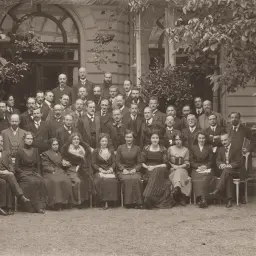
The International Psychoanalytic Congress at Weimar, 21 September 1911, with Otto Rank at the left end of the second row, near Freud, Jung, Ferenczi and Abraham. Photographed by Franz Vältl 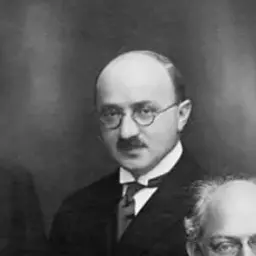
Freud's Committee in Berlin, 1922: standing, Otto Rank, Karl Abraham, Max Eitingon and Ernest Jones; seated, Sigmund Freud, Sándor Ferenczi and Hanns Sachs. Photographed by the Becker & Maass studio (Marie Boehm)
References
- The Artist1907
- The Myth of the Birth of the Hero1909
- The Double1914
- The Development of Psychoanalysis1924
- The Trauma of Birth1924
- Otto Rank: A Biographical Study Based on Notebooks, Letters, Collected Writings, Therapeutic Achievements and Personal Associations1958
- Acts of Will: The Life and Work of Otto Rank1985
- Inhibitions, Symptoms and Anxiety1926
- Analysis Terminable and Interminable1937
- The 'Uncanny'1919
- Remembering, Repeating and Working-Through1914
- Technique of Psychoanalysis1926