Book
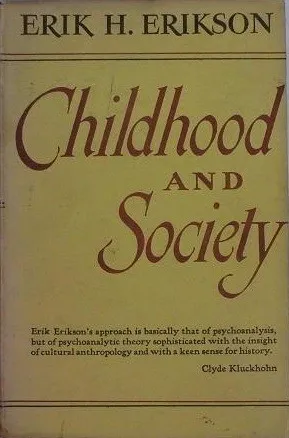
Childhood and Society
Erikson's first book brings clinical psychoanalysis together with cultural anthropology and history to argue that a child's development cannot be understood apart from the society that raises it: each culture meets the stages of the body and of the ego with its own methods of child training, and through them shapes the kind of adult it needs. The first part sets out the method through case histories, in which a symptom is read at once as a bodily event, an ego event and a social one, and restates Freud's theory of infantile sexuality as a scheme of zones and modes: each body zone carries a characteristic mode of approach (taking in, holding on, letting go, intruding, including) that becomes a modality of social life. The second part draws on Erikson's field work among the Sioux of South Dakota and the Yurok of northern California. It shows how the child training of a buffalo-hunting and of a salmon-fishing people fits their economies and their images of the world, and how the Sioux, cut off from their historical way of life, were left without an identity they could live by. The third part turns to the growth of the ego: the early ego failure of a schizophrenic child, children's play as a way of mastering experience, and the chapter "Eight Ages of Man", which extends the libidinal stages into a sequence of psychosocial crises across the whole life cycle, from basic trust versus mistrust in infancy to ego integrity versus despair in old age. The last part, "Youth and the Evolution of Identity", carries the notion of identity into history: the polarities of American identity, Hitler's imagery of his own childhood read as an appeal to the adolescent rebellion of German youth, and the Soviet film of Maxim Gorky's youth read as a document of an emerging Russian revolutionary identity. Revised and enlarged in 1963, the book brought the psychosocial stages and the identity crisis to a wide readership.
- By
- Erik Erikson
- Published
- 1950
- In
- New York: W. W. Norton
- Language
- English