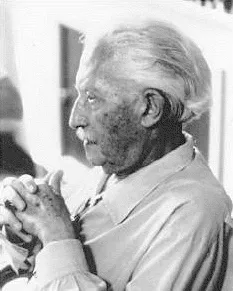
Person
Erik Erikson
German-born American psychoanalyst, trained in Vienna and analysed by Anna Freud, who carried psychoanalytic developmental theory beyond childhood into a sequence of eight psychosocial stages spanning the whole life cycle. He made identity, and the identity crisis of adolescence, central terms of psychoanalysis and of the wider culture, and pioneered psychoanalytic biography in his studies of Luther and Gandhi; Gandhi's Truth won the Pulitzer Prize in 1970.
- Born
- 1902
- Died
- 1994
- Influenced
- Otto F. Kernberg
analysed by
- Anna Freud 1927 In Vienna, from about 1927 until 1933, Anna Freud analysed Erikson while he taught at the Hietzing school and trained at the Vienna Psychoanalytic Institute.
introduced
- Ego identity 1946 Erikson first used the term ego identity in "Ego Development and Historical Change" (1946) and gave it its fullest early treatment in "The Problem of Ego Identity" (1956), both reprinted in Identity and the Life Cycle; Identity: Youth and Crisis (1968) is his summary statement.
- Psychosocial development 1950 Erikson set out the eight stages in the chapter "Eight Ages of Man" of Childhood and Society (1950), and restated the scheme and its epigenetic principle late in life in The Life Cycle Completed (1982).
- Identity crisis 1950 Erikson coined the term during the Second World War for veterans at the Mount Zion Veterans' Rehabilitation Clinic in San Francisco who had lost their sense of sameness and continuity; he described the crisis as the fifth age in Childhood and Society and recalled the term's origin in the prologue to Identity: Youth and Crisis.
influenced by
- Heinz Hartmann 1959 In his introduction to Erikson's "Identity and the Life Cycle" (1959), David Rapaport placed Erikson's psychosocial theory within the ego psychology that Hartmann founded, linking it to Hartmann's concern with adaptation.
- Sigmund Freud Erikson built his eight ages on Freud's theory of libidinal stages, widening it from the body zones to the social tasks of each period of life.