Person
Joan Riviere
British psychoanalyst and translator of Freud, analysed by Ernest Jones and by Freud, who became one of Melanie Klein's closest collaborators. She was Donald Winnicott's second analyst.
Influence
Lineage
- 1936 analysed Donald Winnicott
Winnicott's second analysis (1936–41). Sources differ on when it began, some placing it as late as 1940.
- analysed John Bowlby
Riviere was Bowlby's training analyst at the British Psycho-Analytical Institute in the 1930s.
- analysed Susan Isaacs
A more formal personal analysis in London, which Isaacs undertook after joining Klein's circle. The sources give different start dates: 1922 in Psychoanalytikerinnen, 1927 in other accounts. She dedicated Social Development in Young Children (1933) to Riviere.
- supervised Hanna Segal
Joan Riviere was, with Paula Heimann, one of Segal's first supervisors during her analytic training.
Affinity
- 1937 collaborated with Melanie Klein
Klein and Riviere gave the two public lectures of 1936 published together as Love, Hate and Reparation (1937): Riviere on hate, greed and aggression, Klein on love, guilt and reparation.
- collaborated with Susan Isaacs
Besides being her analyst, Riviere was Isaacs's co-author in Developments in Psycho-Analysis (1952), which Riviere edited.
Conflict
- 1957 disputed with John Bowlby
Riviere objected when Bowlby read 'The Nature of the Child's Tie to His Mother' to the British Psychoanalytical Society in 1957, before its publication in 1958.
Works
- 1937
Love, Hate and Reparation (1937) brings together two lectures by Joan Riviere and Melanie Klein, written for a general audience rather than for analysts. In the first, "Hate, Greed and Aggression", Riviere traces destructive impulses back to the infant's dependence on others. In the second, "Love, Guilt and Reparation", Klein argues that guilt over harm done in phantasy to loved people gives rise to a wish to make reparation, and she follows that wish through adult love, family life, friendship, work and creative activity.
- 1952
Developments in Psycho-Analysis
A collection of papers by Melanie Klein, Paula Heimann, Susan Isaacs and Joan Riviere, edited by Riviere with a preface by Ernest Jones and published by the Hogarth Press in 1952. The publisher presents it as a survey of the advances in psychoanalytic knowledge that came from Klein's work, whose main discoveries concern the earliest phases of mental life. Its central thesis is that unconscious feeling and impulse, called phantasy, is the source of all human behaviour, however much it is changed on its way into outward action or conscious thought. On this account Freud first stated the idea but left problems open, and Klein's steady attention to unconscious phantasy brought them nearer to a solution. After a general introduction, the chapters treat psychical conflict in earliest infancy (Riviere), the nature and function of phantasy (Isaacs), introjection and projection in early infancy, regression (Heimann and Isaacs), the emotional life of the infant, the observation of young infants' behaviour, anxiety and guilt, schizoid mechanisms (Klein), and the life and death instincts. Several began as papers of the Controversial Discussions or in the International Journal of Psycho-Analysis. The book is addressed to students of psychoanalysis, workers in related medical fields, child psychologists and the informed lay public.
Gallery
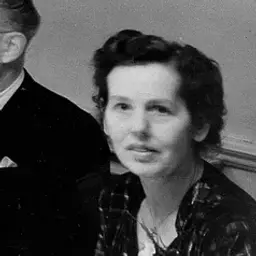
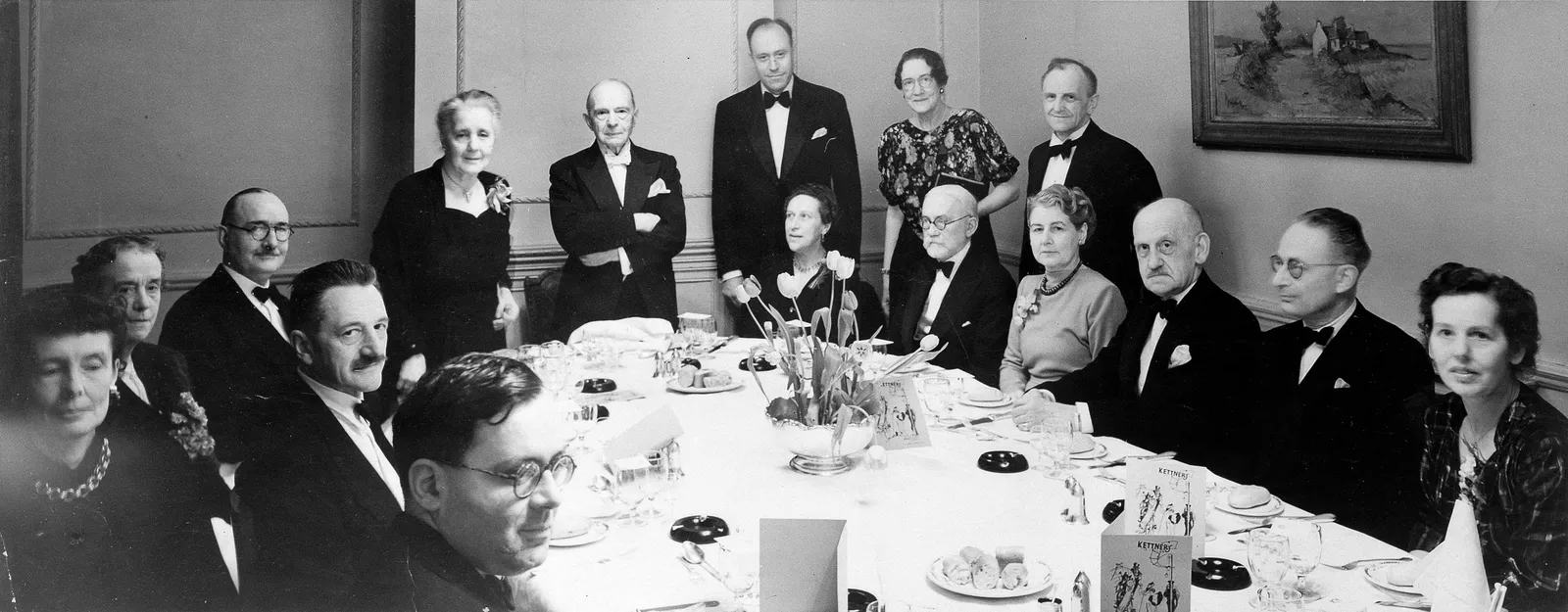
Dinner celebrating Melanie Klein's 70th birthday at Kettner's, London, 1952, with Joan Riviere among the guests, together with Ernest Jones, Donald Winnicott, Paula Heimann and James Strachey; photographer unknown (Wellcome Collection)
References
- The Origins of Attachment Theory: John Bowlby and Mary Ainsworth1992Evidence for a relation
- Social Development in Young Children: A Study of Beginnings1933Evidence for a relation
- Developments in Psycho-Analysis1952Evidence for a relation
- The Nature and Function of Phantasy1948Evidence for a relation
- Love, Hate and Reparation1937Evidence for a relation