Person
Jessica Benjamin
American psychoanalyst and feminist theorist, born in 1946, one of the founding figures of relational psychoanalysis. After studying psychology, sociology and philosophy at the Institute for Social Research in Frankfurt and taking a doctorate in sociology at New York University, she brought Hegel's idea of recognition into psychoanalysis: in The Bonds of Love (1988) she traced domination and the polarity of gender to a breakdown of mutual recognition between subjects. Her later work on intersubjectivity and the third describes how analyst and patient fall into a complementary relation of doer and done to and how they find their way out of it; she teaches at New York University's Postdoctoral Program in Psychotherapy and Psychoanalysis.
Ideas
introduced
- 1988 Mutual recognition
Benjamin took the idea of recognition from Hegel's account of master and slave and made it a psychoanalytic concept in The Bonds of Love (1988), where its breakdown explains domination. Her 1990 outline of intersubjectivity set it out as a line of development.
- 1988 Identificatory love
Benjamin described identificatory love for the father in The Bonds of Love, where she explains the daughter's later ideal love as a result of its frustration. She returned to it in the essay on father and daughter collected in Like Subjects, Love Objects.
- 2004 Doer and done to
Benjamin named the complementary relation of doer and done to in her 2004 paper on thirdness, where it describes the twoness of analytic impasse and enactment. Her 2017 book took it into social conflict as well.
- 2004 Thirdness
Benjamin set out her theory of thirdness in the 2004 paper, distinguishing the early one in the third from the later third in the one. The 2017 book develops the rhythmic and moral thirds.
critiqued
- 1988 Oedipus complex
In The Bonds of Love Benjamin criticised the Oedipal model for making the father the sole agent of separation and desire and the mother an object to be left behind, a split she held to reproduce gender domination.
developed
- 1990 Intersubjectivity
Benjamin's 1990 outline proposed an intersubjective theory of development, centred on recognising the other as a separate subject, to stand beside the intrapsychic theory rather than replace it. Like Subjects, Love Objects (1995) and Shadow of the Other (1998) extended it to gender.
- Relational psychoanalysis
Benjamin was one of the first New York analysts of the relational school and brought feminist theory and the idea of recognition into it. Mitchell and Aron reprinted her outline of intersubjectivity among the founding papers of the tradition.
reworked
- 1990 Use of an object
Benjamin read Winnicott's destruction and survival of the object as the moment the other is recognised as a subject outside one's control, recasting a concept about object use as a step in mutual recognition.
Influence
Affinity
- influenced by Donald Winnicott
Winnicott's paper on the use of an object, with its destruction and survival of the other, is a cornerstone of Benjamin's theory of recognition.
Works
- 1988
The Bonds of Love: Psychoanalysis, Feminism, and the Problem of Domination
Jessica Benjamin's first book asks why people accept, and take part in, relations of domination and submission. Drawing on Hegel's account of recognition, object relations theory and infancy research, it argues that domination grows out of a failure of mutual recognition: the tension between asserting oneself and recognising the other collapses into a split in which one side becomes subject and the other object. The book follows this split into erotic domination, the Oedipus complex and the polarity of masculinity and femininity, and criticises Freud's account of the father as the sole bearer of separation and desire. It appeared in Hebrew in 2005 as כבלי האהבה (Dvir, translated by Tamar Almog).
- 1990
An Outline of Intersubjectivity: The Development of Recognition
Jessica Benjamin's 1990 paper in Psychoanalytic Psychology argues that the psychoanalytic theory of the self needs an intersubjective dimension alongside the intrapsychic one. On her account development follows two complementary lines: the internalisation of object relations, and a separate trajectory along which the child gradually becomes able to recognise the other person as a subject in their own right, with the attunement and tolerance of difference this requires. Looking at differentiation in the first two years of life, she rereads Mahler's rapprochement phase as a struggle for recognition whose outcome is not only object constancy but the beginning of the capacity to recognise another's subjectivity, and she takes up Winnicott's account of the use of an object: the other's survival of destruction is what allows them to be found as real and outside. Recognition is thus a tension between asserting oneself and acknowledging the other, which can break down into domination; and differentiation is not simple separation but a continual breakdown and repair of mutuality, a view that leaves room for fantasy and aggression in a relational theory of the self. The paper was reprinted as "Recognition and Destruction: An Outline of Intersubjectivity".
- 1995
Like Subjects, Love Objects: Essays on Recognition and Sexual Difference
Jessica Benjamin's second book, published by Yale University Press in 1995, gathers six essays that develop a psychoanalytic theory of intersubjectivity and bring it to bear on gender and sexual difference. Its guiding question is what changes when another person is recognised not merely as an object of one's own mind but as a subject in their own right; because recognition concerns how difference is met, it leads to the question of how the sexes are alike and different, which Benjamin answers with what she calls gender heterodoxy. She presents intersubjective theory as a complement to the intrapsychic, individual-centred tradition rather than a replacement for it, and the book keeps to this "both/and" stance throughout, holding together relational and Freudian views, feminist and psychoanalytic theory, and clinical and theoretical material. The opening essay, "Recognition and Destruction: An Outline of Intersubjectivity", reads Winnicott's account of the destruction and survival of the object as the way the other comes to be recognised as a separate subject. The essays that follow propose an "overinclusive" view of gender, examine the fantasy of the omnipotent mother, describe the daughter's identificatory love for the father, and turn to the erotics of the transference and to sexuality and aggression in pornography.
- 1998
Shadow of the Other: Intersubjectivity and Gender in Psychoanalysis
Shadow of the Other (Routledge, 1998) collects three essays by the American psychoanalyst Jessica Benjamin that carry forward her earlier work on intersubjectivity and gender. As the publisher describes it, the book distinguishes two kinds of relationship a person has with an other: in one, the other is met as a being entirely different from oneself and yet still recognisable; in the other, the other is grasped through its function as a repository for qualities the self has cast out of itself. Benjamin asks how the self reconciles these two relationships and what follows for relations between men and women, and in doing so takes part in contemporary debates in feminist theory and psychoanalysis, including feminist and postmodern critiques of the subject. The first essay, "The Primal Leap of Psychoanalysis, From Body to Speech", began as a 1995 paper at New York University's conference "The Psychoanalytic Century" and reads the founding passage of psychoanalysis from body to speech in Freud's early cases; the second, "Constructions of Uncertain Content", questions fixed categories of gender; the third, "The Shadow of the Other Subject", argues for keeping a subject who can own what it projects.
- 2004
Beyond Doer and Done To: An Intersubjective View of Thirdness
In this paper, published in The Psychoanalytic Quarterly in 2004, Jessica Benjamin argues that analytic work which takes both participants, analyst and patient, as subjects needs a discipline rooted in the structural conditions of thirdness. She distinguishes two forms of the third. An early form rests on experiences of union and mutual accommodation, which she calls the one in the third. Later moral and symbolic forms introduce difference, which she calls the third in the one. In clinical work, she uses the idea of a third co-created by analyst and patient to explain two things. Impasses and enactments collapse the relationship into the twoness of complementarity, a relation of doer and done to. Recognition is then restored through surrender.
- 2017
Beyond Doer and Done To: Recognition Theory, Intersubjectivity and the Third
Beyond Doer and Done To is Jessica Benjamin's book-length statement of the theory of mutual recognition she first set out in The Bonds of Love. It gathers and reworks papers written after her 2004 essay of the same name, which opens the book. Its central argument is that recognition between two subjects tends to break down into a complementary relation of "doer and done to", and that thirdness is what restores it. Benjamin traces how the Third develops in early life as experience alternates between recognition and its breakdown: first a rhythmic third of attunement between infant and caregiver, then a moral third of shared values and acknowledgment. She shows the same movement inside the psychoanalytic relationship, where impasse and enactment are its forms. The book stresses the power of acknowledgment, including the analyst's acknowledgment of error, to repair a relationship and to heal both individual and social trauma. It carries the theory from the consulting room to social conflict and the witnessing of collective trauma. After an introduction on recognition, intersubjectivity and the Third, the chapters take up acknowledgment, the failed witness and the fear of harming; mutual recognition, vulnerability and asymmetry; excess, affect and gender complementarity in sexuality; the uses of enactment and play; negation and the lawful world; and the moral Third, with witnessing that goes beyond the logic of "only one can live". The publisher addresses it to psychoanalytic therapists and to theorists in the humanities and social sciences.
Gallery

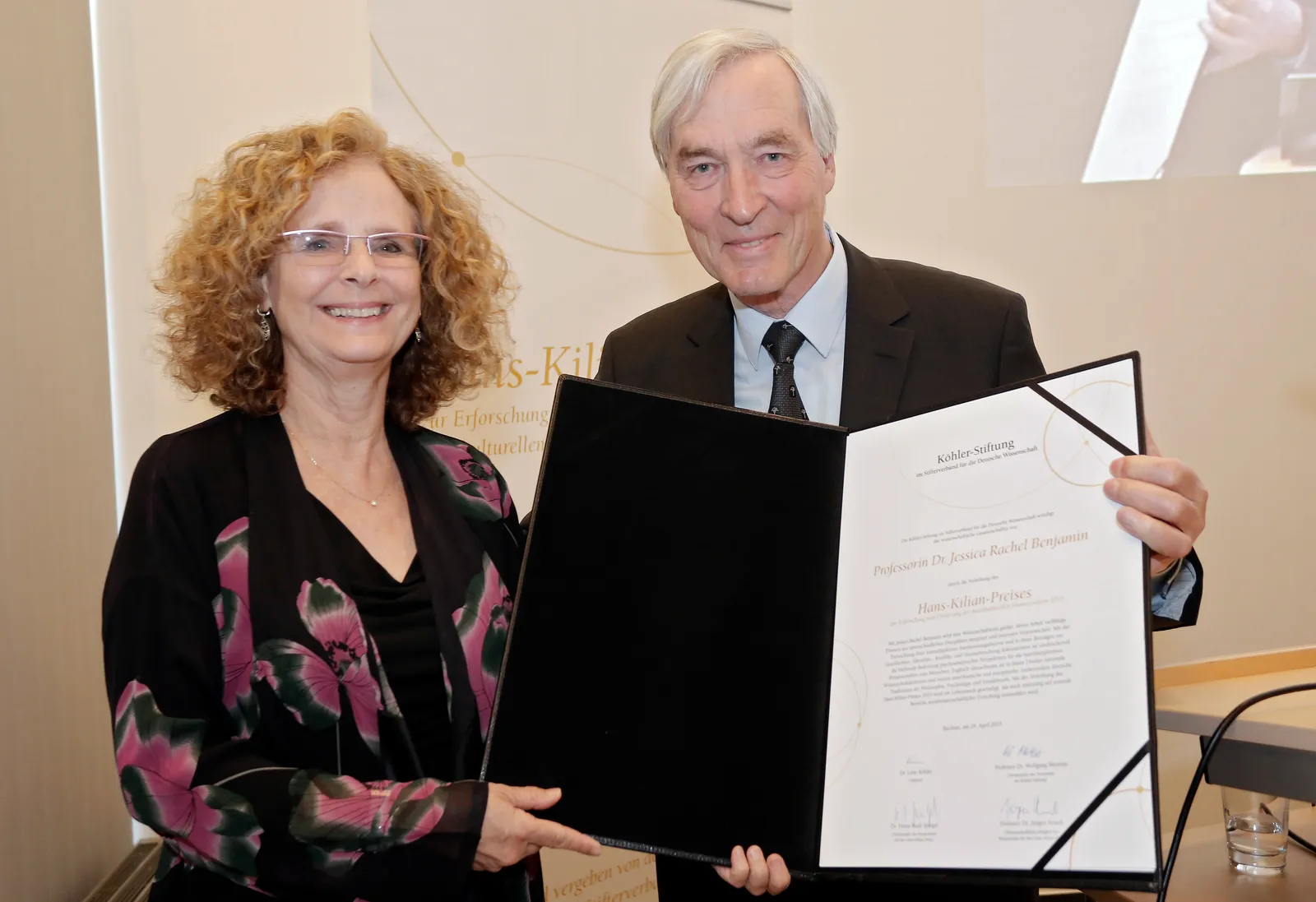
Jessica Benjamin (left) receiving the Hans Kilian Prize from Wolfgang Mertens, chairman of the Köhler Foundation's board, photographed by Die.berna, April 2015
References
- An Outline of Intersubjectivity: The Development of Recognition1990Evidence for a relation
- The Bonds of Love: Psychoanalysis, Feminism, and the Problem of Domination1988Evidence for a relation
- Beyond Doer and Done To: An Intersubjective View of Thirdness2004Evidence for a relation
- Beyond Doer and Done To: Recognition Theory, Intersubjectivity and the Third2017Evidence for a relation
- Like Subjects, Love Objects: Essays on Recognition and Sexual Difference1995Evidence for a relation
- Shadow of the Other: Intersubjectivity and Gender in Psychoanalysis1998Evidence for a relation
- Relational Psychoanalysis: The Emergence of a Tradition1999Evidence for a relation