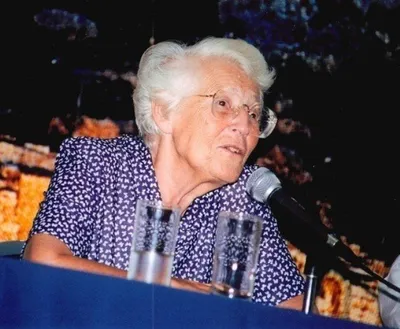
Person
Hanna Segal
British psychoanalyst, born in Łódź, Poland, who qualified in medicine in Edinburgh, was analysed by Melanie Klein and became one of the leading exponents of Kleinian theory and technique. Her analytic work with psychotic patients led her to distinguish the symbolic equation, in which the symbol is felt to be the thing itself, from the true symbol that represents an absent object, and she grounded a psychoanalytic aesthetics in the depressive position and reparation. Her Introduction to the Work of Melanie Klein (1964) became the standard account of Klein's ideas; she was President of the British Psychoanalytical Society and Vice-President of the International Psychoanalytical Association, and in later decades wrote on nuclear war and political violence.
- Born
- 1918
- Died
- 2011
- Influenced
- Donald Meltzer
developed
- Depressive position 1952 Segal carried Klein's depressive position into new fields: she made the mourning and recreation of the lost object the source of artistic creation and aesthetic experience (1952), and the condition for forming true symbols as opposed to symbolic equations (1957).
- Reparation 1952 In her aesthetics paper Segal made reparation the core of artistic creation: the artist, facing an inner world felt to lie in ruins, reassembles its fragments and recreates the lost object in the work, and the beholder shares in that mourning and recreation.
- Projective identification 1957 Segal used projective identification to account for disturbances of symbol formation in psychotic patients, and later, after Bion, separated its pathological form from its normal, communicative use.
supervised by
- Paula Heimann Paula Heimann was one of Segal's first supervisors during her training at the British Psychoanalytical Society.
- Joan Riviere Joan Riviere was, with Paula Heimann, one of Segal's first supervisors during her analytic training.
influenced by
- Melanie Klein Segal built her work on Klein's theory of the paranoid-schizoid and depressive positions and of projective identification, and became its foremost expositor, in the Introduction to the Work of Melanie Klein (1964) and the intellectual biography Klein (1979).
- Wilfred Bion Segal and Bion both belonged to the small group of Klein's pupils who analysed psychotic patients. In her later papers Segal followed Bion in tracing disturbed symbol formation to pathological rather than merely excessive projective identification, and linked her theory of symbols to his alpha and beta elements.