Article
On the Genesis of the Castration Complex in Women
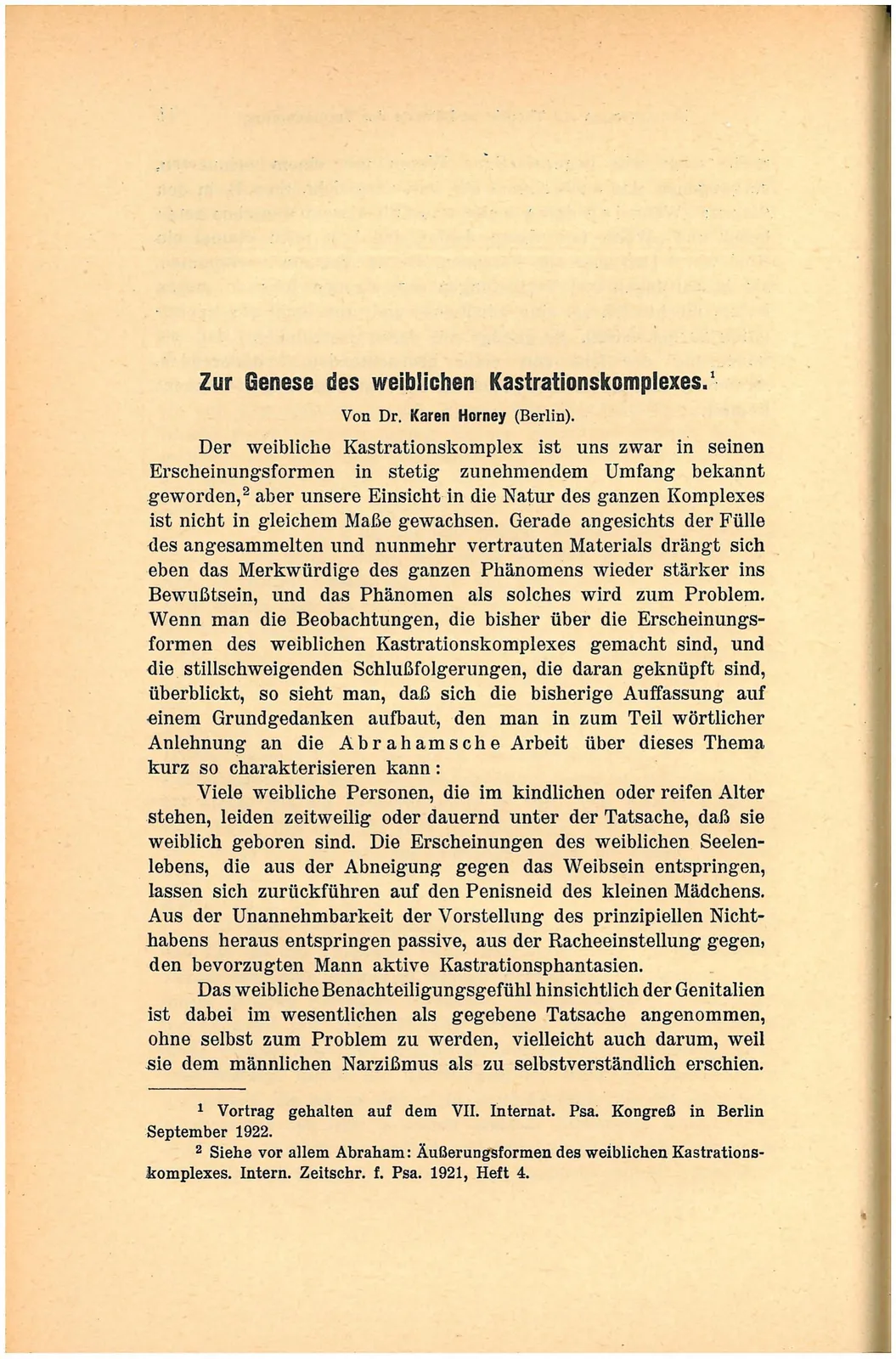
Zur Genese des weiblichen Kastrationskomplexes
Horney's first paper against the received psychoanalytic account of femininity was read at the Berlin congress of 1922 and published in 1923. Analysts had taken it as given that women suffer from their sex and envy the man his penis, and that the female castration complex follows from this. Horney asks whether the view owes its self-evidence to masculine narcissism. She also notes that it is unsatisfying, for biological thinking, that half of humanity should be discontented with its sexual role. She breaks the girl's penis envy into three components: urethral erotism, the wish to look and to show, and suppressed masturbatory wishes. In each the little girl is at a real disadvantage, but none of them makes her feel primarily inferior. From analytic material she argues that the decisive process lies in the Oedipal phase. The girl passes through an intense, fully feminine love for the father, including the wish for a child from him. When that love is disappointed she gives him up as an object and identifies with him instead, so that the wish to be a man covers a renounced femininity. That identification is one core of the castration complex. The other is the fantasy of having been castrated within the love relation to the father, from which women's vindictive attitudes toward men derive. Her conclusion is that wounded femininity creates the castration complex, and that women, like men, are made neurotic by their failure at the Oedipus complex. The same identification with the parent of the other sex underlies both homosexuality and the castration complex.
Read more- By
- Karen Horney
- Published
- 1923
- In
- Internationale Zeitschrift für Psychoanalyse, Bd. IX (1923), Heft 1, S. 12–26
- Language
- German