Book
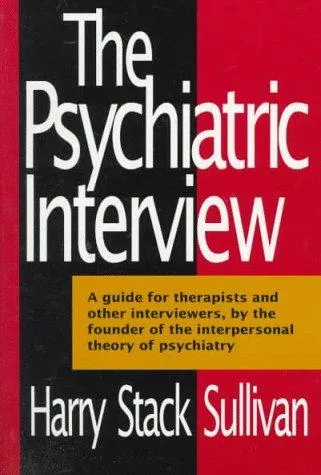
The Psychiatric Interview
The Psychiatric Interview is a posthumous book by Harry Stack Sullivan, edited by Helen Swick Perry and Mary Ladd Gawel from recordings of two lecture courses he gave at the Washington School of Psychiatry in 1944 and 1945, and published by W. W. Norton in 1954. It is the most systematic statement of Sullivan's clinical method, applying his interpersonal theory of psychiatry to the meeting between psychiatrist and patient. Sullivan defines the interview as a situation of primarily vocal, though not merely verbal, communication between two people, proceeding on a progressively unfolding expert–client basis, whose aim is to clarify the interviewee's characteristic patterns of living — those he experiences as especially troublesome or especially valuable — in a way from which he expects to benefit. The psychiatrist is an expert in interpersonal relations and a participant observer: never a neutral mirror, he is part of the field from which the data arise and must stay aware of his own share in it. Anxiety, in both participants, is the chief obstacle to learning anything: the patient's self-system mounts security operations, such as selective inattention, against whatever threatens self-esteem, and the interviewer must keep anxiety from mounting needlessly while noting where it appears. Sullivan divides the interview into four stages — the formal inception, the reconnaissance, the detailed inquiry, and the termination or interruption — and treats the technique of each: how to manage transitions between topics, how to use the developmental history from infancy through adolescence as a frame of reference for the inquiry, how to recognise the signs and patterns of mild and severe mental disorder, and how to close with a summarising statement, a prescription of action and an assessment of their likely effect. A final chapter takes up problems of communication. The book became a classic of interpersonal psychoanalysis and a standard text on psychiatric interviewing.
- Published
- 1954
- Language
- English