Article
The Flight from Womanhood: The Masculinity-Complex in Women, as Viewed by Men and by Women
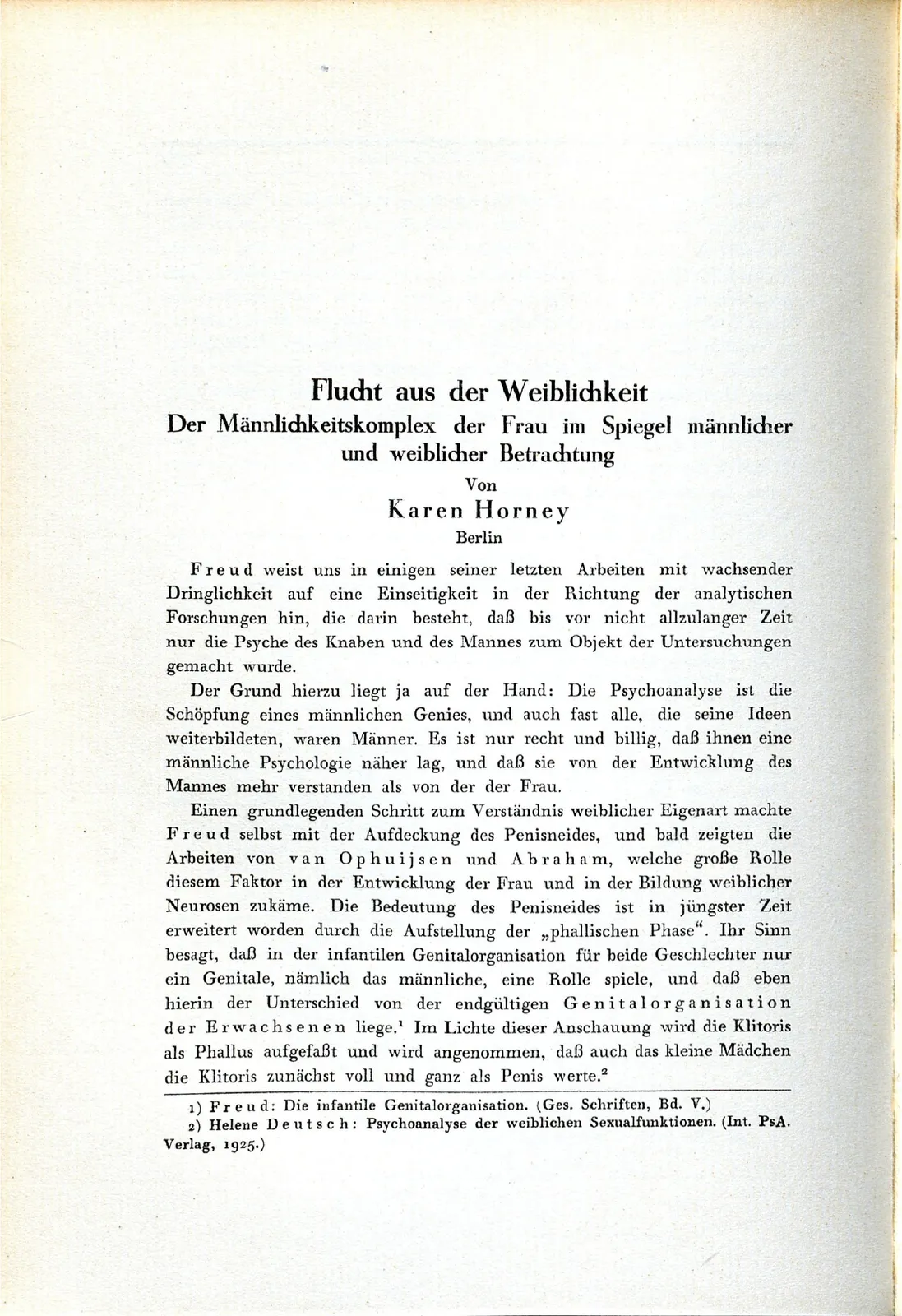
Flucht aus der Weiblichkeit: Der Männlichkeitskomplex der Frau im Spiegel männlicher und weiblicher Betrachtung
In this 1926 paper Horney asks how far the psychoanalytic account of female development has been shaped by the fact that its authors were men. She starts from the philosopher Georg Simmel's argument that our whole culture is a masculine culture, in which the standards of objectivity are in practice male standards. Psychology has observed women from the man's standpoint too. Setting the accepted analytic ideas about the girl side by side with the ideas a little boy forms about girls, she finds that the two largely coincide. She reads Ferenczi's genital theory as an expression of the male view of motherhood. Against that view she stresses the undeniable physiological superiority that motherhood gives women. She also stresses the intense envy of motherhood (Mutterschaftsneid) that boys and men feel toward pregnancy, childbirth, the breast and nursing. She suggests that theories which devalue motherhood may serve an unconscious male tendency, and that men's drive to creative work may draw on their small share in bearing children. The girl's masculinity complex appears as a secondary flight from womanhood. It is driven by guilt and anxiety over Oedipal wishes for the father and by genital anxieties, and the paper holds that the vagina plays a part in early female genital life. This flight is reinforced by the actual disadvantage of women in social life. Horney calls for attention to the interaction between psychic and social factors.
- By
- Karen Horney
- Published
- 1926
- In
- Internationale Zeitschrift für Psychoanalyse, Bd. XII (1926), Heft 3, S. 360–374
- Language
- German