Book
The Development of Psychoanalysis
Entwicklungsziele der Psychoanalyse
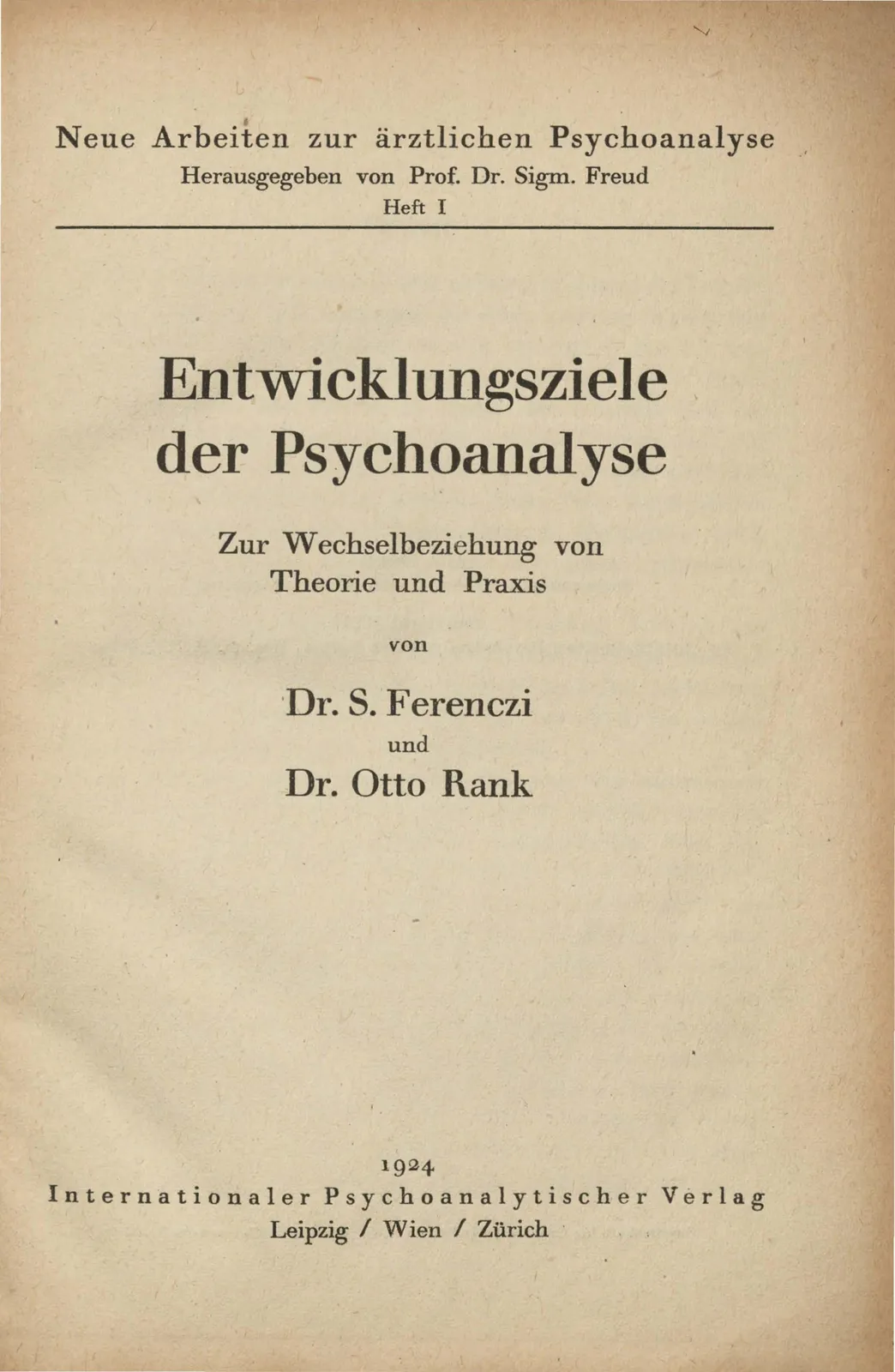
Entwicklungsziele der Psychoanalyse (1924; in English, The Development of Psychoanalysis, 1925) is a short programmatic book by Sándor Ferenczi and Otto Rank, issued as the first number of Freud's series Neue Arbeiten zur ärztlichen Psychoanalyse. According to its preface, it grew out of conversations in the summer of 1922: Ferenczi drafted the critical part and Rank the positive section on the analytic situation. The two revised the whole together after Freud, at the Berlin congress of September 1922, set a prize question on how analytic technique and theory had influenced each other. They adapted the text to that question but withdrew from the competition. The book argues that psychoanalysis had grown from a therapeutic procedure into a vast body of theory while its technique lagged behind, leaving many analysts disoriented and too closely bound to Freud's few technical papers. Starting from Freud's "Remembering, Repeating and Working-Through" (1914) and the repetition compulsion of Beyond the Pleasure Principle, the authors give repetition, rather than remembering, the leading role in treatment: the decisive unconscious material was never conscious, so it can only be reproduced in the relation to the analyst, where it must be understood and turned into present memory. Rank's section describes analysis as a time-limited process of libidinal flow, set going and carried by transference. The analyst stays largely passive and intervenes, like a catalyst, where resistance marks a neurotic deviation. Ego resistances give way to a transference in which the clinical neurosis is converted into a transference neurosis that revives the Oedipal "primal neurosis". Frustration keeps affects from discharging prematurely and drives the libido back to its points of fixation. A final phase of "weaning" dissolves the transference, and for it the analyst sets a fixed end date. Abreaction remains the healing agent, but its affects now run their course in the relation to the analyst rather than being tied to recovered memories. Ferenczi's historical-critical section reviews techniques that had stalled at earlier stages of psychoanalytic knowledge: collecting associations, dictionary-like translation of symbols, symptom analysis, "complex analysis", mechanically uncovering the stages of libido theory, speculative, phylogenetic and anagogic interpretation, lecturing patients, calling every stall a resistance, and both rigid passivity and "wild activity". It names the analyst's own narcissism as a source of error, and holds that the unconscious proper, never experienced, can only be relived piecemeal in the present, as a "fractionated catharsis". A chapter on theory and practice distinguishes intellectual knowledge from conviction gained through experience, and presents Freud's work as a "circulus benignus" in which each corrects the other. The authors see psychoanalysis moving from a phase of knowledge (Erkenntnisphase) to a phase of experience (Erlebnisphase). They conclude that a training analysis should not differ from a therapeutic one, that the patient's excess of knowledge should give way to the analyst's greater knowledge, and that technique will grow simpler, perhaps even readmitting hypnosis and suggestion, while psychoanalytic knowledge becomes common to all physicians and to therapists who are not physicians. Published in the same year as Rank's The Trauma of Birth, the book became a point of contention within Freud's inner circle.
- Published
- 1924
- In
- Neue Arbeiten zur ärztlichen Psychoanalyse
- Language
- German