Book
The Artist
Der Künstler
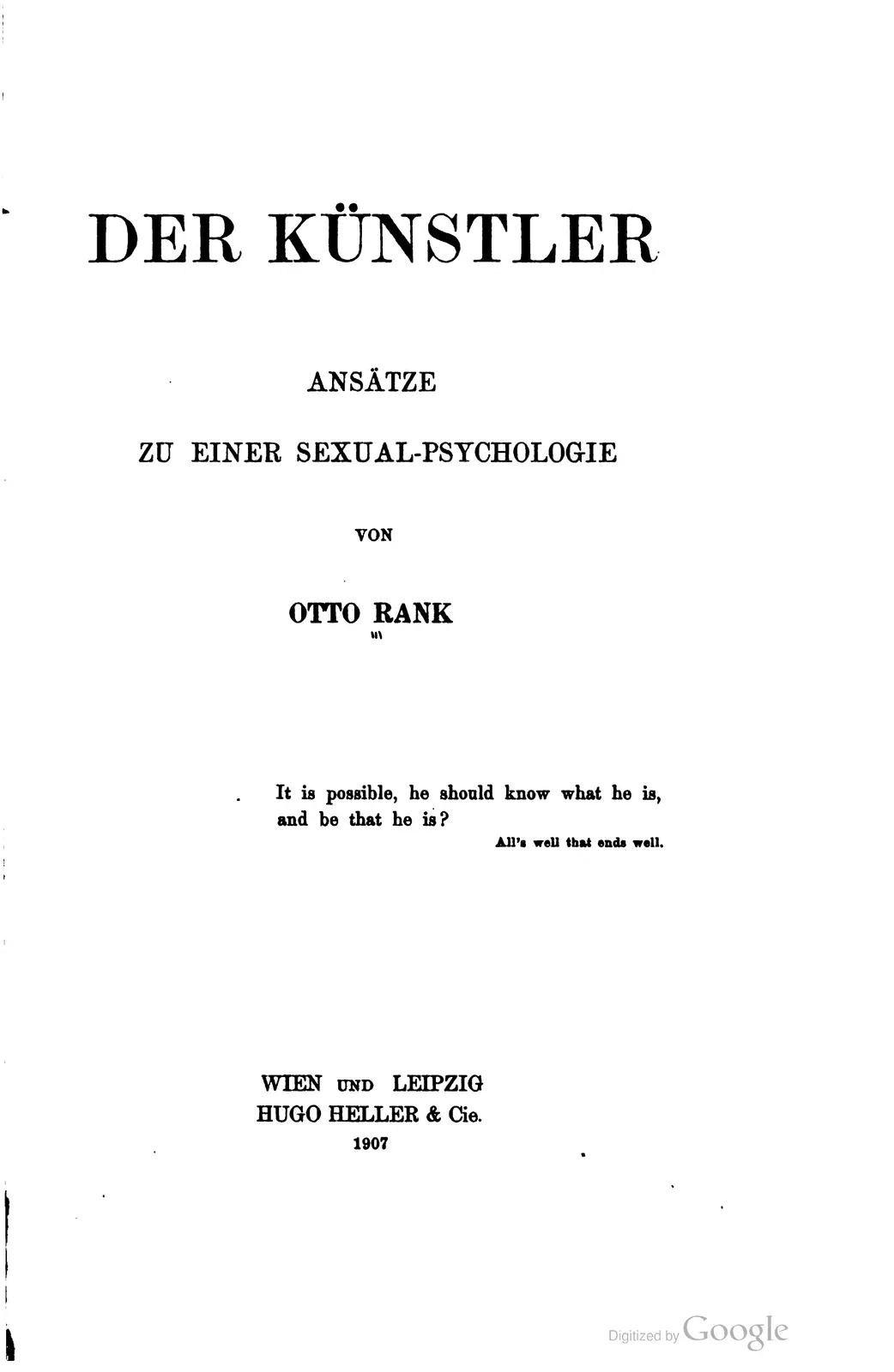
Der Künstler: Ansätze zu einer Sexual-Psychologie (The Artist: Approaches to a Sexual Psychology) is Otto Rank's first book, a short essay of some fifty-six pages published in Vienna and Leipzig by Hugo Heller in 1907. Rank wrote it as a young autodidact outside medicine. It is one of the earliest attempts to build a general psychology of artistic creation on Freud's theories, and it was the manuscript that brought Rank into Freud's circle. An introduction summarizes Freud's work up to 1905: Studies on Hysteria, The Interpretation of Dreams, The Psychopathology of Everyday Life, Jokes and Their Relation to the Unconscious and Three Essays on the Theory of Sexuality. It ends on Freud's view that sublimation is a third outcome of a strong constitutional disposition, beside perversion and neurosis, and one source of artistic activity. Rank's premise is that the artist's mental life differs from other people's in degree, not in kind, so that art has to be understood alongside dreams, jokes and neurotic symptoms. The first part, "The Sexual Basis", is a speculative natural history of the drives. Libido arises as a reaction to unpleasurable need and is in principle capable of every kind of pleasure ("all-sexuality"). It passes through polymorphous perversity and bisexuality to the differentiation of the sexes, and the drives that lose their libidinal premium along the way are stored up as the unconscious, the foundation of the psychical. From this progressive "sexual repression" Rank derives language, reason, fantasy, character, the virtues and culture. Pity, for instance, is cruelty turned into its opposite, and the drives are arranged in series running from active perversion through normality and virtue to passive perversion, neurosis and self-destruction. In this scheme woman personifies the inner resistances that libido creates for itself. The cultural history of peoples runs from a "primal state" toward hysteria and is accompanied by a progressive becoming-conscious of the unconscious, which the art of each period registers. The second part, "Artistic Sublimation", places the artist between the dreamer and the neurotic. The dream is the first compromise formation, myth a collective imitation of the dream, and art at first a communal product. The individual artist feels the conflict between the drives and their repression, which normal people discharge in dreams, too keenly for dreaming, but before it has become pathogenic. The work of art is a self-cure that forestalls the artist's neurosis. Through the pleasure of its form it also lets the audience lift their own inhibitions at little expense. On the model of Freud's account of jokes, aesthetic pleasure is only fore-pleasure that releases a deeper end-pleasure, and every work of art is the disguised fulfilment of a repressed wish. The artist can free himself from painful feelings, the neurotic wants to but cannot, and the dreamer lets it happen; the neurotic is a "feminine" artist, and the artist a "masculine" neurotic who has unconsciously invented his own cure. Religion is a psychotherapeutic cure that a people invents for itself, art one invented by an individual, and philosophy and science a further step toward making the unconscious conscious. Rank then ranks the arts by the drives they sublimate: looking in the painter, touch in the sculptor, hearing in the musician. He places the poet, and above all the dramatist, highest. Tragedy discharges affect through the spectator's identification with the hero, who is the idealized artist, and the actor mediates between poet and audience as the physician does in a cure. Shakespeare united poet and actor, Wagner's music drama is the summit of art, and Ibsen's analytic drama marks the point where art passes into science. The book closes on a prophecy. Because art arises and works unconsciously, it cannot complete the task of making the unconscious conscious. That task falls to science, by way of neurosis and its cure, "the basis of general knowledge", until, the whole unconscious having become conscious, an "unartistic, asexual superman" masters his drives.
- By
- Otto Rank
- Published
- 1907
- Language
- German