Article
The Double
Der Doppelgänger
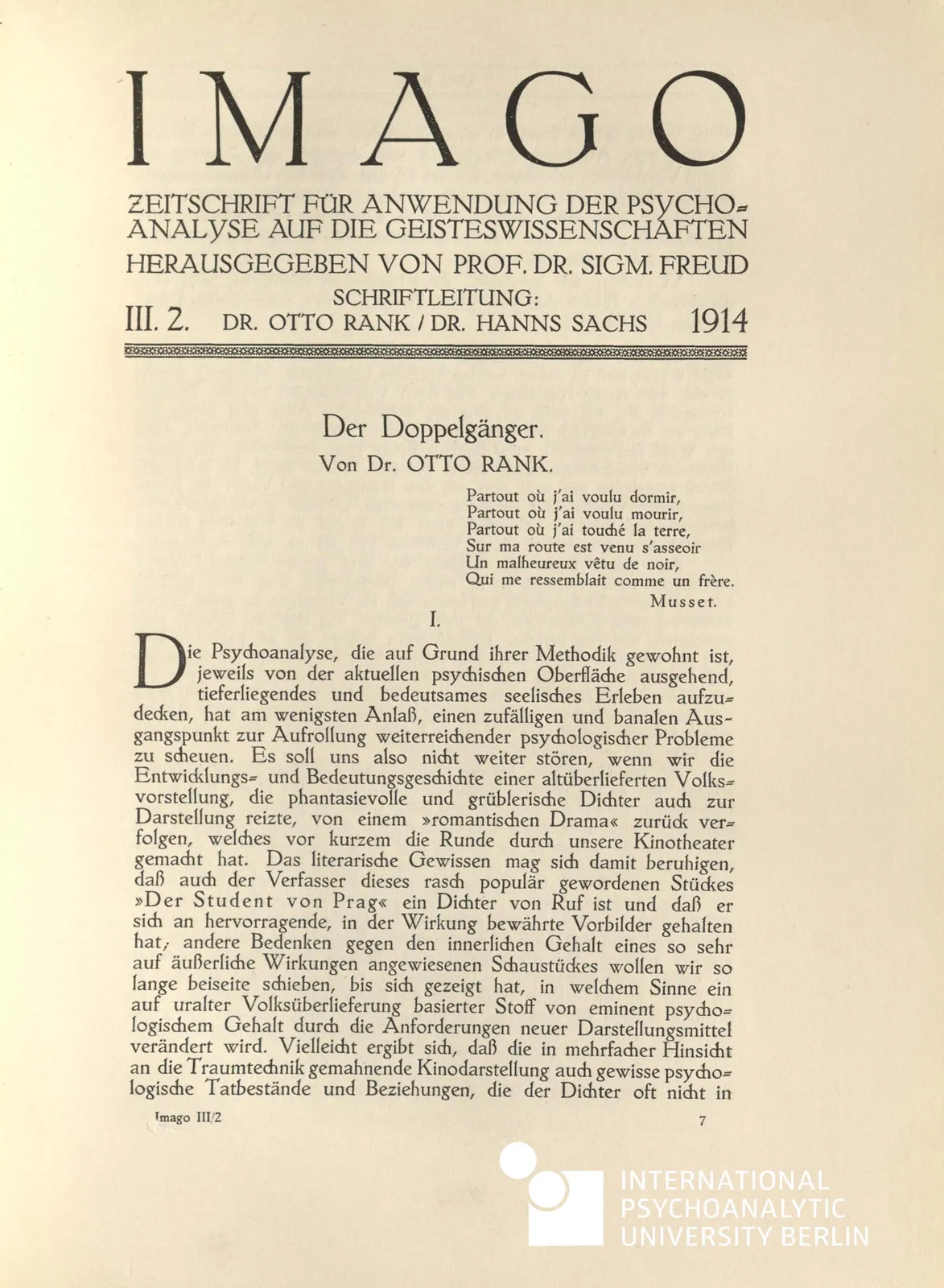
Otto Rank's "Der Doppelgänger", published in the third volume of Imago in 1914 and later reissued in book form (1925), is a psychoanalytic study of the motif of the double. Rank starts from a recent film, Hanns Heinz Ewers's The Student of Prague (1913). In it a poor student sells his mirror image to a sinister stranger. The image takes on a life of its own: it appears at each stage of his courtship of a countess and kills his rival in a duel. When the student finally shoots at it, the shot kills him instead. The film's programme reads the double as the hero's inescapable past. Rank finds this allegory insufficient, because it does not explain why the double intervenes precisely at moments of love, or why losing it and attacking it are so fatal. He argues that the dreamlike imagery of cinema makes visible the deeper problem of a person's relation to their own ego. The study then proceeds in three steps. The first surveys literary treatments of the double: - E. T. A. Hoffmann: the lost mirror image of the New Year's Eve adventures, The Devil's Elixirs, Die Doppeltgänger and Kater Murr. - Chamisso's shadowless Peter Schlemihl, Andersen's "The Shadow" and Lenau's "Anna". - Jean Paul, who brought the double into Romanticism, and Raimund's Der Alpenkönig und der Menschenfeind and Der Verschwender. - Wilde's The Picture of Dorian Gray and Heine. - Maupassant's "Le Horla" and "Lui", and Musset's "La nuit de décembre". - Poe's "William Wilson" and Dostoevsky's The Double. Rank finds features that recur across these works. The double resembles the hero down to the smallest detail and often appears in a mirror. It thwarts him, above all in his relation to a woman. When the hero kills it, the act turns out to be his own suicide. In several cases the story amounts to a picture of paranoid persecution. The second step finds a common psychological type among these authors. Rank describes them as pathological personalities prone to mental illness, alcohol, drugs or sexual excess, intensely preoccupied with their own ego, and either incapable of love or driven by an overstrained longing for it. The third step turns to folklore and ethnology, drawing on Frazer, Tylor, Rochholz, Negelein and Rohde. It covers: - superstitions that tie the shadow and the mirror image to death; - taboos on shadows, mirrors and portraits among the peoples Rank calls primitive; - languages that use one word for shadow, reflection and soul; - the Homeric psyche, the Egyptian ka and the Roman genius as doubles of the person; - the myth of Narcissus, which joins the deathly and the erotic meanings of the reflection. In the closing section Rank interprets the double through Freud's recent work on narcissism, paranoia and animism. Love of one's own image coexists with a defence against it. That defence shows itself as fear and loathing of the reflection, or as persecution by a double that has become independent. Following Freud on paranoia, Rank traces the persecutor back to the once most-loved person, who here is the ego itself. Identification with a rival brother adds to the double's role as a competitor in love. A strong sense of guilt leads the hero to place responsibility for his condemned impulses on a second self: the devil, or in later versions a warning conscience. A threatened narcissism explains the fear of death, the wish to stay young and the suicide of the doomed heroes. Unable to destroy his beloved ego directly, the hero kills it in the shape of the hated double. Rank links this to the history of belief in the soul. He holds that primitive narcissism knows nothing of death. The first idea of the soul was therefore an exact double of the body, an assurance of survival that denied death. Yet the double, created to ward off annihilation, returns in superstition as a herald of death, just as the double that embodies self-love becomes a rival in sexual love.
- By
- Otto Rank
- Published
- 1914
- In
- Imago
- Language
- German