Article
The 'Uncanny'
Das Unheimliche
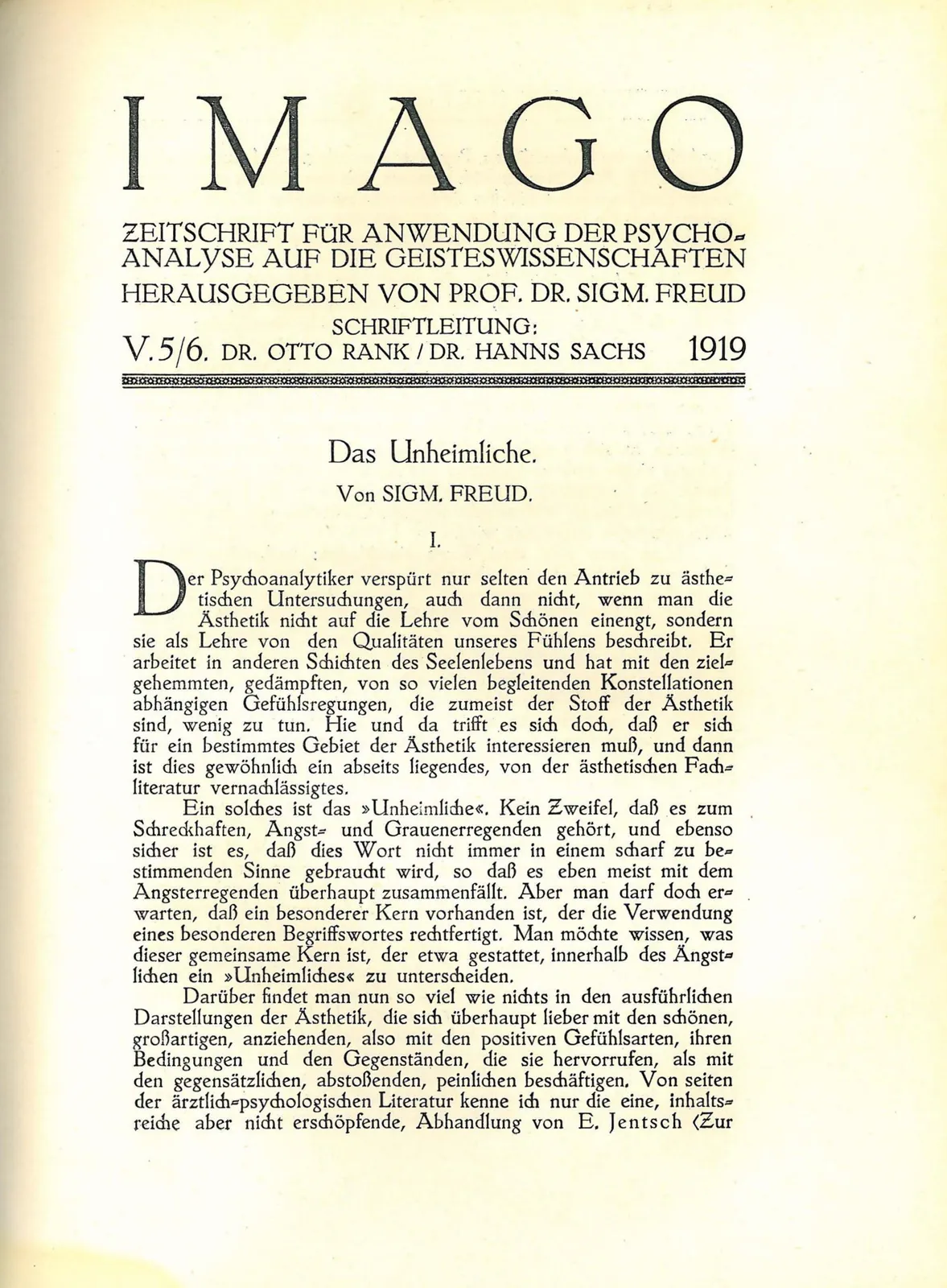
Freud's essay, published in the fifth volume of Imago in 1919, takes up a question he says aesthetics has neglected: what sets the uncanny apart within the wider class of the frightening. Against Ernst Jentsch, who in 1906 traced the feeling to intellectual uncertainty before the new and unfamiliar, Freud argues that the uncanny is the kind of fright that leads back to what is known of old and long familiar. He reaches this by two routes. The first is linguistic: entries from the dictionaries of Sanders and of the Grimms show heimlich ranging from 'homely, familiar' to 'concealed, secret', until it coincides with its opposite, unheimlich. Schelling's remark that the uncanny is whatever ought to have remained hidden and has come to light becomes a key to the essay. The second route is a survey of uncanny experiences and fictions. Reading E. T. A. Hoffmann's 'The Sandman', Freud places the story's effect not in the automaton Olimpia but in the figure who tears out children's eyes, and reads the fear for the eyes as a substitute for castration anxiety, with the good and the bad father split across the tale's paired figures. Following Otto Rank's study of the double, he shows the double turning from an insurance against death, born of primary narcissism, into a harbinger of death, and links it to the self-observing, self-critical agency in the ego. Involuntary repetition of the same, which he ties to a compulsion to repeat in the unconscious, the omnipotence of thoughts, the evil eye, the return of the dead, severed limbs, being buried alive, and the blurring of the line between fantasy and reality are traced in turn to infantile complexes or to surmounted animistic beliefs. The female genitals, which neurotic men often call uncanny, he reads as the entrance to the human being's first home: the prefix 'un-' is the mark of repression. In the last section Freud concedes that his thesis cannot be reversed, and that fairy tales abound in wish-fulfilments and animated objects that are not uncanny at all. He answers these objections by separating the uncanny of experience from the uncanny of fiction and, within experience, the uncanny that comes from repressed infantile complexes from the uncanny that arises when surmounted primitive beliefs seem confirmed once more. Fiction can suspend reality-testing and so spare us the uncanny, as in fairy tales, in Dante, or in Shakespeare's ghosts, or it can heighten the uncanny beyond anything life allows when the writer pretends to stay within common reality. The uncanny of repressed complexes is the more resistant of the two. Because the writer also steers the reader's identification and mood, the same material can turn comic, as in Nestroy or in Wilde's 'The Canterville Ghost'. The uncanniness of solitude, silence and darkness Freud leaves tied to the anxiety of childhood.
- Published
- 1919
- In
- Imago
- Language
- German