Article
Fragment of an Analysis of a Case of Hysteria
Bruchstück einer Hysterie-Analyse
Freud's case history of "Dora", an eighteen-year-old Viennese woman (later identified as Ida Bauer) whom he treated for about eleven weeks at the end of 1900; written in 1901, it appeared in 1905 in the Monatsschrift für Psychiatrie und Neurologie. Dora suffered from a nervous cough, loss of voice, shortness of breath and low moods, and her father brought her to Freud after her parents found a letter in which she hinted at suicide. Behind the symptoms Freud uncovers a family entanglement: her father's affair with Frau K., and the advances of Frau K.'s husband, Herr K., whom Dora slapped after a proposal by a lake and whose earlier kiss had filled her with disgust. Freud reads her symptoms as the expression of repressed sexual wishes — love for Herr K., a revived childhood attachment to her father and, at the deepest layer, love for Frau K. — and builds the case around the interpretation of two dreams: a burning house from which her father rescues her while her mother wants to save her jewel case, and a wandering through a strange town after her father's death. Dora broke off the treatment on 31 December. In the Postscript Freud attributes the failure to his not having recognised and interpreted in time the transference of her feelings for Herr K. onto himself, and gives his first sustained account of transference as a new edition of old impulses directed at the physician.
Main ideas
- Hysterical symptoms are overdetermined: a cough or loss of voice may rest on a real bodily irritation ("somatic compliance"), the grain of sand around which the pearl forms, and carry several meanings at once, such as identification with the sick father or with Frau K. and a sexual fantasy.
- The symptoms are, in Freud's phrase, the patient's sexual activity: hysteria is traced to repressed sexual wishes, not to Janet's fixed ideas, which Freud calls a meagre schematisation.
- Dream interpretation is shown at work in an analysis, as a supplement to The Interpretation of Dreams: a waking intention, such as Dora's resolve to leave, forms a dream only when an unconscious infantile wish backs it, as an entrepreneur needs a capitalist.
- Dora's conflict is layered: a revived attachment to her father defends against her love for Herr K., and beneath both lies her love for Frau K., an instance of the bisexuality Freud places at the root of the neuroses.
- In the course of treatment the neurosis produces transferences: new editions of old impulses and fantasies in which the physician takes the place of an earlier person, some reprinted unchanged and some revised.
- Transference is the greatest obstacle to analysis and becomes its most powerful aid when it is detected and interpreted each time; Freud failed to tell Dora that she had transferred onto him her feelings for Herr K.
- By breaking off the treatment Dora acted out her revenge rather than remembering it in the analysis, leaving Freud as she had left Herr K., and proving the physician powerless.
- The case is presented as a fragment: the analysis was cut short, its technique is deliberately left out, and Freud defends publishing intimate sexual material for the sake of science while disguising the patient.
What it shows
- 1905
Sigmund Freud developed Transference
In the postscript to the Dora case, traces the end of the treatment to a transference he had not mastered in time.
- 1905
Sigmund Freud developed Condensation
Applies condensation in a clinical dream analysis: in the Dora case he treats the jewel-case of her first dream as a product of condensation and displacement and a compromise between opposed currents.
- 1905
Sigmund Freud developed Displacement
Carries displacement over from the dream to hysterical symptom formation: Dora’s disgust and the pressure she feels on her chest are sensations displaced from the genitals, from the lower body to the upper, and the jewel-case of her first dream is read as a product of condensation and displacement.
- 1900
Sigmund Freud introduced Dream-work
Freud set out the mechanism of dream formation in Die Traumdeutung (1900). In the Dora case history he refers back to that book's rule that every dream represents a wish as fulfilled, in disguise when the wish is repressed, and tests it against Dora's first dream; he calls the dream a detour around repression, a means of indirect representation.
- 1905
Sigmund Freud introduced Acting out
In the postscript to the Dora case Freud first uses 'agieren' for the patient's breaking off the treatment: taking revenge on him as she had wanted to on Herr K., she acted out a piece of her memories and fantasies instead of reproducing it in the treatment.
Show all 15 Show fewer
- 1905
Sigmund Freud developed Free association
In the preface to the Dora case, Freud writes that his technique has been transformed since the Studies: instead of tracing the symptoms one by one, he lets the patient choose the subject of each session and starts from whatever the unconscious presents on the surface. He reads hidden connections from the order in which the patient's ideas follow one another.
- 1901
Sigmund Freud introduced Parapraxis
Freud set out the theory of slips in Zur Psychopathologie des Alltagslebens, printed in the Monatsschrift für Psychiatrie und Neurologie in 1901 and as a book in 1904: the forgetting of names and intentions, slips of the tongue and pen, misreadings, bungled and chance actions are treated as meaningful acts with unconscious motives rather than accidents. In the Dora case he refers readers back to that treatise, and Jones in 1908 cites its sections on slips of the tongue and pen, bungled actions and chance actions as Freud's.
- 1905
Sigmund Freud developed Parapraxis
Uses the symptomatic act clinically in the Dora case: Dora's playing with a small purse during a session, opening it and putting a finger in, is read as a pantomime of masturbation, and her quickly hiding a letter she was reading when Freud entered the waiting room as a further symptomatic act. Freud defines such acts as things done automatically and dismissed as meaningless, which on closer observation give expression to unconscious thoughts and impulses.
Parapraxis derives from Unconscious
The parapraxis is defined by its source in the unconscious: an apparently accidental slip or act is the tolerated expression of thoughts and impulses that consciousness does not know of or will not know of. For Freud slips are, with dreams, the everyday evidence that the unconscious exists in the healthy; Lacan treats them as the very place where Freud went looking for it.
Parapraxis derives from Repression
In the classical account a parapraxis results from interference by a thought or wish that has been pushed out of consciousness because it is unacceptable: the forgetting, slip or mislaying shows both the repressed content and the resistance against it. The Dora case speaks of acts consciousness 'will not know of', and Jones ties the concealment of a slip's source to its unacceptable nature.
- 1896
Sigmund Freud introduced Projection
Freud first described projection as the defence of paranoia, in a draft on paranoia sent to Fliess in January 1895 and in 'Weitere Bemerkungen über die Abwehr-Neuropsychosen' (1896): a reproach the ego cannot bear is not acknowledged as its own but attributed to someone else, and returns from outside as delusion. The Dora case restates the mechanism: in paranoia the projection of a reproach onto another, unchanged in content and without support in reality, shows itself as the process that forms delusions.
- 1905
Sigmund Freud developed Projection
In the Dora case Freud treats projection as a primitive, automatic defence that is not confined to paranoia. Defending against a self-reproach by raising the same reproach against someone else is modelled on children's tit-for-tat retorts, and Dora's reproaches against her father turn out to be lined with self-reproaches of the same content. In hysteria too, Dora's disgust at Herr K.'s embrace is read as projected by this mechanism, referring ultimately to her own discharge.
- 1905
Sigmund Freud introduced Reaction formation
In the Dora case Freud observes that repression is often achieved by excessively strengthening the opposite of the thought to be repressed. He calls this “reactive reinforcement” (Reaktionsverstärkung), and the over-strong conscious thought the “reactive thought”, which holds its objectionable counterpart in repression. The same year the Three Essays on the Theory of Sexuality name the process “reaction formation” (Reaktionsbildung).
- 1905
Reaction formation derives from Repression
Freud first conceives reaction formation as a way of carrying out repression: in the Dora case the opposite of the thought to be repressed is over-strengthened so that it keeps the repressed thought down. In Inhibitions, Symptoms and Anxiety he still speaks of “repression by reaction formation”, though there he also ranks it as a mechanism of defence in its own right.
- 1905
Sigmund Freud critiqued Hypnoid state
Freud distanced himself from the hypnoid state in stages. In 1895 he reports never having met a genuine hypnoid hysteria, since every case he took up turned into defence hysteria. In the Dora case (1905) he says he has given up only the stress on the hypnoid state, credits the idea wholly to Breuer, and calls the term superfluous and misleading. In 1909 he tells his Clark University audience that the notion proved obstructive and had been dropped.
Cited in
Gallery
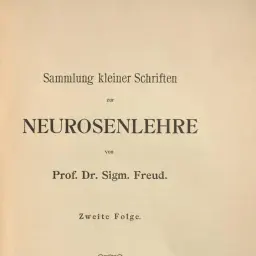
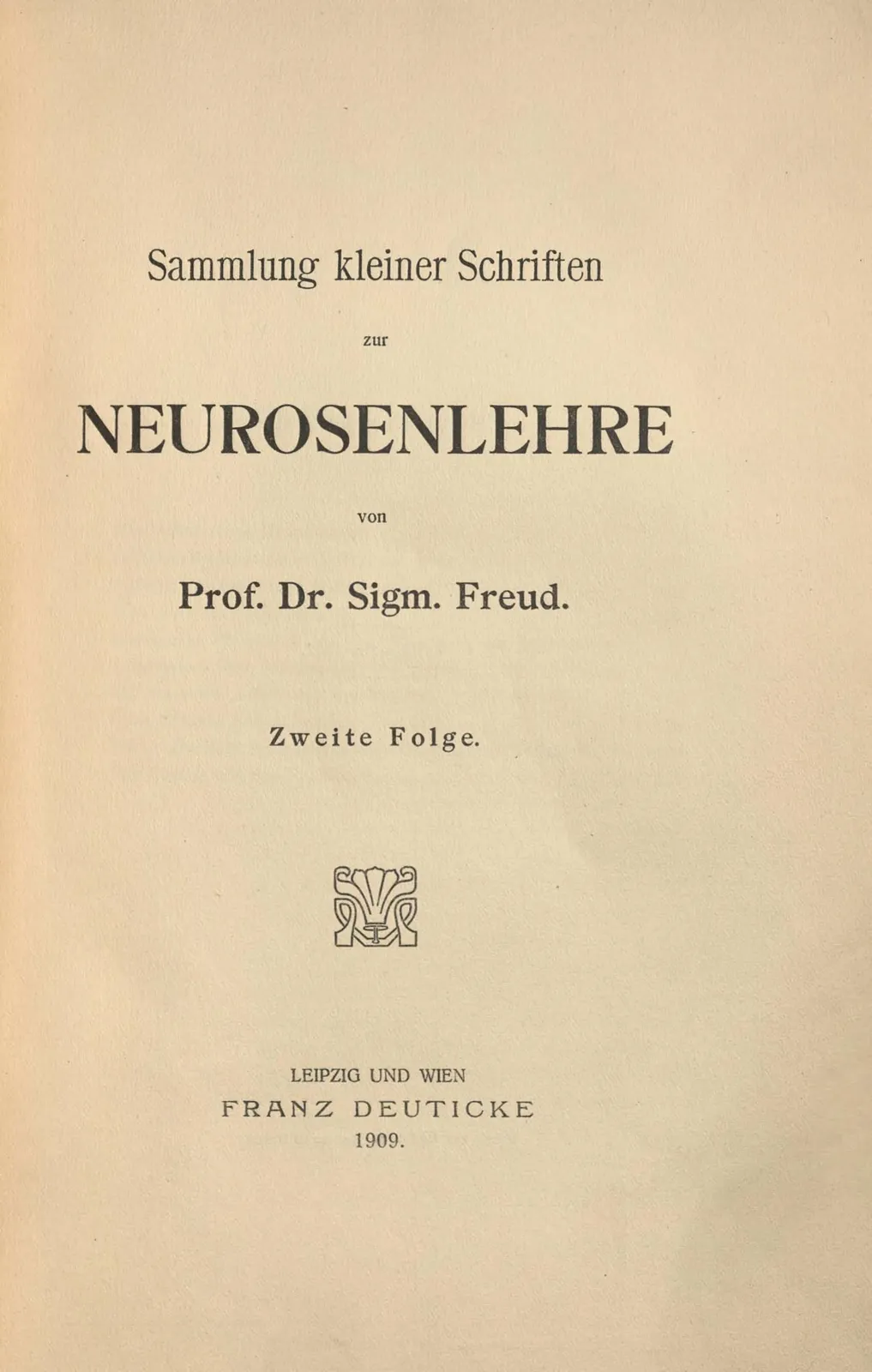
Title page of Sigmund Freud’s Sammlung kleiner Schriften zur Neurosenlehre, Zweite Folge (Leipzig and Vienna: Franz Deuticke, 1909), the first book edition of “Bruchstück einer Hysterie-Analyse” 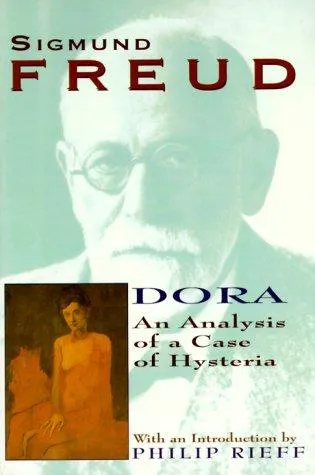
Cover of Dora: An Analysis of a Case of Hysteria, Touchstone paperback edition, 1997
External links
In English
- Barnes & Noble(opens the store’s page in a new tab)
- Barnes & Noble(opens the store’s page in a new tab)