Article
Fragment of an Analysis of a Case of Hysteria
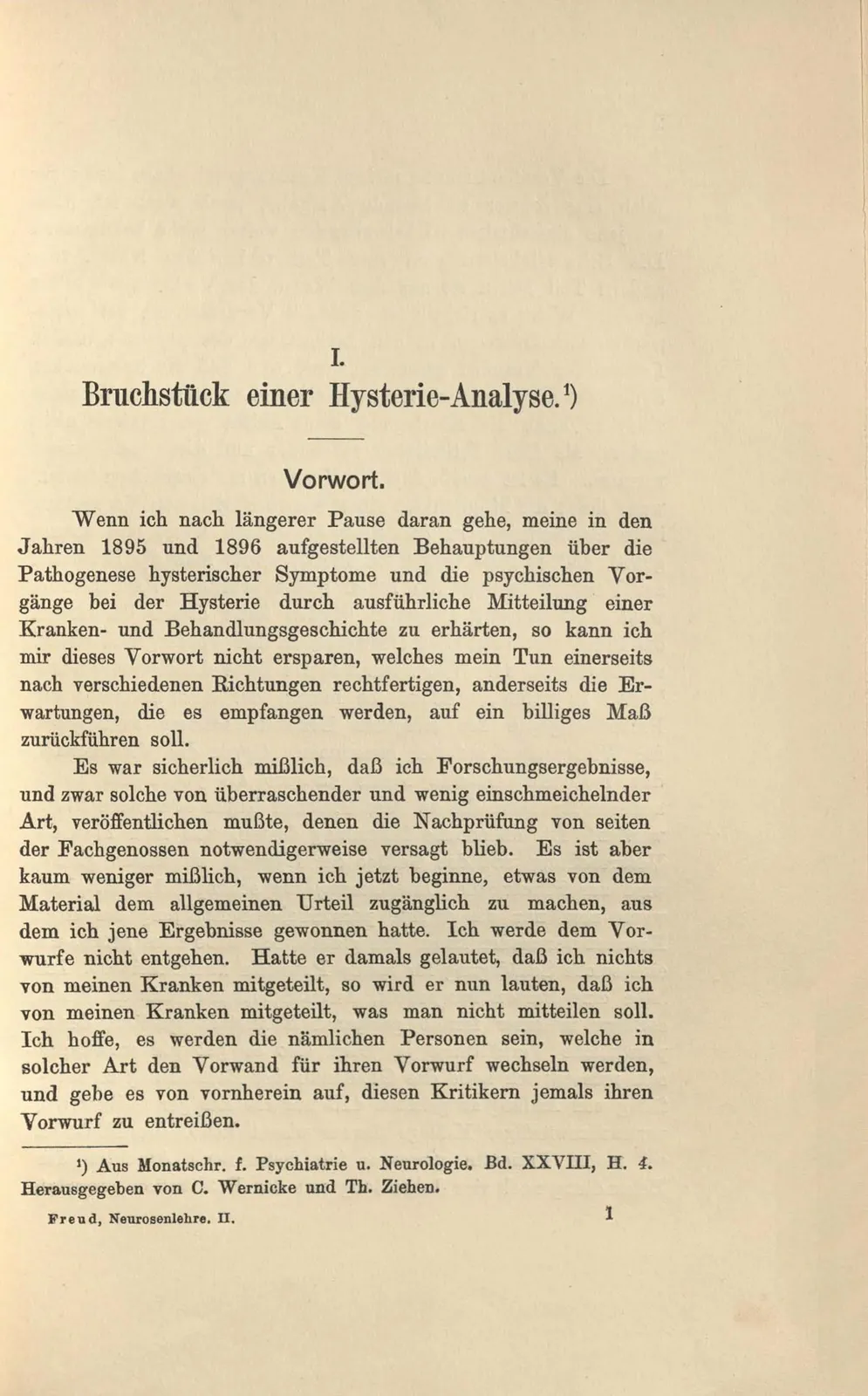
Bruchstück einer Hysterie-Analyse
Freud's case history of "Dora", an eighteen-year-old Viennese woman (later identified as Ida Bauer) whom he treated for about eleven weeks at the end of 1900; written in 1901, it appeared in 1905 in the Monatsschrift für Psychiatrie und Neurologie. Dora suffered from a nervous cough, loss of voice, shortness of breath and low moods, and her father brought her to Freud after her parents found a letter in which she hinted at suicide. Behind the symptoms Freud uncovers a family entanglement: her father's affair with Frau K., and the advances of Frau K.'s husband, Herr K., whom Dora slapped after a proposal by a lake and whose earlier kiss had filled her with disgust. Freud reads her symptoms as the expression of repressed sexual wishes — love for Herr K., a revived childhood attachment to her father and, at the deepest layer, love for Frau K. — and builds the case around the interpretation of two dreams: a burning house from which her father rescues her while her mother wants to save her jewel case, and a wandering through a strange town after her father's death. Dora broke off the treatment on 31 December. In the Postscript Freud attributes the failure to his not having recognised and interpreted in time the transference of her feelings for Herr K. onto himself, and gives his first sustained account of transference as a new edition of old impulses directed at the physician.
- Published
- 1905
- In
- Monatsschrift für Psychiatrie und Neurologie
- Language
- German