Article
Attacks on Linking
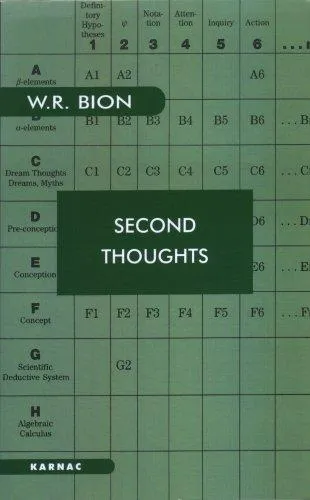
"Attacks on Linking" is a paper by Wilfred Bion, published in the International Journal of Psycho-Analysis in 1959 and reprinted in his collection Second Thoughts (1967). Drawing on the analyses of psychotic and severely borderline patients, it describes the destructive attacks that the psychotic part of the personality makes, in phantasy, on anything it feels to be a link between two objects. Bion takes as his prototype the infant's phantasied attacks on the breast as the link between itself and the mother, and extends the idea to the parental couple in intercourse, to the verbal communication between patient and analyst, and to the patient's own capacities for thought, emotion and perception. The paper proceeds through a series of clinical episodes. In one, a patient's stammer is understood as breaking up his words so that they cannot carry meaning between him and the analyst. In others, the patient's handling of the analyst's interpretations, and of the analytic pair working together, shows how any creative coupling, above all that of the parents, is felt as something to be split, emptied and destroyed out of envy and hatred. Because emotions themselves link one object to another, they too are attacked: the patient comes to hate emotion, reality and the mental apparatus that apprehends them. Bion places these attacks within Melanie Klein's paranoid-schizoid position and her account of splitting and projective identification, but adds a distinction of his own. Projective identification is not only a means of evacuating unwanted parts of the self. In its normal form it is the infant's earliest way of communicating, putting feelings it cannot bear, such as the fear that it is dying, into the mother, so that they can be modified there and taken back in a form it can tolerate. When the mother, and later the analyst, will not receive these projections, the infant resorts to projective identification with ever greater force and frequency, and its development deteriorates. Bion therefore traces attacks on linking to two sources together: an inborn disposition to destructiveness, hatred and envy, and an object that denies the patient the normal use of projective identification. The outcome is a primitive superego that forbids projective identification, and an internal object that intensifies the emotions it was needed to modify. The links that survive are logical, even mathematical, but never emotionally reasonable: they are perverse, cruel and sterile. The paper's account of a mind that cannot take in and transform experience prepares Bion's later theory of thinking and of container and contained.
Read more- By
- Wilfred Bion
- Published
- 1959
- In
- International Journal of Psycho-Analysis
- Language
- English