Book
Attachment and Loss, Vol. 2: Separation: Anxiety and Anger
The second volume of Bowlby's trilogy Attachment and Loss turns from the attachment bond itself to what happens when it is threatened. Drawing on observations of young children separated from their mothers in hospitals and residential nurseries — the Robertsons' films and Heinicke and Westheimer's studies among them — and on Hinde's separation experiments with rhesus monkeys, Bowlby takes the sequence of protest, despair and detachment as his starting point and argues that anxiety at separation is a primary response to the loss, or threatened loss, of an attachment figure, not a by-product of some other danger such as unmet bodily needs. After reviewing earlier psychoanalytic theories of anxiety, including Freud's late recognition that missing a loved person is the key to anxiety, he builds an ethological account of fear: humans are disposed to fear certain natural clues to danger — strangeness, sudden change, darkness, rapid approach and, above all, being alone — which in the environment in which the species evolved went with heightened risk. Fear of separation is therefore neither childish nor irrational, and any frightening situation is worse when met alone. The book then asks why some people are far more prone to fear than others. Bowlby's answer is that each person builds working models of attachment figures and of the self, forecasting whether care will be available when needed; these expectations take shape during childhood, tend to persist, and reflect fairly accurately what the person actually experienced. Anxious attachment — what clinicians had called over-dependency and blamed on spoiling — is traced to uncertain access to the attachment figure: repeated separations, threats of abandonment or suicide used as discipline, and the inversion of roles in which a parent seeks care from the child. Anger is examined as a natural response to separation that can serve to restore and keep the bond but turns dysfunctional when separations persist. School refusal and agoraphobia are reinterpreted as expressions of anxious attachment within particular patterns of family interaction, rather than as fear of the places themselves. The book closes with personality development, describing how confident self-reliance grows from a secure base along developmental pathways that early experience helps to set.
Main ideas
- Young children separated from their mother figure respond in a typical sequence of protest, despair and detachment; the presence of a familiar substitute caregiver greatly reduces this distress, showing that the loss of the attachment figure is its main cause.
- Separation anxiety is a primary response to the absence or threatened loss of an attachment figure, not derived from fear of unmet bodily needs, birth trauma or fantasied dangers; Bowlby reviews psychoanalytic theories of anxiety and builds on Freud's late view that missing a loved person is the key to anxiety.
- Humans, like other animals, are disposed to fear natural clues to danger — strangeness, sudden change, darkness, rapid approach and being alone — which went with heightened risk in the environment of evolutionary adaptedness; such fears are adaptive rather than irrational.
- Fear behaviour comprises both withdrawal from what alarms and approach to an attachment figure; a frightening situation is far more alarming when faced alone, so the availability of a trusted companion is a major determinant of fear.
- Each person builds working models of attachment figures and of the self that forecast whether support will be available; someone confident that an attachment figure will be there when wanted is much less prone to intense or chronic fear.
- These expectations form gradually through infancy, childhood and adolescence, tend to persist into adult life, and are tolerably accurate reflections of the experiences the person actually had with caregivers.
- Anxious attachment, previously called over-dependency and blamed on spoiling, results from uncertainty about the availability of attachment figures: separations, rejection, and threats of abandonment or suicide used to control a child.
- Anger at separation is functional when it aims to recover the attachment figure and discourage further separation, but repeated or prolonged separation makes it dysfunctional, feeding hostility and ambivalence toward the very person the child depends on.
- School refusal and agoraphobia are better understood as anxious attachment within pathogenic family patterns than as fear of a place: often a parent holds the child at home or inverts roles by seeking care from the child, and the sufferer fears that harm will befall a parent while they are apart.
- Personality develops along pathways that early experience helps to set; healthy self-reliance is not the opposite of relying on others but grows from confidence in a secure base.
Gallery
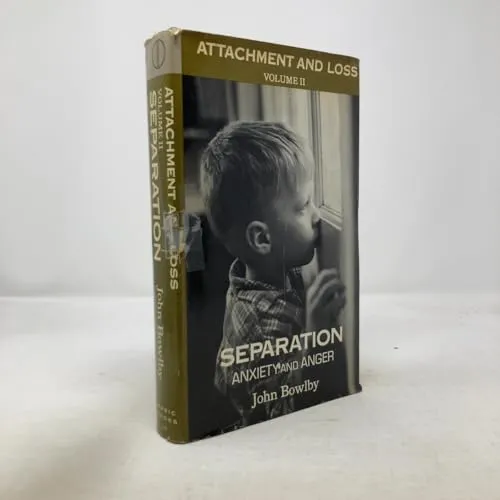
Dust jacket of the first American edition of John Bowlby's Separation: Anxiety and Anger, Attachment and Loss volume II, Basic Books hardcover, 1973 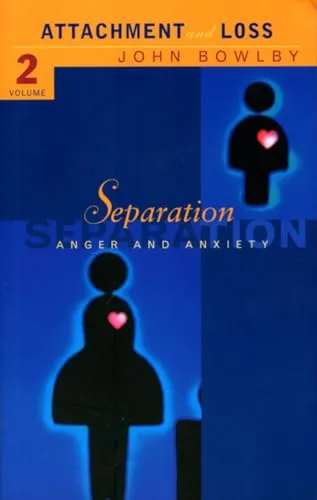
Cover of John Bowlby's Separation, Attachment and Loss volume 2, Pimlico paperback, 1998 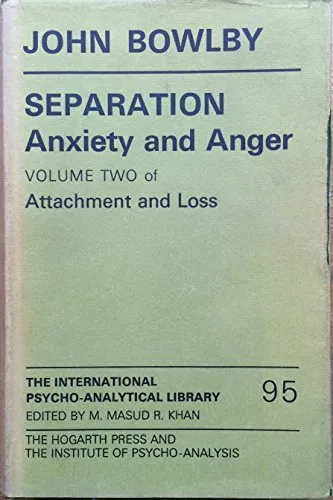
Dust jacket of John Bowlby's Separation: Anxiety and Anger, volume two of Attachment and Loss, in the Hogarth Press and Institute of Psycho-Analysis hardcover edition of 1973 (International Psycho-Analytical Library No. 95)