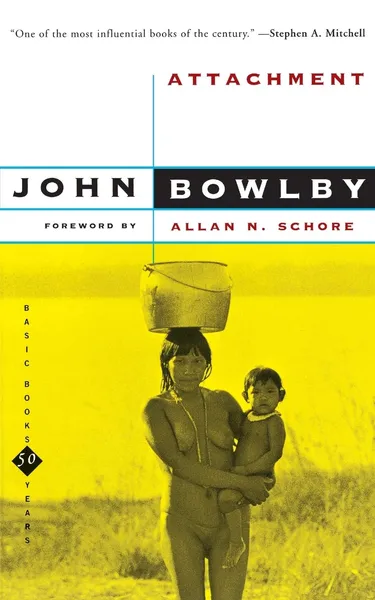
Book
Attachment and Loss, Vol. 1: Attachment
The first volume of John Bowlby's trilogy lays the theoretical foundation of attachment theory. Bowlby starts not from adult patients' recollections but from direct observation of young children separated from their mothers, who typically pass through protest, despair and detachment, and he asks what kind of theory could explain the strength of the tie that such separations disrupt. Finding Freud's model of psychic energy and drive discharge inadequate, he proposes an alternative theory of instinctive behaviour drawn from ethology, evolutionary biology and control theory. Instinctive behaviour is organized in behavioural systems that pursue set-goals, are activated and terminated by particular conditions, and are shaped by the environment in which the species evolved. On this basis he argues that the child's tie to the mother is not a by-product of feeding, as secondary-drive theories held, but the outcome of a distinct attachment behavioural system whose biological function is protection. Crying, smiling, clinging, following and calling serve to keep the child near a preferred figure and are integrated around that person during the first year. The second half of the book traces the ontogeny of attachment through four phases, from undiscriminating orientation and signalling to a goal-corrected partnership in which the child takes the mother's own goals into account. It discusses the focusing of attachment on one principal figure among a small hierarchy of others, the balance between attachment and exploration from a secure base, the role of the mother's responsiveness, drawing on Mary Ainsworth's studies, and the internal working models of self and attachment figure through which experience is appraised. The book thus recasts the psychoanalytic theory of the child's earliest relationship in the language of the biological and behavioural sciences, and prepares the ground for the volumes on separation and loss that follow.
- By
- John Bowlby
- Published
- 1969
- In
- London: Hogarth Press and the Institute of Psycho-Analysis; New York: Basic Books, 1969 (International Psycho-Analytical Library)
- Language
- English