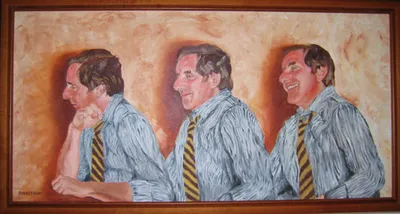
Person
Stephen A. Mitchell
American psychologist and psychoanalyst, the leading figure in the founding of relational psychoanalysis. Trained at the William Alanson White Institute, he wrote Object Relations in Psychoanalytic Theory (1983) with Jay Greenberg, which sorted psychoanalytic theories into a drive model and a relational model. In Relational Concepts in Psychoanalysis (1988) he drew interpersonal psychoanalysis, British object relations theory and self psychology together around the idea of a relational matrix, in which relations with others, not drives, are the basic stuff of mental life. He founded the journal Psychoanalytic Dialogues in 1990 and the Relational Perspectives book series, and helped create the relational track of New York University's postdoctoral program; the international relational association founded in 2001, after his early death, grew out of his work.
- Born
- 1946
- Died
- 2000
- Influenced by
introduced
- Relational psychoanalysis 1983 Mitchell and Jay Greenberg first used "relational" as the name of a family of theories in their 1983 book. Mitchell then made it the name of a school: his 1988 integration, the journal Psychoanalytic Dialogues (1990), the Relational Perspectives book series and the relational track at NYU's postdoctoral programme.
- Drive/structure and relational/structure models 1983 With Greenberg, Mitchell drew the line between theories in which relations with others serve the drives and theories in which relations come first. That division became the founding frame of the relational school.
- Relational matrix 1988 In Relational Concepts in Psychoanalysis Mitchell made the relational matrix (self, other and the space between) the central structure of the mind, in place of the drive. He used it to integrate interpersonal theory, British object relations and self psychology.
collaborated with
- Jay Greenberg 1983 Both trained at the William Alanson White Institute and together wrote Object Relations in Psychoanalytic Theory (1983), the comparative survey that set out the drive and relational models. Later they parted ways on whether drive still has a place.
- Lewis Aron 1999 Aron worked alongside Mitchell in the New York relational group. Both were among the founders of Psychoanalytic Dialogues, and together they edited Relational Psychoanalysis: The Emergence of a Tradition (1999), the collection of the school's founding papers.
influenced by
- Harry Stack Sullivan Mitchell trained in the interpersonal tradition at the White Institute, which Sullivan co-founded. Sullivan's interpersonal theory is one of the two roots of the relational model he and Greenberg described, and one of the strands his 1988 integration draws together.
- Ronald Fairbairn Fairbairn's view that libido is object-seeking, not pleasure-seeking, is a cornerstone of the relational model. In Relationality Mitchell built on Fairbairn's idea of a self made of many internal self–other configurations.
- Hans Loewald In his last book, Relationality, Mitchell drew on Loewald's account of the original undifferentiated unity of infant and mother. He read Loewald as a bridge between drive theory and relational thinking.