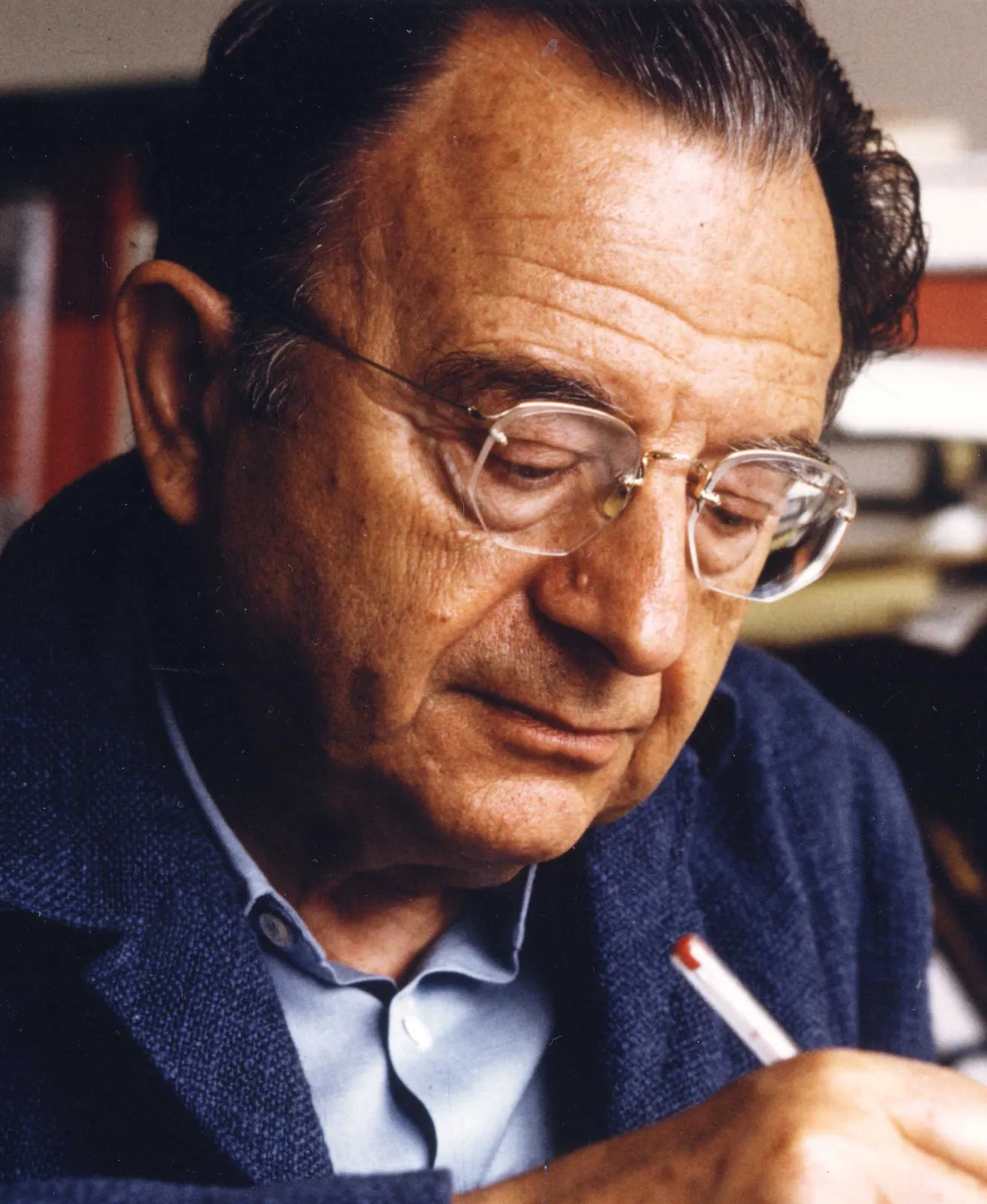
Person
Erich Fromm
German-born psychoanalyst and social philosopher, trained in sociology at Heidelberg and in psychoanalysis in Berlin, who worked with the Frankfurt Institute for Social Research before emigrating to the United States in 1934. He read character as shaped by society as much as by drives, and his books, among them Escape from Freedom (1941) and The Art of Loving (1956), set out a humanistic psychoanalysis. A lay analyst, he was a close associate of Karen Horney in New York until their break in 1943.
- Born
- 1900
- Died
- 1980
- Influenced
- Karen Horney
analysed by
- Hanns Sachs 1929 Fromm's training analysis was with Hanns Sachs at the Berlin Psychoanalytic Institute, beginning about February 1929.
- Frieda Fromm-Reichmann Frieda Reichmann analysed Fromm in Heidelberg in the mid-1920s; the analysis turned into a love affair, and they married in 1926.
introduced
- Social character 1941 Fromm used the phrase social character structure in his 1935 essay on the social determination of psychoanalytic therapy, after sketching the idea in the early 1930s as the libidinal structure of society, and set out the concept systematically in the appendix to Escape from Freedom (1941).
- Mechanisms of escape 1941 In the fifth chapter of Escape from Freedom (1941) Fromm described authoritarianism, destructiveness and automaton conformity as the ways in which the isolated modern individual flees the burden of freedom.
- Character orientation 1947 In Man for Himself (1947) Fromm classified character by its orientations, the receptive, exploitative, hoarding and marketing, which are nonproductive, and the productive.
collaborated with
- Karen Horney 1941 Fromm, who had a long personal relationship with Horney in the 1930s, joined her in 1941 in founding the Association for the Advancement of Psychoanalysis and its American Institute for Psychoanalysis after she left the New York Psychoanalytic Society.
- Harry Stack Sullivan Sullivan published Fromm's essay on selfishness and self-love in his journal Psychiatry in 1939 and cited it as close to his own view; Fromm taught at the Washington School of Psychiatry and in 1943 was among the founders of what became the William Alanson White Institute.