Book
Transformations
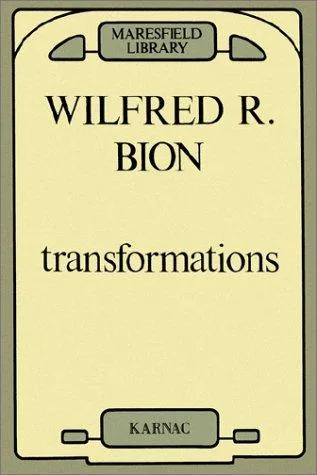
Transformations (London: Heinemann Medical, 1965), subtitled Change from Learning to Growth, is the third of Wilfred Bion's short theoretical books of the 1960s, after Learning from Experience (1962) and Elements of Psycho-Analysis (1963) and before Attention and Interpretation (1970). It asks what a psychoanalyst actually observes, and how an interpretation stands to the experience it is about. Bion borrows the idea of transformation, and of what stays invariant under it, from geometry. A painter's picture of a field of poppies transforms the scene, yet a viewer recognises the field because certain features survive the change. In the same way the patient's associations, the analyst's interpretations and analytic theories themselves are transformations of something never directly given. Bion calls that something O: the ultimate reality of the session, the thing-in-itself, absolute truth, which cannot be known but only become, and which evolves until it can be met in experience. He gives a notation for the process of transforming (Tα) and its product (Tβ), for patient and analyst alike, and uses the Grid from his previous book to place the elements of a session. He then distinguishes kinds of transformation. In rigid-motion transformations, as in transference in its classical sense, feelings and ideas move from one setting to another with little deformation. Projective transformations, rooted in projective identification, deform far more. In transformations in hallucinosis the psychotic part of the personality treats its own evacuated products as self-sufficient and superior to anything it could receive from another. Transformations in K concern knowing about something; transformations in O concern becoming it, and Bion argues that the passage from K to O, on which psychological growth depends, is feared and resisted. Along the way he discusses the psychotic's intolerance of the 'no-thing', the point that marks where the breast was; hyperbole, the exaggeration by which an emotion is forced out to reach an object felt to be distant or unreceptive; and a psychotic breakdown as a catastrophe whose invariants can be traced in the states before and after it. The book points towards Bion's later insistence that the analyst must be at one with the emotional reality of the session, not merely know about it.
Read more- By
- Wilfred Bion
- Published
- 1965
- Language
- English