Book
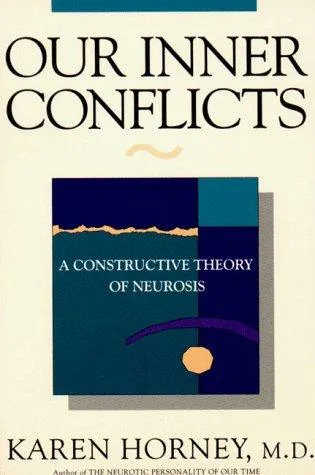
Our Inner Conflicts: A Constructive Theory of Neurosis
In this book Horney sets out a theory of neurosis centred on conflict between incompatible attitudes toward other people. In the introduction she traces her path away from Freud. It began with doubts about his feminine psychology and led, with Erich Fromm's help, to the cultural conditions of neurosis. She came to hold that neuroses are generated by disturbances in human relationships, and that the libido theory was no longer tenable. The ten neurotic trends she had listed in Self-Analysis are here regrouped into three basic attitudes: moving toward people, moving against them and moving away from them. Each overstresses one element of basic anxiety: helplessness, hostility or isolation. Their clash is the basic conflict, the dynamic centre of neurosis. Freud saw conflict as a battle between repressed and repressing forces, universal and in principle insoluble. Horney places it between contradictory neurotic trends and holds that it can be resolved where it arises. The book then examines the neurotic's attempts at a solution. One side of the conflict may be suppressed, or the person may withdraw into detachment. The idealized image is the most important attempt: in it the conflicting trends appear not as conflicts but as aspects of a rich personality. Externalization is the tendency to experience inner processes as though they occurred outside oneself. It is wider than projection, and Horney calls it an active process of self-elimination. Further auxiliary approaches, among them arbitrary rightness, rigid self-control and cynicism, serve to keep up an artificial harmony. A second part describes what unresolved conflicts cost: fears, impoverishment of the personality, hopelessness and sadistic trends. The conclusion holds that neurotic conflicts cannot be resolved by rational decision, but only by changing the inner conditions that brought them about. Against what she calls the pessimism of Freud's psychology, Horney affirms that a person can change and go on changing as long as they live.
- By
- Karen Horney
- Published
- 1945
- In
- New York: W. W. Norton
- Language
- English