Article
Destruction as the Cause of Coming into Being
Die Destruktion als Ursache des Werdens
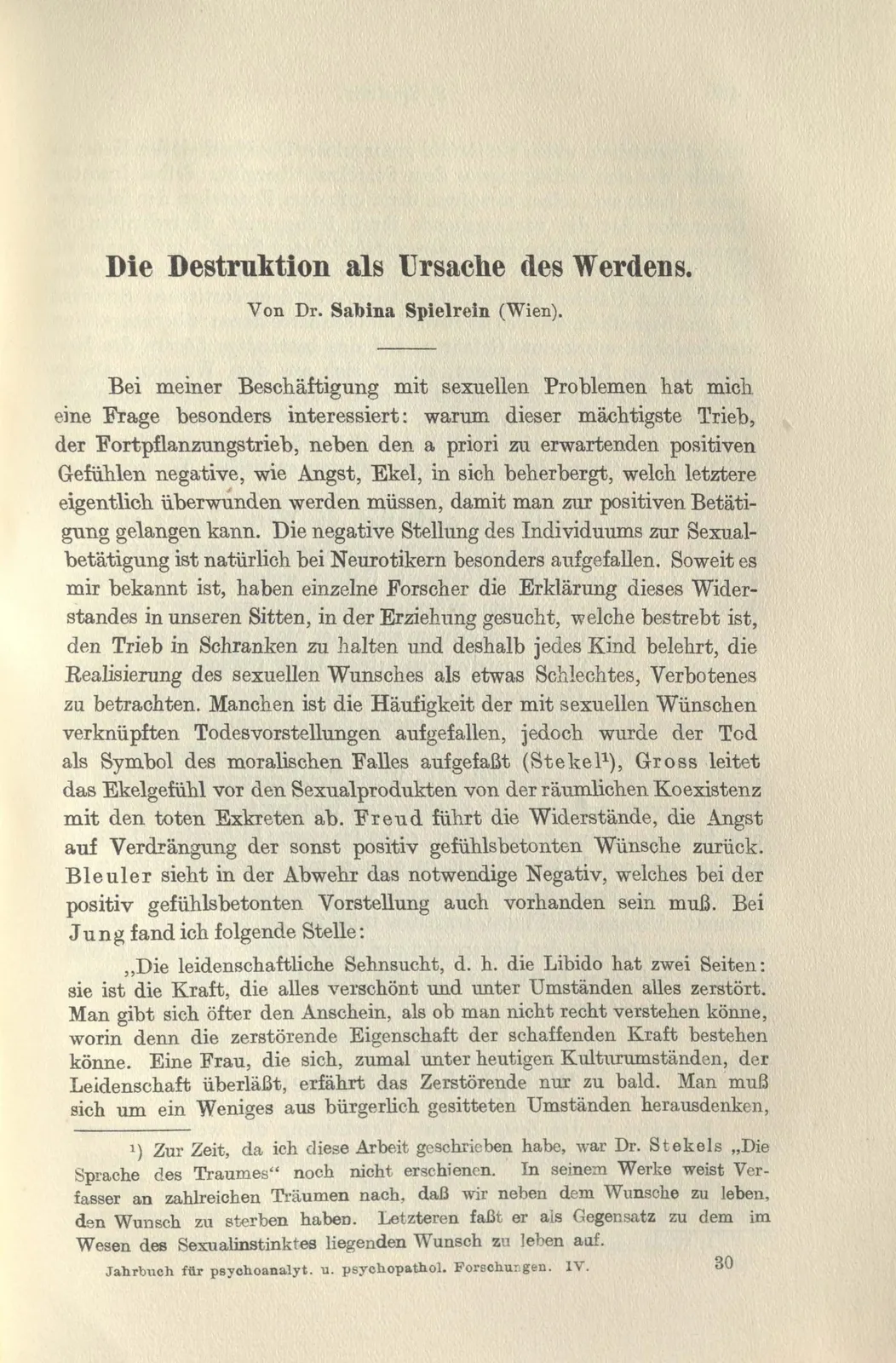
Spielrein’s best-known paper starts from a question that earlier analysts, among them Stekel, Gross, Freud and Bleuler, had touched on: why does the reproductive drive, the strongest of the drives, bring with it anxiety and disgust as well as pleasure? In a first part, drawing on biology and individual psychology, she argues that reproduction requires the individual to dissolve: the drive to preserve the species expresses itself psychically in a dissolution in which the “I” passes into a “we”, and so it works against the drive of self-preservation. The reproductive drive demands destruction from the individual, and its destructive urge gains in tension when it is left unsatisfied; destruction can be carried out symbolically so as to escape it in reality, and self-destruction can be replaced by the destruction of a victim. A second part offers samples from mythology to show that becoming arises from destruction, and the paper concludes that the reproductive drive consists, psychologically too, of two antagonistic components, as much a drive of destruction as of becoming. Spielrein notes that Jung sets ideas of death in opposition to sexual ideas, whereas she places destruction within sexuality itself. In Beyond the Pleasure Principle (1920) Freud acknowledged that she had anticipated part of his speculation on the death drives.
- Published
- 1912
- In
- Jahrbuch für psychoanalytische und psychopathologische Forschungen 4 (1): 465–503
- Language
- German