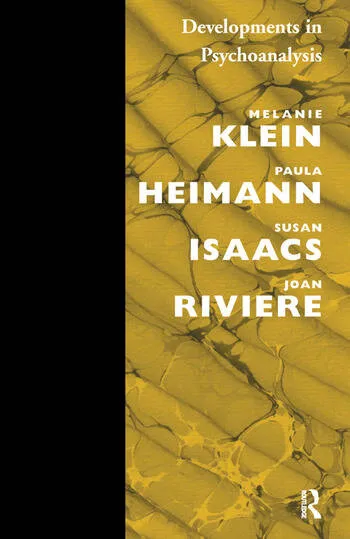
Book
Developments in Psycho-Analysis
A collection of papers by Melanie Klein, Paula Heimann, Susan Isaacs and Joan Riviere, edited by Riviere with a preface by Ernest Jones and published by the Hogarth Press in 1952. The publisher presents it as a survey of the advances in psychoanalytic knowledge that came from Klein's work, whose main discoveries concern the earliest phases of mental life. Its central thesis is that unconscious feeling and impulse, called phantasy, is the source of all human behaviour, however much it is changed on its way into outward action or conscious thought. On this account Freud first stated the idea but left problems open, and Klein's steady attention to unconscious phantasy brought them nearer to a solution. After a general introduction, the chapters treat psychical conflict in earliest infancy (Riviere), the nature and function of phantasy (Isaacs), introjection and projection in early infancy, regression (Heimann and Isaacs), the emotional life of the infant, the observation of young infants' behaviour, anxiety and guilt, schizoid mechanisms (Klein), and the life and death instincts. Several began as papers of the Controversial Discussions or in the International Journal of Psycho-Analysis. The book is addressed to students of psychoanalysis, workers in related medical fields, child psychologists and the informed lay public.
Read more- Published
- 1952
- In
- London: Hogarth Press and the Institute of Psycho-Analysis (International Psycho-Analytical Library, no. 43); edited by Joan Riviere, with a preface by Ernest Jones
- Language
- English