Book
The Trauma of Birth
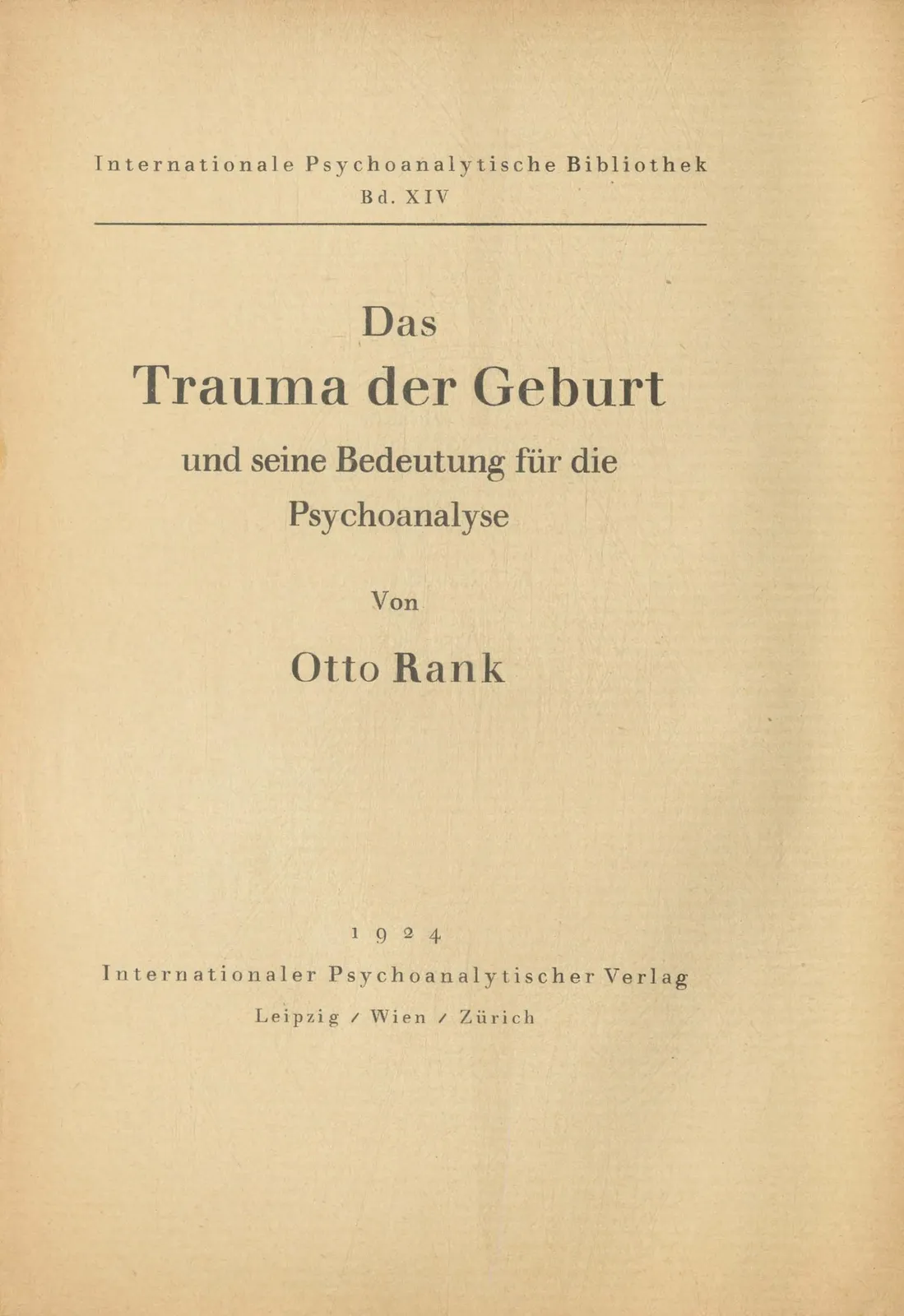
Das Trauma der Geburt und seine Bedeutung für die Psychoanalyse
Otto Rank's *Das Trauma der Geburt und seine Bedeutung für die Psychoanalyse* (1924; English: *The Trauma of Birth*) was written in April 1923 and dedicated to Freud for his birthday on 6 May 1923. Rank presents it as a consistent extension of Freud's method. Following the analytic material down to its deepest layer, he arrives at the separation from the mother at birth. He calls it the "primal trauma" (Urtrauma) and the ultimate biological substrate of the psychical. His starting point is the analytic situation. In the dreams of the final phase of treatment, patients regularly represent the detachment from the analyst as a birth. The transference libido is at bottom maternal, and the cure is the belated, at last successful mastering of the birth trauma (Preface; "Die analytische Situation"). The anxiety the newborn experiences is the first content of perception. Once it is anchored in the psyche, it forms the primal repression (Urverdrängung) that bars the libido from striving back to the pleasurable intrauterine state. Every later anxiety reproduces it, beginning with the child's fear of the dark and of being alone. The middle chapters follow the birth trauma through the individual and through culture. Birth is the "primal castration" (Urkastration). Weaning and castration repeat the separation, and the Oedipus complex is its third repetition. Infantile sexual theories, the perversions and coitus itself are partial returns to the womb. The neuroses reproduce birth or the fetal state, as in hysterical conversion symptoms, phobias, obsessional brooding on origins and death, and the alternation of melancholia and mania. Psychosis is a failed attempt at cure. Under the heading of "symbolic adaptation", Rank finds the womb again in sleep and dreams and in the house, the temple, the city and the state. It returns in the hero, who overcompensates a severe birth, and in fairy tales and paradise myths. Religions move from mother goddesses and anxiety to a father god and guilt. Rank derives art from the sculptural reproduction of the maternal vessel and of one's own coming into being. Its Greek form idealizes the detachment of the human body from the animal mother (the Sphinx, the centaurs, Prometheus, the Trojan horse). Philosophy circles the same problem: Thales' water as the womb of all things, Plato's Eros and cave, and Kant's thing-in-itself. Socrates, the midwife's son, is in Rank's account the forerunner of analytic therapy. The two concluding chapters draw the theoretical and clinical consequences. Breuer's original discovery was that symptoms depend on forgotten traumas and on "conversion". Rank links it to the birth trauma, so that conversion becomes identical with the emergence of the psychical out of bodily innervation. The truly unconscious, Freud's Es, is "the embryonic that lives on unchanged in the growing ego". The primal fantasies (castration, the primal scene, Oedipus) have a real prenatal substrate. Rank therefore finds Jung's appeal to inherited phylogenetic memory unnecessary. The death drive and the compulsion to repeat aim at restoring the state before birth. Woman can reproduce the primal situation in pregnancy and childbirth. Man must compensate through identification with the mother and through cultural creation. From this Rank explains both the male character of culture and the social disparagement of women as consequences of primal repression. In therapy the analyst acts as a "midwife". The patient should not reproduce the birth trauma unconsciously at the parting from the analyst. Instead, the analyst should uncover it early in the transference and work it through, with a fixed end to the treatment. Analysis cannot change the unconscious itself, only the ego's attitude toward it. The neurotic has "got stuck a little earlier, in the birth trauma". Culture, art and above all psychoanalysis are more or less successful attempts to overcome it.
Read more- By
- Otto Rank
- Published
- 1924
- In
- Internationale Psychoanalytische Bibliothek
- Language
- German