Book
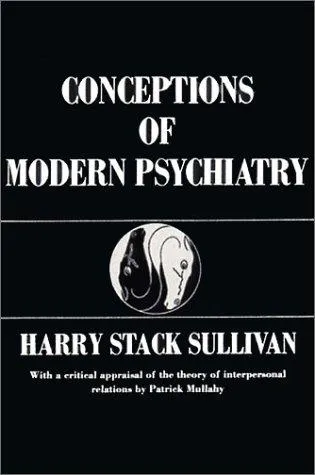
Conceptions of Modern Psychiatry
Conceptions of Modern Psychiatry is Harry Stack Sullivan's text of the first William Alanson White Memorial Lectures, given in Washington in the autumn of 1939 and printed in the journal Psychiatry in February 1940; the book of 1947 adds a foreword by the author and Patrick Mullahy's extended exposition of the theory. It was the only general statement of Sullivan's theory published in his lifetime. The first lecture traces psychiatry's double descent, from medicine and from the social traditions of healers and sages, credits Freud, Adolf Meyer and William Alanson White with the move toward a complete psychiatry, and defines the field as the study of interpersonal relations, which the psychiatrist can know only as a participant observer. Conduct is organised around the pursuit of satisfactions, tied to the body, and of security, tied to culture. Anxiety, first caught empathically from the disapproval of the adults who care for the infant, shapes the self-dynamism: built from the appraisals of others, it controls what enters awareness, and what it cannot admit persists as dissociated. The second and third lectures follow the person's growth within a necessary environment of others, through infancy, childhood, the juvenile era, preadolescence, with its first love for a chum of the same sex and the consensual validation it brings, and adolescence. They then sketch ten developmental syndromes, among them the self-absorbed, the incorrigible, the negativistic, the ambition-ridden, the asocial, the inadequate and the chronically adolescent person, offered as better guides to a person's future than the categories of mental disease. The fourth lecture explains mental disorder as patterns of interpersonal process: parataxic distortion of situations; the substitutive states, such as obsessional, hypochondriacal and paranoid conditions; panic as the collapse of the self's power to dissociate; and schizophrenic states, which Sullivan distinguishes from dementia praecox and holds to depend on the situation for their outcome. The fifth lecture derives therapy from Freud, Meyer and White. It presents the interview as a situation both parties shape, whose work is to bring into the patient's awareness what anxiety has kept out, leading to insight into parataxic distortions, including those directed at the psychiatrist. In the foreword Sullivan calls the developmental sketch the weakest part, admits that his accounts of anxiety, the self and selective inattention are inadequate, and attacks the "delusion of unique individuality".
- Published
- 1940
- In
- Psychiatry: Journal of the Biology and Pathology of Interpersonal Relations, vol. 3, no. 1 (February 1940)
- Language
- English