Book
Borderline Conditions and Pathological Narcissism
Kernberg's first book gathers and reworks the papers he wrote in the late 1960s and early 1970s, largely out of his clinical and research work at the Menninger Foundation, into a single account of the patients who fall between the neuroses and the psychoses. Its first part argues that these patients have a borderline personality organization: a specific and stable structure, not a passing state on the way to psychosis. Behind a wide range of symptoms (diffuse anxiety, multiple phobias, perverse and impulsive trends, addictions, lower-level character disorders) Kernberg finds a common structure: nonspecific ego weakness, a pull toward primary-process thinking, primitive defences centred on splitting, and a pathology of internalized object relations that leaves the patient without an integrated identity, while reality testing is largely kept. He traces it to excessive early aggression, especially oral aggression, which prevents the loving and hating images of self and others from being brought together and draws pregenital conflicts into the oedipal ones. The book draws practical conclusions from this. It weighs the factors that make the prognosis better or worse, and sets out an expressive psychoanalytic psychotherapy for most of these patients: the primitive defences are confronted and interpreted as they emerge in the transference, the negative transference is taken up in the here and now, and acting out is limited, with the patient's life structured from outside when necessary. A chapter on countertransference argues for treating the analyst's whole emotional response as a source of knowledge about such patients. The second half turns to the narcissistic personality, which Kernberg sees as a special form of the same organization, its surface held steady by a pathological grandiose self that fuses the real self, the ideal self and the ideal object and wards off envy, rage and dependence. He distinguishes it from normal adult and normal infantile narcissism, describes its idealizing and devaluing transferences, recommends psychoanalysis proper with systematic interpretation of the grandiose self for those who do not function at an overt borderline level, and sets his views against Heinz Kohut's.
Main ideas
- Borderline personality organization is a specific, stable pathological structure lying between the neurotic and the psychotic levels, not a transitional state on the way to psychosis.
- It is diagnosed by structure rather than symptoms: nonspecific ego weakness (poor anxiety tolerance, impulse control and sublimation), a shift toward primary-process thinking, primitive defences and identity diffusion, with reality testing largely preserved.
- Splitting, the active keeping apart of all-good and all-bad images of self and others, is the central defence, supported by primitive idealization, projective identification, denial, omnipotence and devaluation.
- The organization is understood through internalized object relations: units of self-image, object-image and affect that, in these patients, remain split instead of being integrated into a coherent self and stable images of others.
- Excessive early aggression, especially oral aggression, whether constitutional or provoked by frustration, blocks the integration of loving and hating images and condenses pregenital conflicts with oedipal ones.
- Most borderline patients are best treated by an expressive psychoanalytic psychotherapy that confronts and interprets primitive defences and the negative transference in the here and now, limits acting out, and adds external structure when needed.
- Prognosis depends on structural features such as the degree of ego weakness, the quality of object relations, superego integration and the presence of antisocial traits.
- Countertransference is best understood broadly, as the analyst's whole emotional response to the patient, and with borderline patients it is an especially valuable source of information about their primitive transferences.
- The narcissistic personality is a special form of borderline organization stabilized by a pathological grandiose self, a fusion of the real self, the ideal self and the ideal object that defends against envy, rage and dependence.
- Pathological narcissism differs in kind from both normal adult and normal infantile narcissism; it is a defensive structure, not a developmental stage that has been arrested, a view Kernberg sets against Kohut's.
- Narcissistic patients who do not function at an overt borderline level can be treated by psychoanalysis proper, in which the grandiose self, the idealizing and devaluing transferences, and the envy behind them are systematically interpreted.
What it shows
- 1967
Otto F. Kernberg introduced Borderline personality organization
Kernberg set out borderline personality organization in his 1967 paper as a stable structure between neurosis and psychosis, defined by identity diffusion, primitive defences and preserved reality testing, and expanded it in Borderline Conditions and Pathological Narcissism (1975).
- 1967
Otto F. Kernberg developed Splitting
Kernberg made splitting, the active keeping apart of all-good and all-bad images of self and others, the central defence of borderline organization, and tied it to a failure to integrate early object relations.
- 1975
Otto F. Kernberg developed Projective identification
Kernberg counted projective identification among the primitive defences of borderline patients, who put into others what they cannot bear in themselves while still feeling it and trying to control the other, and he used it to read their transferences.
- 1975
Otto F. Kernberg developed Narcissism
Kernberg distinguished normal from pathological narcissism, traced a gradient of severity from normal infantile narcissism to the narcissistic personality, and explained pathological narcissism as a defensive structure rather than a stage of development that has been arrested.
- 1970
Otto F. Kernberg reworked Grandiose self
Kernberg described the grandiose self of narcissistic personalities as a pathological fusion of the ideal self, the ideal object and the actual self-image, built to ward off dependence and envy, against Kohut's view of it as a normal stage of development that had been arrested.
Show all 8 Show fewer
- 1965
Otto F. Kernberg developed Countertransference
Kernberg argued for a broad, "totalistic" view of countertransference as the analyst's whole emotional response to the patient, rather than only the analyst's own unresolved conflicts, and held it to be especially telling with borderline and other severely disturbed patients.
- 1974
Otto F. Kernberg disputed with Heinz Kohut
Kernberg and Kohut disagreed over narcissistic personalities: Kohut saw an arrested but normal line of narcissistic development to be allowed to unfold in the transference, while Kernberg saw a pathological, defensive structure laden with rage and envy that has to be confronted and interpreted.
Borderline personality organization derives from Splitting
The concept rests on the Kleinian notion of splitting: Kernberg made the predominance of splitting and related primitive defences the second defining feature of borderline organization.
Cited in
Gallery
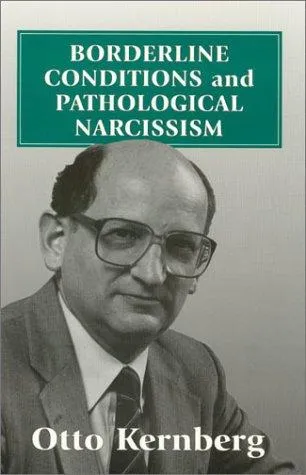
Cover of Borderline Conditions and Pathological Narcissism in Jason Aronson's Master Work Series, 1995