Person
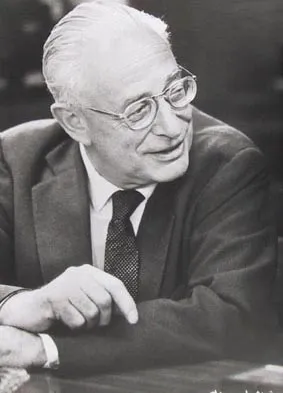
Michael Balint
Hungarian-born physician and psychoanalyst of the Budapest school. He was Sándor Ferenczi's pupil, successor and literary executor, emigrated to Manchester in 1939 and later worked in London, where he belonged to the British Society's Independent analysts. Against the theory of primary narcissism he held that the infant's first relation is a primary love for its surroundings; he later described the basic fault, benign and malignant regression and the ocnophil and philobat attitudes, and with Enid Balint created the case-discussion groups for general practitioners that bear his name.
Read more- Born
- 1896
- Died
- 1970
- Known for
- Influenced
- Margaret Mahler
analysed by
- Hanns Sachs 1921 Balint's first analysis, in Berlin, alongside Alice Balint. Dissatisfied with it, the couple went back to Budapest to finish their analyses with Ferenczi.
- Sándor Ferenczi 1924 After leaving Sachs, Balint finished his training analysis with Ferenczi in Budapest from the mid-1920s, and went on to become his pupil and closest successor.
introduced
- New beginning 1935 In his Lucerne congress paper of 1934, printed in 1935, Balint names the new beginning: towards the end of deep analyses patients again seek simple, pleasurable gratifications, all of them aimed at an object, and he counts this as an essential mechanism of cure.
- Primary love 1937 At the Budapest meeting of 1937 Balint gathers his own findings and those of Alice Balint and Imre Hermann into one thesis: a primary, or primitive, object love comes before any narcissism, every child must pass through it, and all later relations keep traces of it. He collected the papers on it in Primary Love and Psycho-Analytic Technique (1952).
- Balint group 1957 The Doctor, His Patient and the Illness (1957) reports the work of Balint's first discussion-cum-research seminars with general practitioners at the Tavistock Clinic. The training method it describes became known as the Balint group.
collaborated with
- Alice Balint 1939 Balint presents his work on early object relations as converging with Alice Balint's and Imre Hermann's, reached by separate paths. In 1939, from Manchester, the couple published a joint paper asking whether transference is the patient's work alone or whether the analyst's behaviour shares in it.
- Enid Balint 1950 In London, Balint took up again his project of putting psychoanalysis at the service of general practitioners, now with Enid Balint, whom he later married. They co-wrote Psychotherapeutic Techniques in Medicine (1961).