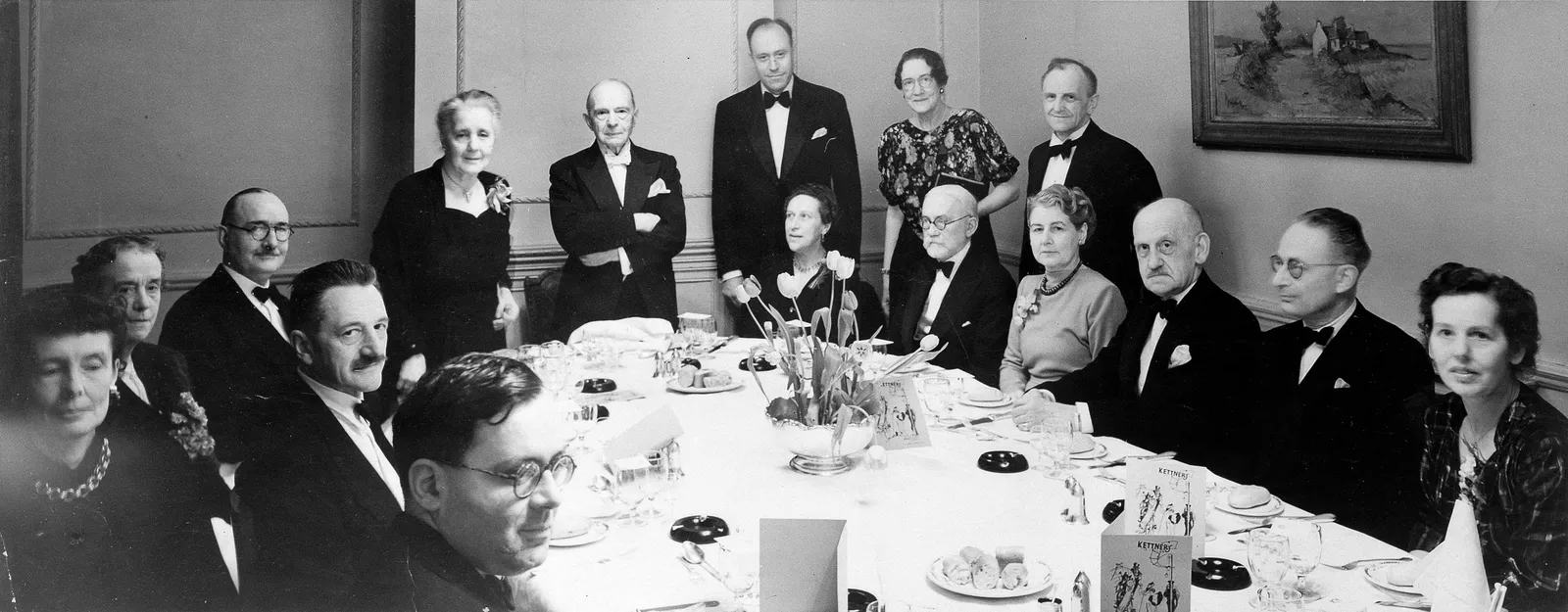
Person
Herbert Rosenfeld
German-born British psychoanalyst of the Kleinian school. He trained in medicine in Munich, fled Nazi Germany for Britain in 1935 and qualified as an analyst in 1945 after an analysis with Melanie Klein. With Hanna Segal and Wilfred Bion he pioneered the psychoanalytic treatment of schizophrenic patients by interpretation alone, describing their psychotic transference, confusional states and use of projective identification. His best-known contribution is his theory of pathological narcissism: omnipotent narcissistic object relations, and a destructive narcissism in which idealized destructive parts of the self, organized like a gang, attack the dependent self. In his last book, Impasse and Interpretation (1987), he turned to the analyst's part in therapeutic impasse and distinguished thick-skinned from thin-skinned narcissistic patients.
Read more- Born
- 1910
- Died
- 1986
- Influenced
analysed by
- Melanie Klein 1942 Rosenfeld began his training analysis with Melanie Klein in 1942 and qualified at the British Psycho-Analytical Society in 1945; his first training case became his 1947 paper on depersonalization.
developed
- Projective identification 1947 Rosenfeld's 1947 case was the first clinical paper to use Klein's newly named projective identification, and he later sorted its forms by motive: communicative projections the analyst can contain, as against evacuative and controlling ones aimed at denying separateness and dependence.
- Psychotic transference Against the view that psychotic patients form no transference, Rosenfeld analysed schizophrenic patients without changing the classical setting and showed that they form an intense transference, in which the analyst is treated as the bearer of the patient's projected parts; he called it the transference psychosis and made its interpretation the core of his technique.
introduced
- Confusional states 1950 Rosenfeld's 1950 paper described the confusional states of chronic schizophrenia as a failure of the normal splitting of good and bad objects, so that love and hatred and the good and bad self become mixed up; Klein took the idea into Envy and Gratitude.
- Narcissistic object relations 1964 Rosenfeld's 1964 paper described narcissism not as withdrawal from objects but as an omnipotent relation to them, in which the object's goodness is appropriated by introjection and the self's unwanted parts are projected into it, so that separateness, dependence and envy are denied.
- Destructive narcissism 1971 In his 1971 congress paper Rosenfeld set the destructive aspect of narcissism beside the libidinal one he had described in 1964: an idealization of the omnipotent destructive parts of the self, organized like a gang against the dependent self. He returned to it in the chapter on destructive narcissism and the death instinct in Impasse and Interpretation (1987).