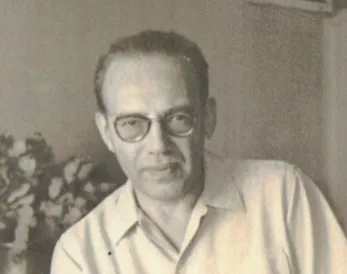
Person
Heinrich Racker
Psychoanalyst born in Galicia and raised in Vienna, where he trained before fleeing Nazism to Buenos Aires in 1939; there he became a leading training analyst of the Argentine Psychoanalytic Association. He made countertransference a central instrument of technique, understanding it as the whole of the analyst's psychological response to the patient, and distinguished concordant from complementary identifications in the analyst. His papers were collected in Estudios sobre técnica psicoanalítica (1960), published in English as Transference and Countertransference (1968).
Read more- Born
- 1910
- Died
- 1961
- Influenced
- Horacio Etchegoyen
introduced
- Countertransference neurosis 1948 Racker's 1948 paper to the Argentine Psychoanalytic Association, 'La neurosis de contratransferencia', published in English in 1953 as 'A Contribution to the Problem of Counter-Transference', traced how the analyst's infantile conflicts persist in a countertransference neurosis. When he returned to the term in 1957 he cited Margaret Little's 1951 paper beside his own.
- Concordant identification 1957 Racker named the analyst's identification of each part of his personality with the corresponding part of the patient's (ego with ego, id with id, superego with superego) 'concordant' or 'homologous' identification. He did so in 'The Meanings and Uses of Countertransference', read to the Argentine Psychoanalytic Association in 1953 and published in 1957.
- Complementary identification 1957 Racker named the analyst's identification with the patient's internal objects 'complementary identification', adapting an expression of Helene Deutsch's. The analyst comes to feel treated as the object the patient projects onto him. He did so in 'The Meanings and Uses of Countertransference' (read 1953, published 1957).
developed
- Countertransference 1948 From his 1948 papers to the Argentine Psychoanalytic Association onward, Racker treated countertransference as a technical instrument for understanding the patient as well as a danger. In 1957 he argued for taking it as the totality of the analyst's psychological response, within which concordant and complementary identifications are distinguished. He reached this independently of Paula Heimann, who was working along similar lines.
analysed by
- Jeanne Lampl-de Groot Racker's first analysis, begun in Vienna while he trained at the Vienna Psychoanalytic Institute and broken off when he fled the Nazis.
- Ángel Garma In Buenos Aires Racker resumed his analysis, first with Garma, before his later training analysis with Marie Langer.
- Marie Langer Langer conducted Racker's later training analysis in Buenos Aires, after his analysis with Garma.