The graph of concepts, people and works

Drawing the graph…

psychopedia
Legend

Nodes

Relations

At rest every relation is a thin grey line. Its colour shows on hover and in focus.

Person

Ernest Jones

1879–1958

Also known as Alfred Ernest Jones

Welsh neurologist and psychoanalyst who led psychoanalysis in the English-speaking world, founding the British Psycho-Analytical Society and the International Journal of Psycho-Analysis and twice presiding over the International Psychoanalytical Association. A member of Freud's inner circle, he coined the term rationalization, championed Melanie Klein's work in London, and wrote the standard three-volume biography of Freud.

Ernest Jones (1879–1958) was a Welsh neurologist and psychoanalyst who led the establishment of psychoanalysis in the English-speaking world. A member of Sigmund Freud's inner circle from 1908, he worked in Toronto until 1913 and helped found the American Psychoanalytic Association. On his return to London he founded the London Psycho-Analytical Society and then, in 1919, the British Psycho-Analytical Society, which he led until 1944. He founded and edited the International Journal of Psycho-Analysis, directed the first systematic translation of Freud's works into English, and was twice president of the International Psychoanalytical Association. In 1938 he took a leading part in bringing Freud and his family from Vienna to London.

As a theorist Jones introduced the term rationalization in 1908 and the term aphanisis in 1927. He gave the classic psychoanalytic account of symbolism, and he turned Freud's brief remark on Hamlet into a full study of the Oedipus complex in literature. Drawing on Karen Horney and Melanie Klein, he opened the London side of the debate with Freud on female sexuality. He invited Klein to London in 1926 and defended her work against criticism from Vienna, which strained, without breaking, his loyalty to Freud. His three-volume The Life and Work of Sigmund Freud1 (1953–1957), written with the support of Freud's family and with access to unpublished letters, was for decades the standard life of Freud. Critics, among them Erich Fromm, contested its portrayal of Otto Rank and Sándor Ferenczi.

Life and training

Jones was born on 1 January 1879 at Gowerton, near Swansea, the son of Thomas and Mary Ann Jones. He was educated in Swansea and then, on a scholarship, at Llandovery College. He studied medicine at University College, Cardiff, and University College, London. He qualified in 1900 and the following year took the London MB with gold medals in medicine and obstetrics. Within five years he had added the MD, membership of the Royal College of Physicians and a diploma in public health. He specialised in neurology and held a number of posts in London hospitals, and a growing interest in Continental psychiatric literature led him to experiment with hypnosis in his clinical work.

Around 1906, with his friend the surgeon Wilfred Trotter, he came upon Freud's writings, and he learned German to read them. His London career was meanwhile broken by a series of setbacks. In 1906 he was charged with indecent assault on two girls he had interviewed as an inspector of schools for children then classed as mentally defective, and he was acquitted. In 1908 he was obliged to resign a hospital post after questioning a young patient about the sexual memory behind a hysterical paralysis without telling her consultant. In 1907 he met Carl Gustav Jung at a congress of neurologists in Amsterdam, and he spent time in Munich. He proposed the first international meeting of psychoanalysts, held at Salzburg in April 1908, where he read his paper on rationalization and met Freud for the first time; that spring he also visited Freud in Vienna with A. A. Brill.

Soon afterwards he left for Canada to head a newly founded psychiatric clinic in Toronto. There he taught psychiatry at the University of Toronto, where he became associate professor, and served as pathologist to the Toronto Asylum. His long relationship with Loe Kann, a Dutch woman who had first come to him as a patient in 1906, ended in 1913, by which time she was in analysis with Freud. At Freud's wish, Jones went that year into a short analysis with Ferenczi. He later described it as perhaps the first analysis an analyst undertook for his own sake, before training analysis existed (The Life and Work of Sigmund Freud1).

In February 1917 Jones married Morfydd Llwyn Owen, who died in September 1918. In 1919 he married Katherine Jökl of Vienna; he had four children. Proud of his Welsh origins, he joined the Welsh Nationalist Party, Plaid Cymru. He was elected a fellow of the Royal College of Physicians in 1942 and received an honorary doctorate of science from the University of Wales in 1954. He retired in 1946 to his cottage in Sussex. In his last years, though suffering from cancer of the bladder, he wrote the biography of Freud and began an autobiography. He died in London on 11 February 1958, and his ashes were laid in the grave of his eldest child at Cheriton, on Gower.

Career

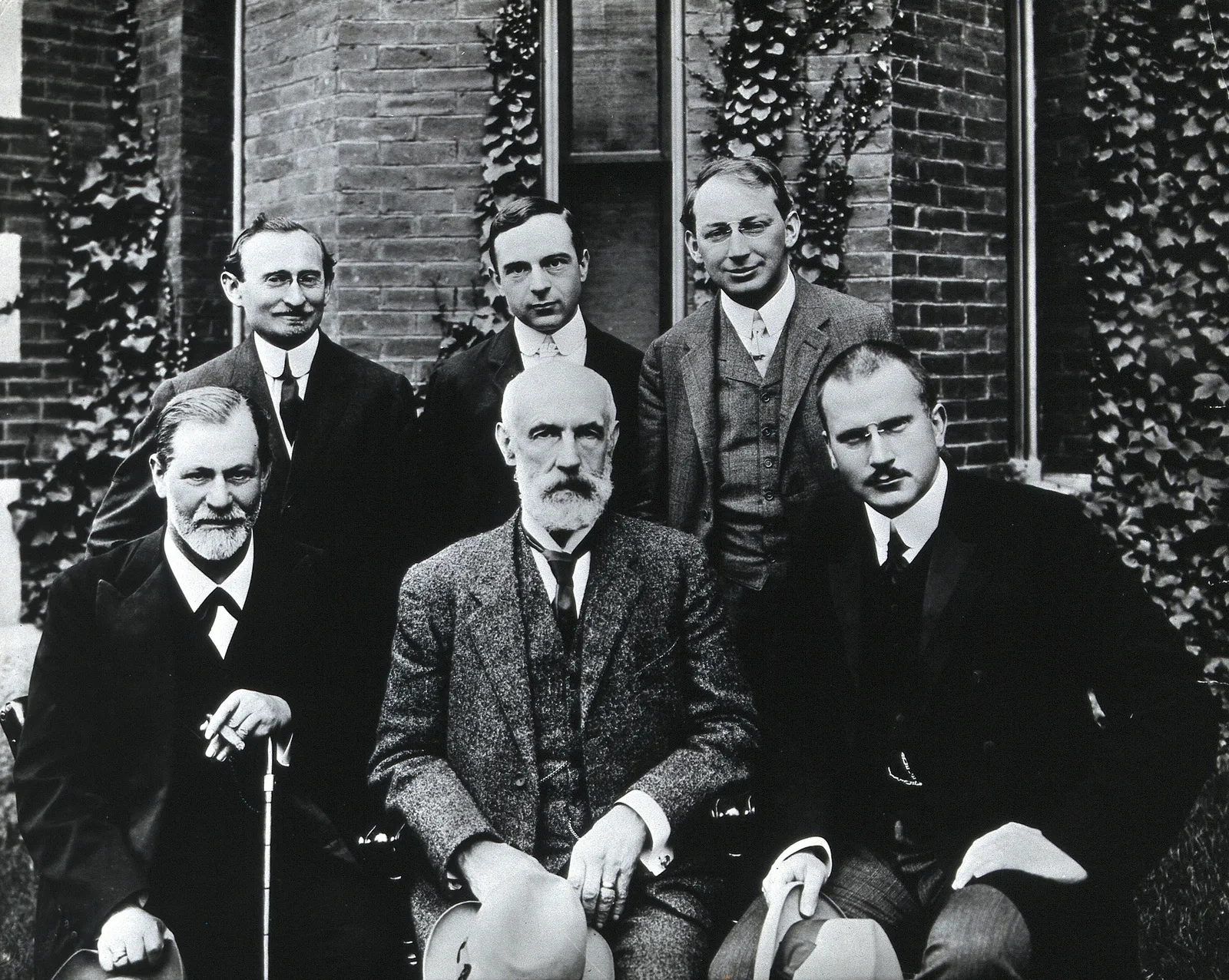
In North America Jones was assistant editor of Morton Prince's Journal of Abnormal Psychology. He published psychoanalytic papers there, among them Rationalization in Every-Day Life2 in 1908. He co-founded the American Psychopathological Association in 1910, and in 1911 he organised the American Psychoanalytic Association, serving as its first secretary until 1913. In September 1909 he was with Freud, Jung and Ferenczi at Clark University in Worcester, Massachusetts, where Freud lectured. Papers he had read to medical and psychological societies in Britain, Canada and the United States made up his first book, Papers on Psycho-Analysis3 (1913), one of the earliest presentations of Freud's work for English-speaking doctors.

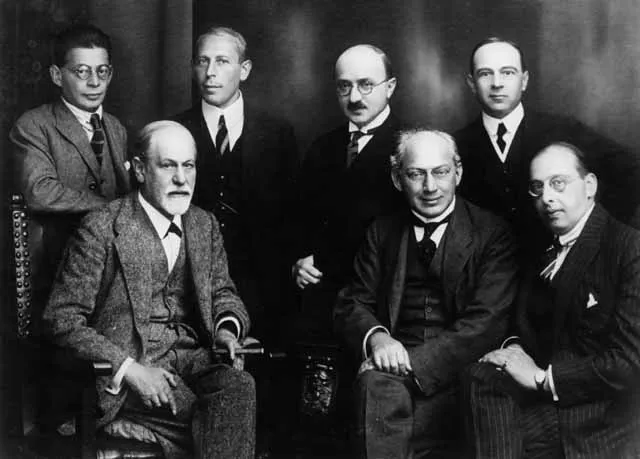
In 1912, out of a conversation with Ferenczi, Jones proposed a secret Committee of Freud's closest followers to guard the basic tenets of psychoanalysis. By 1922 its members were Ferenczi, Rank, Karl Abraham, Hanns Sachs, Max Eitingon and Jones himself. Jones later told the story of the Committee from the inside in his biography of Freud (The Life and Work of Sigmund Freud1).

Jones returned to London in 1913 with no prospect of a university or hospital post. He founded the London Psycho-Analytical Society that year, but later dissolved it because several of its leading members favoured Jung. In 1919 he founded the British Psycho-Analytical Society in its place and presided over it until 1944. He raised money for a clinic offering subsidised fees, the first psychoanalytic clinic in Britain, and founded the Institute of Psycho-Analysis to provide administrative, publishing and training facilities. In 1920 he founded the International Journal of Psycho-Analysis, which he edited until 1939, and from 1921 he edited the International Psycho-Analytical Library, which issued some fifty volumes. He obtained the English translation rights to Freud's works and coordinated a group of translators, among them James Strachey, Alix Strachey, Joan Riviere and John Rickman, in the first systematic English translation of Freud. Riccardo Steiner credits him with many of the English terms of Freud's technical vocabulary. In 1929 Jones's evidence to a committee of the British Medical Association led it to recommend that psychoanalysis be accepted as a form of treatment. He was president of the International Psychoanalytical Association from 1920 to 1924 and again from 1932 to 1949, when he was made its honorary president.

Klein lectured in London in 1925, and at Jones's invitation she settled there in 1926. Her analyses of young children shaped his own views on female development and the early Oedipus complex (The Early Development of Female Sexuality4). In May 1927 the British Society held a symposium on child analysis that answered the views of Anna Freud, with Jones siding with Klein; the dispute foreshadowed the later Controversial Discussions. Freud accused Jones of orchestrating a campaign against him and his daughter, and cordial relations returned only later, after exchange lectures that Jones arranged with Anna Freud. In the early 1940s, when the conflict between the followers of Klein and of Anna Freud came to a head in the British Society, Jones sought to mediate between them. Illness and the difficulty of wartime travel kept him from most of the meetings, and he resigned the presidency in 1944. Under the presidency of Sylvia Payne a compromise was then reached that set up parallel training courses for the followers of Klein, the followers of Anna Freud and a non-aligned Middle or Independent Group.

After the Anschluss of 1938 Jones flew to Vienna and helped negotiate the emigration of Freud and his family. To obtain British permits he drew on his personal relationship with the Home Secretary, Sir Samuel Hoare, a fellow member of his London skating club. In these years he also helped nearly fifty endangered analysts, many of them Jewish, to resettle in England and other countries.

Theory

Jones's first theoretical paper, read at Salzburg in 1908, brought the term rationalization into psychoanalysis. Starting from Freud's demonstration that many mental processes have causes the person neither knows nor will admit, he sorted the mechanisms that hide these causes into two classes. In the first the person holds that no explanation is needed, as when slips and chance actions are put down to accident. Jones read the resistance to asking where such acts come from as a sign that their source is unacceptable, and so brought parapraxes into the same scheme. In the second class the person supplies a plausible but false explanation, because everyone needs to give a connected and rational account of themselves. False explanations formed mainly for oneself he called evasions; those formed with an eye to the opinion of one's circle he called rationalisations (Rationalization in Every-Day Life2). The paper became the opening chapter of Papers on Psycho-Analysis. That book's other papers contrast psychoanalysis with suggestion, which in Jones's account works through a transference of positive feeling onto the physician and replaces symptoms with dependence. They also set out Freud's theory of dreams, of the neuroses and of sublimation, and treat neurotic symptoms as failed or imperfect sublimations (Papers on Psycho-Analysis3).

In 1910, in the American Journal of Psychology, Jones worked up into a full study a hypothesis Freud had sketched in a footnote to The Interpretation of Dreams5: that Hamlet's delay springs from the Oedipus complex. He reviewed the critical literature and rejected explanations from Hamlet's temperament or from external obstacles, describing Hamlet's state as a "specific aboulia", an inability to will one particular act. By killing Hamlet's father and marrying his mother, Claudius had carried out Hamlet's own repressed wishes, so the duty to kill him was bound up with those wishes and inhibited along with them. Jones also placed the story among the hero myths studied by Rank and Abraham, and linked the play to the death of Shakespeare's father in 1601 (The Œdipus-Complex as an Explanation of Hamlet's Mystery6). He later expanded the essay, eventually into the book Hamlet and Oedipus (1949).

The Theory of Symbolism7 (1918) expanded a lecture given to the British Psychological Society in 1916. It reserved the term symbolism for one kind of indirect representation, the unconscious kind, as distinct from metaphor, simile and emblem. Modifying criteria proposed by Rank and Sachs, Jones held that a true symbol represents unconscious material, keeps a nearly constant meaning, is not determined by individual factors alone, and has parallels in myth, cult and religion. The symbols run into thousands, but the ideas they stand for are few: the bodily self, the closest relatives, and birth, love and death. Against Jung, he argued that symbols are recreated by each individual rather than inherited ready-made. His touchstone was that only what is repressed is symbolised, and only the repressed needs to be. On these grounds he rejected the "functional" and "anagogic" readings of Herbert Silberer and Jung, which take abstract tendencies for the meaning of a symbol; in his view they diluted the concept and, in treatment, often served resistance. In metaphor, he concluded, feeling is over-sublimated; in the true symbol it is under-sublimated.

The Early Development of Female Sexuality4, read at the Innsbruck Congress on 1 September 1927, opened by endorsing Horney's warning that analytic views of early female development were distorted by bias. Jones suggested that male analysts had taken an unduly phallocentric view that underrated the female organs. He argued that castration is only a partial threat, and proposed the name aphanisis for the total and permanent extinction of the capacity and opportunity for sexual enjoyment. This, he held, is the fundamental dread of both sexes and underlies all the neuroses; in this way he recast the castration complex as one special case of a wider fear. The sexes differ in how they imagine aphanisis: the boy as castration, the girl, more dependent on her partner, as separation and desertion. Drawing on Klein's analyses, he described direct transitions from the oral stage to the Oedipal situation in girls. He distinguished a pre-Oedipal from a post-Oedipal penis envy, the latter a regressive defence against the privation of the girl's incestuous wishes. He also suggested that the phallic phase Freud described in girls was a secondary, defensive formation rather than a true developmental stage. The same paper proposed that guilt and the super-ego are built up from within, to protect the child from the stress of ungratified libido, and that the child exploits external disapproval rather than simply submitting to it.

Though he remained loyal to Freud, Jones differed from him on female sexuality, on lay analysis, on telepathy and on the merits of Klein's work. In the biography he was sceptical of the death drive but valued Inhibitions, Symptoms and Anxiety and Freud's later theory of the ego (The Life and Work of Sigmund Freud1).
The biography of Freud

Jones's biography of Freud appeared from the Hogarth Press in three volumes: The Formative Years and the Great Discoveries, 1856–1900 (1953), Years of Maturity, 1901–1919 (1955) and The Last Phase, 1919–1939 (1957). Freud's family opened to him letters and papers no outsider had seen, among them the letters to Martha Bernays and to Wilhelm Fliess. His wife translated much of the early correspondence, and Anna Freud supplied material from the archive. Jones set himself two aims. The first was to record the facts of Freud's life while they could still be checked, against the legends already gathering. The second was to relate Freud's personality to the growth of his ideas, since in his view psychoanalysis could be understood only as a historical development bound up with its founder.

He traced the principles of Freud's psychology to Brücke and the Helmholtz school of physiology rather than to Charcot or Breuer, and he was critical of Freud's enthusiasm for cocaine. He held that Freud suffered a considerable psychoneurosis in the 1890s, which the self-analysis begun in 1897 worked through, and he regarded The Interpretation of Dreams as Freud's greatest and most original book. He explained the breaks with Adler, Stekel and Jung as a return of resistance presenting itself as new theory, and he attributed the departures of Rank and Ferenczi, and the end of the Committee, chiefly to their failing mental health. Writing as both biographer and participant, he recorded Freud's secretiveness, his indiscretion and his poor judgement of people alongside his integrity and courage, and he told his own part in the founding of the Committee and in the emigration of 1938 (The Life and Work of Sigmund Freud1). A one-volume abridgement by Lionel Trilling and Steven Marcus appeared in 1961.
Influence and reception

Riccardo Steiner, in the International Dictionary of Psychoanalysis, calls Jones "the finest organizer and politician in the first generation of Freud's followers", and writes that before the Second World War he effectively ruled psychoanalysis in England. His term rationalization was taken up by Freud and has remained part of the vocabulary of psychoanalysis (Rationalization in Every-Day Life2). The Theory of Symbolism became the standard reference for the strict psychoanalytic concept of the symbol, and Klein and later Hanna Segal built on it in their accounts of symbol formation (The Theory of Symbolism7). His 1927 paper, with the work of Horney, Helene Deutsch and Klein on which it drew, set the London position against the Vienna view in the debate on female sexuality. Jones and these analysts argued for a primary femininity, against Freud's account of the girl's phallic phase (The Early Development of Female Sexuality4). His reading of Hamlet, begun in 1910, carried Freud's hint about the play into a full literary analysis, which he went on revising for four decades.

The biography was published to wide acclaim and for decades stood as the standard life of Freud, valued above all for the documents it first made public. It also drew criticism. In 1958 Erich Fromm publicly contested its claim that Rank and Ferenczi had become psychotic, citing testimony from people close to Ferenczi in his last years, and in Sigmund Freud's Mission (1959) he criticised Jones's picture of Freud. Later critics objected to the book's partisanship towards the dissenters, and historians have questioned some of its stories, among them Jones's account, based on what Freud told him privately, of the end of Breuer's treatment of Anna O. (The Life and Work of Sigmund Freud1).
Selected works

Jones published more than three hundred papers and about a dozen books. His first book, Papers on Psycho-Analysis3 (1913), was revised in later editions; the second, of 1918, added The Theory of Symbolism, and Jones re-edited the book in 1948. His papers include Rationalization in Every-Day Life2 (1908), The Œdipus-Complex as an Explanation of Hamlet's Mystery6 (1910), The Theory of Symbolism7 (1918) and The Early Development of Female Sexuality4 (1927). Among his later books are On the Nightmare (1931), Hamlet and Oedipus (1949) and The Life and Work of Sigmund Freud1 (three volumes, 1953–1957). His unfinished autobiography, Free Associations, was published in 1959, the year after his death.

Ideas

introduced

  • 1908 Rationalization
    Jones coined the term in a paper first given in 1908 and later reprinted as the opening chapter of his Papers on Psycho-Analysis; Freud and the later literature adopted it.
  • 1927 Aphanisis
    Proposed in his paper at the Innsbruck Congress of 1927.

developed

  • 1908 Parapraxis
    Jones takes the insistence that a slip or chance action had no cause, or was due to chance or inattention, as one of the ways a person keeps the source of a mental process out of consciousness; the resistance to asking where it came from signals that the source is unacceptable. Analysis, he holds, always finds a precise cause.
  • 1910 Oedipus complex
    Jones extended Freud's brief remark on Hamlet in The Interpretation of Dreams into a full study, an early and influential application of the Oedipus complex to literature, later expanded as Hamlet and Oedipus (1949).
  • 1918 Symbolism
    Jones's paper gave the classic account of 'true symbolism', setting it apart from metaphor and from the broader usage of Jung and Silberer.

critiqued

  • 1927 Phallic phase
    Jones's challenge opened the 'London' side of the debate on female sexuality against Freud's Vienna view.

reworked

  • 1927 Castration complex
    Jones recast castration fear as one special case of a more basic dread shared by both sexes.

Influence

Affinity

  • 1912 collaborated with Sigmund Freud
    Jones proposed the secret Committee of Freud's closest followers in 1912 and remained one of Freud's chief allies, later helping him and his family escape Vienna in 1938.
  • 1912 collaborated with Sándor Ferenczi
    The Committee grew out of this conversation; Jones and Ferenczi were among its founding members.
  • 1927 influenced by Melanie Klein
    Jones invited Klein to London in 1926; her early analyses of children shaped his views on female development and the early Oedipus complex.
  • 1927 influenced by Karen Horney
    Jones opened his paper on female sexuality by endorsing Horney's charge that analytic views of early female development were distorted by bias.

Lineage

  • 1913 analysed by Sándor Ferenczi
    Jones described this as perhaps the first analysis an analyst undertook for his own sake, before training analysis existed.

Conflict

  • 1927 disputed with Sigmund Freud
    A loyal ally who still differed from Freud on female sexuality, lay analysis, telepathy and the merits of Klein's work.
  • 1927 disputed with Anna Freud
    The dispute turned on child analysis: in May 1927 Jones's British Society held a symposium answering Anna Freud's views, with Jones siding with Melanie Klein; it foreshadowed the later Controversial Discussions.
  • 1958 disputed with Erich Fromm
    In 1958 Fromm publicly contested the claim in Jones's biography of Freud that Rank and Ferenczi had become psychotic, drawing on testimony from people close to Ferenczi in his last years, and in Sigmund Freud's Mission (1959) he criticized Jones's account of Freud.

Works

  • 1908

    Rationalization in Every-Day Life

    Ernest Jones read this paper at the first psychoanalytic congress, in Salzburg in April 1908, and printed it that summer in Morton Prince's Journal of Abnormal Psychology. It is where the term ‘rationalisation’ enters psychoanalysis. Jones starts from Freud's demonstration that many mental processes, in the normal as in the ill, have causes the person neither knows nor will admit. He sorts the mechanisms that hide these causes into two classes. In the first class the person holds that a thought or act needs no explanation. Slips and chance actions are put down to accident. Choices shaped by hidden motives or by custom, such as a number picked ‘freely’ or a tie worn every day, are claimed as acts of will, so that asking where they come from seems absurd. Jones reads this resistance to inquiry as a sign that the real source is unacceptable, and finds it behind many fixed religious, ethical and political beliefs. In the second class the person offers an explanation, but a false one, because everyone needs to give a connected and rational account of themselves. False explanations formed mainly for oneself he calls evasions; those formed with an eye to the opinion of one's circle he calls rationalisations. There is no sharp line between them. His examples are a young man who believes he chose his family's sect after weighing the evidence, and physicians who still prescribe valerian for hysteria. The remedy was once justified by the theory of the wandering womb and is now explained as an ‘antispasmodic’. Jones closes by arguing that the new psychology will show how opinions are formed and how true but unwelcome ideas can best be spread, since restating the evidence is not enough.

    Ernest Jones The Journal of Abnormal Psychology Copyright Life + 70 years In copyright The last author or translator died in 1958; protected through 2028.United States Public domain Published in 1908; public domain since 2004.

  • 1910

    The Œdipus-Complex as an Explanation of Hamlet's Mystery: A Study in Motive

    Ernest Jones's 1910 paper in The American Journal of Psychology develops at length a hypothesis Freud had sketched in a footnote to The Interpretation of Dreams (1900), which Jones notes had not been critically discussed since. Jones surveys the large, mostly German, body of criticism on why Hamlet delays avenging his father. He sorts the explanations into three groups: a temperament unfit for action (Goethe, Schlegel, Coleridge); external obstacles that make the task nearly impossible (Klein, Werder); and some feature of the task that makes it repugnant to Hamlet. Against the first two he argues from the play itself. Hamlet acts decisively in everything except the revenge, and the Laertes episode shows how readily the people could have been turned against Claudius. Jones concludes that Hamlet at heart does not want to do the deed and does not know why. The shifting pretexts he offers are rationalisations, and his state is a 'specific aboulia', an inability to will one particular act. Ethical or religious scruples would be open to introspection, so the hidden motive must be a repressed 'natural' trend. Jones identifies it as the Œdipus complex: a childhood wish to take the father's place in the mother's affection. By murdering the father and marrying the mother, Claudius has carried out Hamlet's own repressed wishes, so denouncing and killing him would mean facing them. The duty to kill the uncle is bound up with the repressed impulse to kill the mother's husband, and is inhibited along with it. Jones reads Hamlet's revulsion from Ophelia, his disgust at his mother's sexuality and his hostility to Polonius in the same light. He then places the story among the hero myths studied by Rank and Abraham, in which a son displaces a rival father. Using the mechanisms of 'decomposition' and 'doubling', he reads Claudius, Polonius, Laertes, Fortinbras and others as split-off aspects of the parental or heroic figures. Comparing the play with Saxo Grammaticus and Belleforest, he notes two changes Shakespeare made: the murder becomes secret, removing the external obstacles, and the hero now hesitates. Together they turn a tale of outward adventure into one of inner conflict. Jones links this change to the death of Shakespeare's father in 1601, shortly before the play was written. He holds that hero, poet and audience are all moved by a conflict whose source none of them knows. Jones later expanded the essay, eventually into the book Hamlet and Oedipus (1949).

    Ernest Jones The American Journal of Psychology Copyright Life + 70 years In copyright The last author or translator died in 1958; protected through 2028.United States Public domain Published in 1910; public domain since 2006.

  • 1913

    Papers on Psycho-Analysis

    Papers on Psycho-Analysis (London: Baillière, Tindall and Cox, 1913) was Ernest Jones's first book. It was one of the earliest presentations of Freud's work for English-speaking doctors. It collects twenty papers written between 1908 and 1912. Most were first read to medical and psychological societies in Britain, Canada and the United States, then revised and arranged under five headings: general papers, clinical papers, papers on treatment, papers on dreams and papers on education. In the preface Jones sets out the ideas he takes from Freud: the pleasure and reality principles, repression, sublimation, and the view of neurotic symptoms as failed or imperfect sublimations. He argues that much of the opposition to psychoanalysis comes from its subject matter, because uncovering the hidden roots of conduct offends people's aesthetic and rational image of themselves. He also says what the book leaves out: it gives no systematic theory of hysteria, obsessional neurosis or paranoia, and education is the only applied field it covers. The general papers introduce rationalisation, the inventing of plausible reasons for acts and beliefs whose real motives are unconscious. They also survey Freud's psychology. A third paper presents the psychopathology of everyday life, in which slips and errors are explained by a repressed counter-impulse and taken as evidence of psychical determinism. The clinical papers include: - a case of hysterical fugue with complete loss of personal memory, which Jones uses to argue that forgotten memories are preserved and only fail to be recalled; - an account of the psychoneuroses (conversion hysteria, anxiety hysteria and obsessional neurosis), with a plea to teach clinical psychology in medical school; - a distinction between the actual neuroses and the psychoneuroses; - a study of feigned childish foolishness in hysteria; - a paper on morbid anxiety, which Jones, following Freud, traces to unsatisfied sexual longing. The papers on treatment contrast psychoanalysis with suggestion. Jones argues that suggestion works through an emotional tie to the physician, a transference of positive feelings, and so replaces symptoms with dependence. Psychoanalysis instead brings repressed tendencies into consciousness, overcomes the resistances against them and frees them for sublimation. Its results are therefore lasting, educative and preventive. These papers also describe Jung's word-association method and answer criticisms of psychoanalysis made at the time. The dream papers set out Freud's theory of the dream as a disguised wish fulfilment and the guardian of sleep. They show how dreams can colour waking moods and even produce hysterical symptoms, and argue that dreams and neurotic symptoms are formed by the same mechanisms. One short note traces a forgotten dream to an Oedipal rescue phantasy. The last two papers apply psychoanalysis to education. The first is negative: it names the ways upbringing harms children. The second is positive: it proposes that education and re-education should guide instinctual energy towards sublimation.

    Ernest Jones Copyright Life + 70 years In copyright The last author or translator died in 1958; protected through 2028.United States Public domain Published in 1913; public domain since 2009.

  • 1918

    The Theory of Symbolism

    Ernest Jones's "The Theory of Symbolism" (British Journal of Psychology, 1918) expands a paper he read to the British Psychological Society in January 1916, and was reprinted the same year in the second edition of his Papers on Psycho-Analysis. It is the classic statement of the psychoanalytic theory of the symbol. Its aim is to separate symbolism in the strict psychoanalytic sense from the many other kinds of indirect or figurative representation — metaphor, simile, emblem, allegory — that ordinary usage also calls symbolic. Jones begins with the broad sense of the word, in which the growth of civilisation is itself a chain of symbolisms: interest passes from primitive ideas to more complex ones, and older symbolic beliefs are later exposed as such. He lists traits shared by all symbols: they stand for another idea, share some attribute with it, are concrete and sensory, belong to early stages of both individual and species, express something hidden, and arise spontaneously. He then argues that true symbolism is set apart by its relation to the unconscious. Building on Otto Rank and Hanns Sachs's account of 1913, he restates its criteria. A true symbol represents unconscious material. Its meaning stays nearly constant across dreams, myths, jokes and different people. It is not fixed by individual factors alone: a person may choose or invent symbols but cannot give an established symbol a private meaning. It has a developmental basis. The history of words regularly preserves a link between symbol and symbolised; his extended example is the etymology of Punchinello. And it has parallels in myth, cult and religion. Against Jung, he holds that symbols are not inherited ready-made but recreated by each individual, and that their uniformity reflects the uniformity of basic human interests. Symbols run into thousands, but by his estimate the ideas they stand for number under a hundred. All of these ideas concern the bodily self, the closest relatives, or birth, love and death. Most are sexual, and the male organ probably has more symbols than all other ideas together. When such a meaning is revealed, consciousness reacts with surprise, disbelief and often repugnance. On the genesis of symbolism Jones asks two questions: why the mind equates ideas that consciousness finds unlike, and why the equation runs in one direction only. To the first, he answers that the primitive tendency to identify owes less to intellectual incapacity, the usual explanation, which he finds in Pelletier, Jung and Silberer. It owes more to two principles. The pleasure principle attends to what matters to the subject and favours the easier perception of likeness. The reality principle assimilates the new to the familiar. Drawing on the Swedish philologist Hans Sperber's theory that sexual interest shaped early speech, he explains why tools are male symbols and worked material female. On that theory, words that accompanied communal labour first named sexual acts. He reads sublimation as the individual's repetition of this desexualising process. To the second question, he answers that the symbolised ideas are the most primary and the most deeply repressed in the mind. Energy flows from them and never towards them, and the symbol is a compromise formation between repressed and repressing forces. Hence only what is repressed gets symbolised, and only the repressed has any need of it, a principle Jones calls the touchstone of the psychoanalytic theory. The longest section, on "functional symbolism", criticises the writers he calls post-psychoanalytic, chiefly Herbert Silberer and Jung, for diluting the concept. Jones reviews four parts of Silberer's work: the auto-symbolic phenomena, the division into material and functional symbolism, the appeal to apperceptive insufficiency, and the anagogic reading of symbols. He argues that when a patient or theorist reads a symbol as standing for an abstract tendency (power, wisdom, overcoming one's old self), this is usually a form of resistance. The abstract idea and the symbol descend side by side from the same unconscious source; they are not related as the symbolised and its symbol. His examples include: - the serpent as an emblem of wisdom; - the wedding ring as emblem rather than symbol; - amulets; - gold and wealth; - the sceptre; - the nineteenth-century reinterpretation of phallic worship as reverence for creative power. Progress in knowledge, as from the sun conceived as an eye to modern astronomy, comes from gradually renouncing symbolic equivalences, not from symbols themselves. Symbols are rather a barrier to progress, as neurotic symptoms show. The conclusion separates symbolism in the broad sense from symbolism proper. The general function of symbolism in the broad sense is to overcome an inhibition of feeling by regressing to a concrete, sensory mode. If the regression stops at the conscious or preconscious level, the result is metaphor; if it reaches the unconscious, the result is a true symbol. In metaphor the feeling is over-sublimated, in the symbol under-sublimated. The essay became the standard reference for the strict psychoanalytic concept of the symbol, and Melanie Klein and later Hanna Segal built on it in their accounts of symbol formation.

    Ernest Jones British Journal of Psychology Copyright Life + 70 years In copyright The last author or translator died in 1958; protected through 2028.United States Public domain Published in 1918; public domain since 2014.

  • 1927

    The Early Development of Female Sexuality

    Jones read this paper at the Tenth International Psycho-Analytical Congress at Innsbruck on 1 September 1927, and it appeared in the International Journal of Psycho-Analysis that October. He opens by endorsing Karen Horney's warning that knowledge of early female development is distorted by bias, suggesting that male analysts have taken an unduly phallocentric view that underrates the female organs. The paper draws chiefly on deep analyses, conducted at the same time, of five women with manifest homosexuality, and sets out to answer two questions: what in women corresponds to the male fear of castration, and what distinguishes the development of homosexual from heterosexual women. Jones argues that the first question is wrongly put. Because the genital plays so large a part in male sexuality, analysts tend to equate castration with the abolition of sexuality altogether, whereas in both sexes castration is only a partial threat. For the total and permanent extinction of the capacity, and the opportunity, for sexual enjoyment he proposes the Greek term "aphanisis", and he holds that this is the fundamental dread underlying all the neuroses; castration fear and thoughts of death are its nearest clinical expressions. Both sexes dread the same thing; they differ in how they imagine it coming about. For the boy it takes the active form of castration as punishment for a forbidden act. For the girl, who depends more on her partner's willingness for her gratification, the primary fear is separation: that the rival mother will come between her and the father or send her away for ever, or that the father will simply withhold gratification. Hence the deep fear of desertion. Jones connects this dependence on the partner's approval with Helene Deutsch's observation that the female super-ego, like the male, derives chiefly from reactions to the father. Building on Freud's account of the female Oedipus complex passing away through continued disappointment, Jones arrives at the formula that privation is equivalent to frustration: sheer non-gratification comes to mean deliberate deprivation by others. He goes further, proposing that guilt, and with it the super-ego, is built up from within to protect the child from the stress of ungratified libido and so to ward off aphanisis, by damping down wishes that cannot be fulfilled. External disapproval, once held to be the whole cause, is largely exploited by the child, who projects the inner danger outward and seizes on whatever "moral complaisance" (moralisches Entgegenkommen) the environment offers in order to signal the danger and erect a barrier against it. For the girl's early development, Jones accepts Freud's account but adds, in line with Melanie Klein's early analyses, direct transitions from the oral stage to the Oedipal situation: oral tendencies bifurcate early into clitoral and fellatio directions. In development towards heterosexuality, sadism sets in late, sucking passes into the anal stage, and mouth, anus and vagina form an equivalent series of receptive organs, a stage that amounts to identification with the mother. Penis envy always appears, but Jones, agreeing with Horney, Deutsch and Klein, distinguishes a pre-Oedipal (auto-erotic) from a post-Oedipal (allo-erotic) penis envy and holds the latter to be clinically the more important. It is a regressive defence, revived by the privation of never being allowed to share the father's penis or to obtain a child from him. Faced with aphanisis through this inevitable privation, the girl must renounce either her object, the father, or her sex, that is, her femininity. In the first case her feminine wishes develop on the adult plane and pass to more accessible objects; in the second the bond with the father is kept but turned into identification with him, a penis complex. The boy faces the parallel choice between renouncing his mother and renouncing his masculinity, so that one formula holds for both sexes: they must give up either their sex or their incest. In the homosexual solution the individual makes sexual integrity depend on possessing the organ of the opposite sex, directly or through identification. Jones suggests that the "phallic phase" Freud described in girls is probably a mild form of this father-penis identification, a secondary and defensive formation rather than a true developmental stage. Among homosexual women Jones distinguishes two main groups: those who keep their interest in men but want to be recognised by them as one of themselves, and those who have little interest in men and enjoy femininity vicariously through identification with a feminine woman, whom they gratify with a substitute for the penis, most typically the tongue. The decisive and apparently inborn factors are an unusual intensity of oral erotism and of sadism, which converge in an intensified oral-sadistic stage that he regards as the central characteristic of homosexual development in women; oral erotism predominates in the second group, sadism, with its biting and castrating phantasies, in the first. He adds that the heterosexual woman dreads the mother more, the homosexual woman the father, whose punishment is feared as desertion on the oral level and as beating or anal assault on the anal one. The paper introduced the term aphanisis and opened Jones's side of the debate with Freud on female sexuality.

    Ernest Jones International Journal of Psycho-Analysis Copyright Life + 70 years In copyright The last author or translator died in 1958; protected through 2028.United States Public domain Published in 1927; public domain since 2023.

  • 1953

    The Life and Work of Sigmund Freud

    Ernest Jones's biography of Freud was published by the Hogarth Press in three volumes: The Formative Years and the Great Discoveries, 1856–1900 (1953), Years of Maturity, 1901–1919 (1955) and The Last Phase, 1919–1939 (1957). It was written with the support of Freud's family, who opened to Jones letters and papers no outsider had seen, among them the more than nine hundred letters to Martha Bernays and the letters to Wilhelm Fliess, and Jones drew as well on his own forty years' acquaintance with Freud as a member of the inner circle. In his preface he sets himself two aims: to record the facts of Freud's life while they could still be checked, against the legends already gathering, and to relate Freud's personality and experiences to the development of his ideas, since psychoanalysis can be understood only as a historical growth bound up with its founder. This summary is written from the one-volume abridgement of 1961 by Lionel Trilling and Steven Marcus, which keeps the narrative but drops the scholarly apparatus, most of Jones's exposition of Freud's theories, the long historical review of Freud's influence in the third volume, and the appendices of letters. The first part follows Freud from his birth at Freiberg in 1856 to The Interpretation of Dreams. Jones makes much of the tangled family into which he was born, with half-brothers as old as his mother and a nephew older than himself, and of his place as his mother's favourite, which he sees as the root of Freud's lifelong confidence. He argues that the principles of Freud's psychology came not from Charcot or Breuer but from Brücke's physiological institute and the Helmholtz school, and that Freud long held his own bent for speculation in check. He tells how Freud left research for medical practice so as to be able to marry, and describes the long and stormy engagement to Martha Bernays. He is critical of the cocaine episode: Freud's enthusiasm for the drug, the addiction of his friend Fleischl, and Freud's later playing down of his own advice to inject it. There follow the months with Charcot in Paris, the neurological work, above all the book on aphasia, and the collaboration with Breuer; for the ending of Anna O.'s treatment Jones relies on what Freud told him privately. He presents the road to free association as slow and laborious, and the giving up of the seduction theory in 1897 as the moment Freud came into his own. At the centre of the first volume stands the friendship with Fliess, which Jones calls the one truly extraordinary experience of Freud's life. He reads Freud's dependence on a man he judges intellectually inferior as a kind of delayed adolescence, and states plainly that through the 1890s Freud suffered from a considerable psychoneurosis, of swings of mood, fears of dying and anxiety about travel, which he links with the creative surge of those years. The self-analysis begun in 1897, in Jones's view Freud's most heroic feat, worked through this neurosis, uncovered the Oedipal constellation of his childhood and produced The Interpretation of Dreams, which Jones holds to be his greatest and most original book. The second part runs from the end of Freud's isolation to the end of the First World War. It covers the Wednesday Society of 1902, the support of Bleuler and Jung in Zurich, the first congress at Salzburg in 1908, the lectures at Clark University in 1909 and the founding of the International Psycho-Analytical Association in 1910, and documents the hostility of the medical world. Jones explains the breaks with Adler, Stekel and Jung as a return of resistance that gives up insight already gained and presents itself as a new theory, and adds a portrait of each dissenter's failings. He tells how he himself proposed in 1912 the secret Committee of loyal followers that was to guard the basic tenets. Two closing chapters portray Freud's daily routine, family life and character. Jones rejects the charges that he was tyrannical, dogmatic, arrogant or a pessimist, and defends his marriage against rumour, but he also admits Freud's secretiveness about himself, his indiscretion with the secrets of others, his black-and-white judgements of people, his poor judgement of men, and a hidden credulity that led him to trust Fliess and his patients' stories. The third part covers the last twenty years. After the hunger and losses of postwar Vienna, among them the death of his daughter Sophie in 1920, Jones relates the theoretical revisions of the 1920s. He denies that grief over Sophie produced the death drive and is himself sceptical of the idea, but praises Inhibitions, Symptoms and Anxiety and the new theory of the ego. He attributes the dissolution of the Committee and the departures of Rank and Ferenczi chiefly to their failing mental health. He follows the cancer of the jaw from 1923, with its many operations, the disputes over lay analysis, the late writings on religion and civilization and Moses and Monotheism, the Goethe Prize of 1930, the Nazi destruction of psychoanalysis in Germany and Austria, and the emigration to London in 1938, in which he himself took a leading part. The book ends with Freud's death in London in September 1939, which Jones describes as the death of a realist. Throughout, Jones writes as both biographer and participant: admiring, but willing to record Freud's faults, often correcting Freud's own memory and the stories of others, and reading Freud's life in psychoanalytic terms. For decades it was the standard life of Freud, valued for the documents it first made public. Later critics, among them Erich Fromm, objected to its portrayal of Rank and Ferenczi as mentally disturbed and to its partisanship towards the dissenters, and historians have questioned some of its stories, such as Jones's account of the end of Anna O.'s treatment.

    Ernest Jones Copyright Life + 70 years In copyright The last author or translator died in 1958; protected through 2028.United States Status unknown Published in 1953; its copyright notice and renewal have not been checked.

  • Clark University, Worcester, Massachusetts, September 1909: in front, Sigmund Freud, G. Stanley Hall and C. G. Jung; behind, Abraham A. Brill, Ernest Jones and Sándor Ferenczi; photographer unknown (Wellcome Collection)
    Clark University, Worcester, Massachusetts, September 1909: in front, Sigmund Freud, G. Stanley Hall and C. G. Jung; behind, Abraham A. Brill, Ernest Jones and Sándor Ferenczi; photographer unknown (Wellcome Collection) Image credit: Wellcome Library, London. Wellcome ImagesCC BYWikimedia Commons
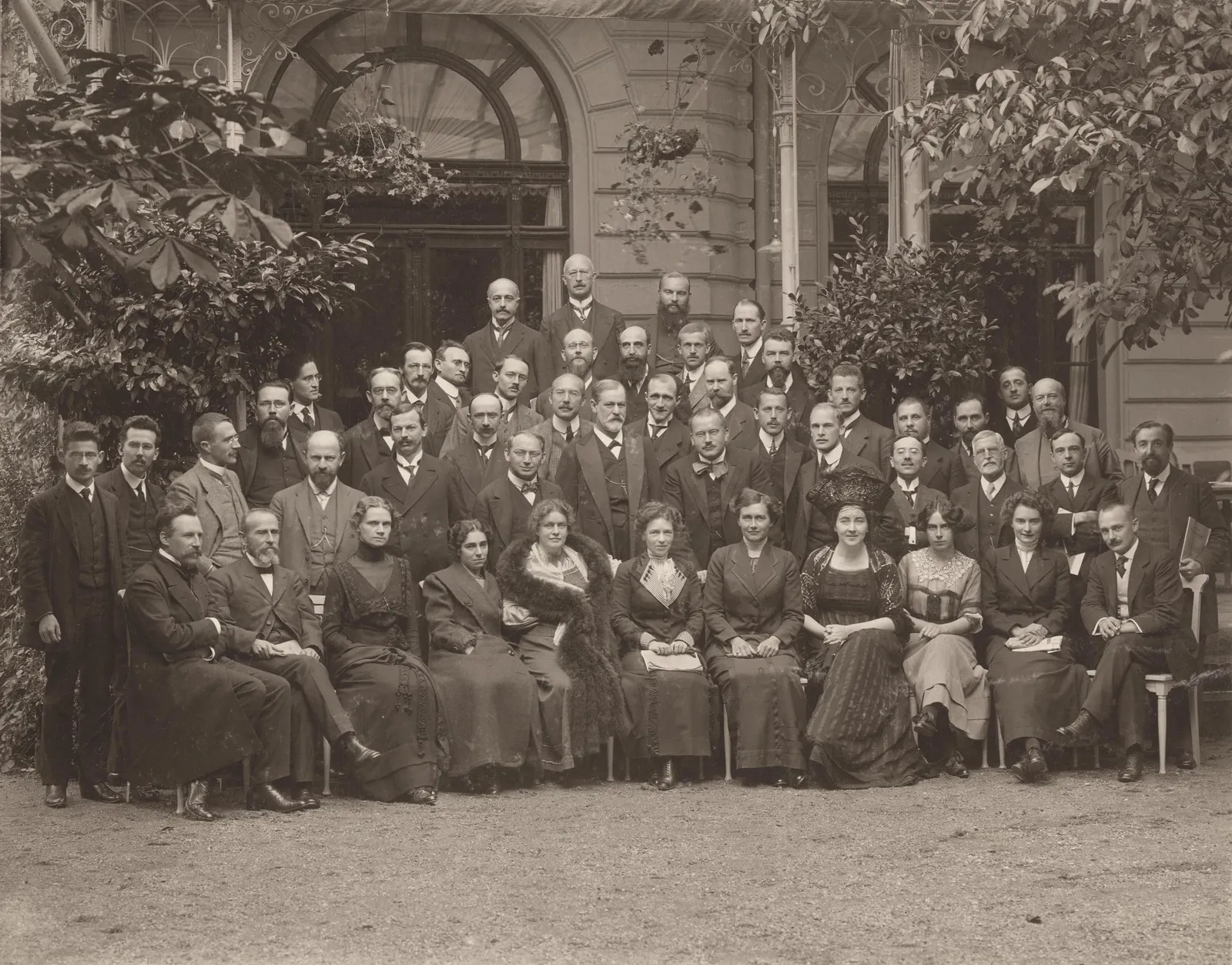
  • Participants in the Third International Psychoanalytic Congress, Weimar, 21 September 1911, with Ernest Jones in the second row near Freud, Jung, Abraham and Putnam; photographed by Franz Vältl
    Participants in the Third International Psychoanalytic Congress, Weimar, 21 September 1911, with Ernest Jones in the second row near Freud, Jung, Abraham and Putnam; photographed by Franz Vältl Image credit: Franz Vältl, 1911Public domainWikimedia Commons
  • Freud and the Committee in Berlin, 1922: seated, Freud, Sándor Ferenczi and Hanns Sachs; standing, Otto Rank, Karl Abraham, Max Eitingon and Ernest Jones; photographed by Marie Boehm of the Becker & Maass studio
    Freud and the Committee in Berlin, 1922: seated, Freud, Sándor Ferenczi and Hanns Sachs; standing, Otto Rank, Karl Abraham, Max Eitingon and Ernest Jones; photographed by Marie Boehm of the Becker & Maass studio Image credit: Marie Boehm (Becker & Maass), 1922Public domainWikimedia Commons
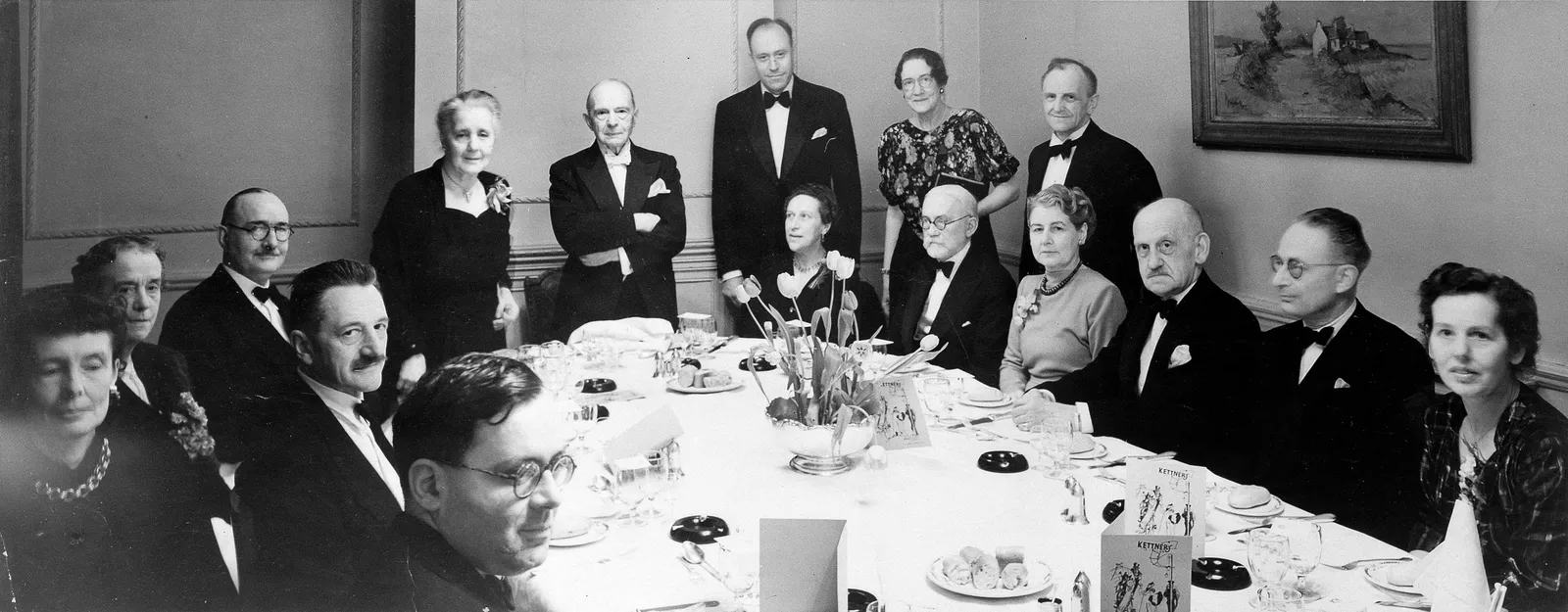
  • Dinner for Melanie Klein's seventieth birthday at Kettner's, London, 1952: Ernest Jones stands beside Klein, left of centre, among members of the British Psycho-Analytical Society; photographer unknown (Wellcome Collection)
    Dinner for Melanie Klein's seventieth birthday at Kettner's, London, 1952: Ernest Jones stands beside Klein, left of centre, among members of the British Psycho-Analytical Society; photographer unknown (Wellcome Collection) Image credit: Wellcome Library, London. Wellcome ImagesCC BYWikimedia Commons
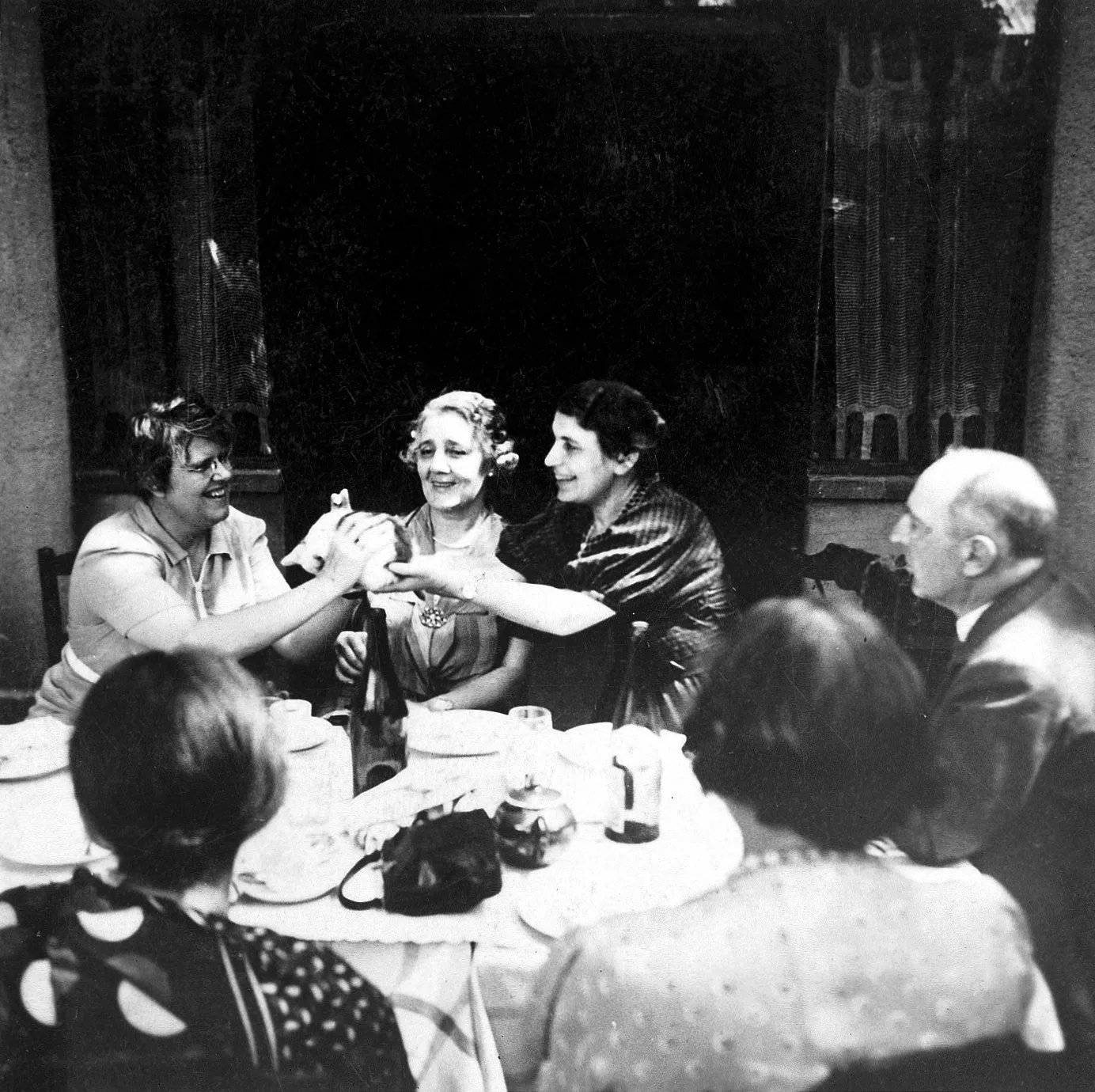
  • Melanie Klein, Anna Freud and Ernest Jones (right) with others at a café table; undated photograph from Melanie Klein's papers, photographer unknown (Wellcome Collection)
    Melanie Klein, Anna Freud and Ernest Jones (right) with others at a café table; undated photograph from Melanie Klein's papers, photographer unknown (Wellcome Collection) Image credit: Wellcome Library, London. Wellcome ImagesCC BYWikimedia Commons

References

  1. The Life and Work of Sigmund Freud1953
  2. Rationalization in Every-Day Life1908
  3. Papers on Psycho-Analysis1913
  4. The Early Development of Female Sexuality1927
  5. The Interpretation of Dreams1900
  6. The Œdipus-Complex as an Explanation of Hamlet's Mystery: A Study in Motive1910
  7. The Theory of Symbolism1918
Esc

↑ ↓ to move · Enter to go · Esc to close