Article
The Dynamics of Transference
Zur Dynamik der Übertragung
What it shows
- 1912
Sigmund Freud developed Transference
Distinguishes positive from negative transference and treats transference as the most powerful resistance to treatment.
- 1912
Sigmund Freud developed Acting out
In the technical papers Freud places acting out within the transference: the unconscious impulses seek to be reproduced rather than remembered, the patient wants to act on them in the relation to the analyst, and the treatment must bring them back to remembering and psychic working over.
- 1912
Sigmund Freud developed Free association
Ties the failure of free association to the transference: whenever the patient's associations stop, the stoppage can be removed by telling him that he is in the grip of an idea about the physician. A patient caught in transference resistance feels free to neglect the fundamental rule.
- 1912
Sigmund Freud introduced Fundamental rule
Calls the obligation to communicate everything that comes to mind, without criticism, the 'psychoanalytic fundamental rule'. He observes that a patient caught in transference resistance takes the liberty of neglecting it.
- 1912
Fundamental rule derives from Free association
The fundamental rule states the method of free association as the obligation the patient accepts: to say everything that comes to mind, without criticism. Ferenczi and Rank speak of the technical 'fundamental rule' of free association.
- 1912
Sigmund Freud developed Resistance
Freud makes resistance a constant of the treatment, present in every association as a compromise with the forces aiming at recovery, and shows how transference is put in its service: the transference to the doctor serves resistance when it is negative, or positive but made of repressed erotic impulses.
Gallery
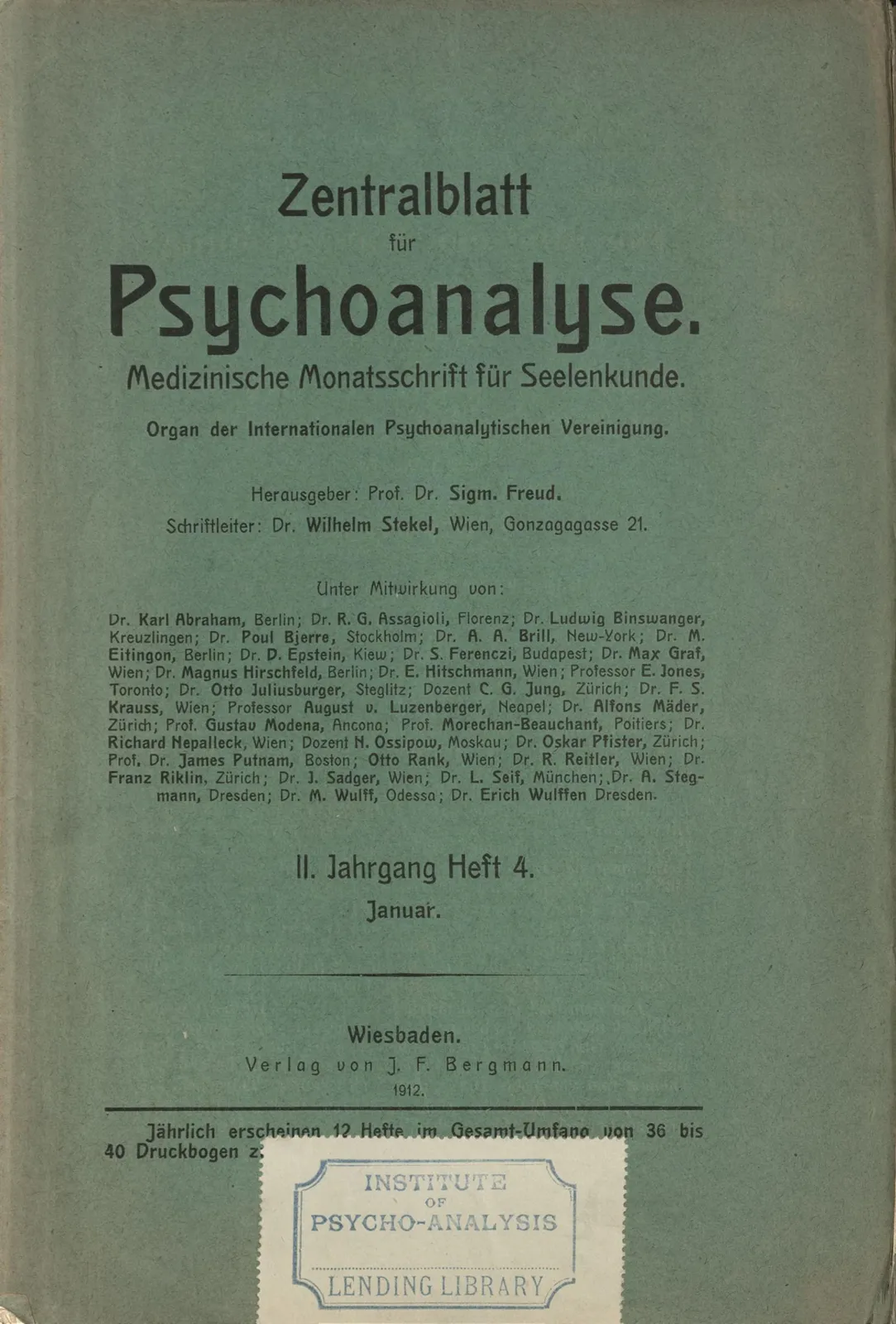
Cover of the Zentralblatt für Psychoanalyse, vol. 2, no. 4 (Wiesbaden: J. F. Bergmann, January 1912), edited by Sigmund Freud with Wilhelm Stekel, the issue in which “Zur Dynamik der Übertragung” first appeared