Book
Écrits
Lacan's collected papers, published by Éditions du Seuil in 1966: a volume of some nine hundred pages gathering articles and essays written over three decades, from 1936 to 1966. It includes the text on the mirror stage given at Zurich in 1949; the Rome discourse of 1953, 'The Function and Field of Speech and Language in Psychoanalysis', which has been called the founding manifesto of Lacanianism; 'The Instance of the Letter in the Unconscious' (1957); and the 1958 essay on the treatment of psychosis. Across these papers Lacan pursues his return to Freud by way of structural linguistics, reading the unconscious as structured like a language, and turns against the ego psychology of Hartmann, Kris and Loewenstein. The book became a bestseller in France and made Lacan known as 'the French Freud', while also fixing his reputation for difficulty. Its first complete English translation, by Bruce Fink with Héloïse Fink and Russell Grigg, was published by W. W. Norton in 2006.
Main ideas
- The return to Freud runs through structural linguistics: the unconscious is structured like a language, in the sense of a general logic of syntax and meaning rather than a particular tongue.
- The ego takes shape in the mirror stage and belongs to the imaginary register: it is formed as an object, through an image, and not as the seat of the subject's autonomy.
- Metaphor, the substitution of one signifier for another, is the structure of condensation and of the symptom; metonymy, the linking of signifier to signifier along the chain, is the structure of displacement and of desire.
- The Name-of-the-Father, named in 1953 as the support of the symbolic function, is cast in 1958 as the paternal metaphor that replaces the mother's desire; its foreclosure and the failure of the metaphor are the condition of psychosis.
- Resistance is located on the analyst's side, as a product of the analyst's own pressure and demand, while the subject's resistance to suggestion is read as the wish to keep desire alive.
- Strengthening an autonomous, adapted ego, as the ego psychology of Hartmann, Kris and Loewenstein proposes, betrays Freud's discovery of the unconscious.
What it shows
- 1966
Jacques Lacan critiqued Ego psychology
Across the papers collected in "Écrits" (1966), Lacan attacked the ego psychology of Hartmann, Kris and Loewenstein, arguing that strengthening an autonomous, adapted ego betrays Freud's discovery of the unconscious.
- 1957
Jacques Lacan introduced Metaphor
In “The Instance of the Letter in the Unconscious” (1957, collected in Écrits), Lacan defines metaphor as one signifier taking another's place in the chain, the hidden one remaining linked to the rest, and makes it the structure of condensation and of the symptom.
- 1958
Jacques Lacan reworked Resistance
Against an analysis of resistances aimed at the patient's ego, Lacan locates resistance on the analyst's side: it is produced by the analyst's own pressure and demand, while the subject's resistance to suggestion is read as the wish to keep desire alive.
- 1957
Jacques Lacan introduced Metonymy
In "The Instance of the Letter in the Unconscious" (1957, collected in Écrits), Lacan turns Jakobson's metonymic pole into a psychoanalytic concept. Metonymy becomes the word-to-word connection along the signifying chain, and he sets it beside metaphor: the symptom is a metaphor and desire is a metonymy.
- 1957
Metonymy derives from Displacement
Lacan reads Freud's displacement (Verschiebung) in the dream-work as metonymy: the shift of significance from one element to the next along the chain, which the unconscious uses to evade censorship. Condensation he reads in the same way as metaphor.
Show all 8 Show fewer
- 1957
Following Jakobson, Lacan makes metaphor and metonymy the two opposite poles of the signifier's action. Metaphor substitutes one signifier for another and crosses the bar into signification; metonymy connects signifier to signifier and keeps the bar in place. He maps the pair onto condensation and displacement, and onto the symptom and desire.
- 1953
Jacques Lacan introduced Name-of-the-Father
In the Rome discourse of 1953, Lacan names the father's name as the support of the symbolic function, which identifies the father with the law. In 1958 he develops it as the paternal metaphor.
- 1958
Name-of-the-Father derives from Metaphor
In his 1958 essay on psychosis, Lacan casts the Name-of-the-Father in the form of his metaphor: it substitutes for the mother's desire and so produces the phallic signification. Psychosis follows when this signifier is foreclosed and the paternal metaphor fails.
Gallery
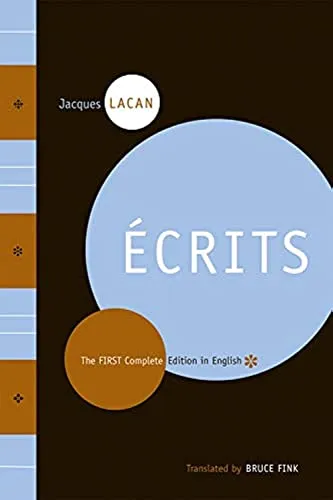
Cover of Écrits: The First Complete Edition in English, translated by Bruce Fink, W. W. Norton & Company, 2007 paperback