Book
Acts of Will: The Life and Work of Otto Rank
Acts of Will: The Life and Work of Otto Rank (New York: Free Press, 1985; reissued with a new preface by the University of Massachusetts Press, 1993) is the American psychiatrist E. James Lieberman's biography of Otto Rank (1884–1939), the first to cover his whole life and work. Drawing on the diary Rank kept as an adolescent, his correspondence and his published writings, it sets out to restore a man who had been Freud's closest younger associate and was afterwards disparaged in, or written out of, the standard histories of psychoanalysis. The book follows Rank from a poor family in Vienna, through a youth of self-education in Nietzsche and the culture of fin-de-siècle Vienna, to his meeting with Freud, to whom he brought the manuscript of his essay on the artist. It traces his years as secretary of the Wednesday Psychological Society, his doctorate, his studies of myth, the hero and the incest motif, his work as editor and publisher, and his place among the seven ring-holders of Freud's secret Committee, including his rivalry with Ernest Jones. The central chapters reconstruct the crisis of 1923–1926: Rank's work with Sándor Ferenczi on an active, relationship-centred therapy, the publication of The Trauma of Birth, Freud's cancer, the breakup of the Committee, and Freud's wavering between acceptance and rejection, until Rank left Vienna. Lieberman treats the break as an intellectual parting and a drama of father and son, not the outcome of mental illness; in the introduction, under the heading "History of a Libel", he contests the picture of Rank as disturbed that Jones's account had made standard. The later chapters follow Rank's independent years in Paris and the United States: his psychology of will and creativity, his view of the neurotic as a failed artist, Art and Artist, his work with Anaïs Nin, first his patient and then his assistant, his will therapy with its focus on the present relationship and on setting an end to treatment, his teaching at the Pennsylvania School of Social Work, his ostracism by organised psychoanalysis, and his death in New York in 1939, a month after Freud. An epilogue places Rank in the history of ideas, as a forerunner of relational, humanistic and existential therapies and an influence on writers and thinkers such as Nin, Henry Miller, Paul Goodman and Max Lerner.
Main ideas
- The book is the first full biography of Otto Rank. Built on his adolescent diary, his letters and his writings, it aims to restore to the history of psychoanalysis a figure the movement's own historians had marginalised or maligned.
- Rank was self-made: a youth from a poor Viennese family who educated himself through Nietzsche and the culture of fin-de-siècle Vienna, and whose early preoccupation with the artist brought him to Freud.
- For two decades Rank stood at the centre of Freud's circle, as secretary of the Wednesday Psychological Society, author of studies of myth, the hero and the incest motif, editor and publisher, and one of the seven members of the secret Committee, where his rivalry with Ernest Jones took shape.
- The break with Freud grew out of Rank's work with Ferenczi on an active, relationship-centred therapy and out of The Trauma of Birth, which shifted attention to the mother and to separation; it unfolded amid Freud's cancer, the Committee's collapse and Freud's own ambivalence.
- Lieberman reads the break as an intellectual parting and a drama between a father and a son, and rejects the claim, made standard by Jones's history, that Rank's dissent was a symptom of mental illness.
- After leaving Vienna, Rank built an independent psychology of will and creativity, in which the neurotic appears as a failed artist and the creative person as one who actively wills what others merely endure.
- Rank's will therapy centred on the relationship between patient and therapist in the present and on setting an end to treatment, an early form of time-limited therapy; through his teaching at the Pennsylvania School of Social Work it shaped American social work and counselling.
- Rank's years in Paris and New York joined clinical work to the arts, above all through Anaïs Nin, who came to him as a patient and stayed on as his assistant, and whose diaries became a chief record of him as a therapist.
- Rank was treated as a pariah by organised psychoanalysis in his last years, and died in New York in 1939, a month after Freud; his ideas survived largely outside the psychoanalytic establishment.
- Lieberman presents Rank as a forerunner of later developments, among them the stress on the mother and on separation, relationship-centred and time-limited therapy, and humanistic and existential psychology, and as an influence on writers and thinkers such as Henry Miller, Paul Goodman and Max Lerner.
What it shows
- 1926
Otto Rank broke with Sigmund Freud
After the dispute over the birth trauma, Rank left Vienna and Freud's circle in 1926, settling in Paris and later in the United States.
- 1926
Otto Rank analysed Jessie Taft
Taft, who met Rank in 1924, was in analysis with him in 1926–27 and went on to adapt his ideas for social work.
- 1924
Karl Abraham disputed with Otto Rank
Karl Abraham led the opposition within Freud's inner circle to Rank's Das Trauma der Geburt and to the book Rank wrote with Ferenczi in 1924.
Gallery
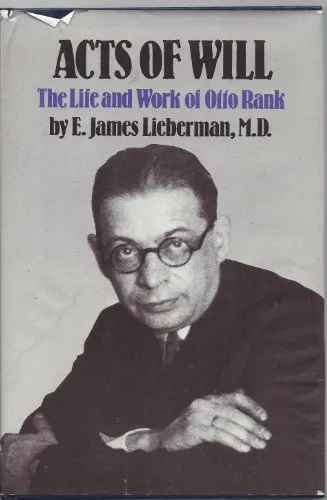
Dust jacket of the first edition of E. James Lieberman's Acts of Will: The Life and Work of Otto Rank, Free Press hardcover, 1985, with a photograph of Rank