The graph of concepts, people and works

Drawing the graph…

psychopedia
Legend

Nodes

Relations

At rest every relation is a thin grey line. Its colour shows on hover and in focus.

Person

Michael Balint

1896–1970

Also known as Mihály BálintBálint MihályMihály Bergsmann
+1 more Bergsmann Mór Mihály

Hungarian-born physician and psychoanalyst of the Budapest school. He was Sándor Ferenczi's pupil, successor and literary executor, emigrated to Manchester in 1939 and later worked in London, where he belonged to the British Society's Independent analysts. Against the theory of primary narcissism he held that the infant's first relation is a primary love for its surroundings; he later described the basic fault, benign and malignant regression and the ocnophil and philobat attitudes, and with Enid Balint created the case-discussion groups for general practitioners that bear his name.

Michael Balint (1896–1970) was a Hungarian-born physician and psychoanalyst. A pupil and successor of Sándor Ferenczi in the Budapest school, he settled in England in 1939 and became one of the Independents of the British Psychoanalytical Society. He was born Mihály Mór Bergsmann and is known in Hungarian as Bálint Mihály.

His work turned on one thesis, which he held from the early 1930s until his death. The human being is related to its surroundings from the very beginning, in a state he called primary love. On this view Freud's primary narcissism describes no state that can be observed. Each of his clinical ideas grew from this thesis, and each was worked out from patients who regress in treatment. They are the new beginning as the final goal of analysis, the paired attitudes of ocnophilia and philobatism, the basic fault, and the distinction between benign and malignant regression.

Outside psychoanalysis he is best known for the case-discussion seminars for general practitioners that he began at the Tavistock Clinic with Enid Balint. These are now called Balint groups, and the book that came out of them is The Doctor, His Patient and the Illness1.

He was Ferenczi's literary executor and transcribed and translated Ferenczi's Clinical Diary. His last book, The Basic Fault2, uses his own distinctions to reread the old disagreement between Freud and Ferenczi.

Life and training

Balint was born in Budapest on 3 December 1896, the son of a practising physician. Against his father's wishes he changed his name from Bergsmann to Bálint. He also converted from Judaism to Unitarian Christianity. In the First World War he served at the front, first in Russia and then in the Dolomites, and in 1918 he completed his medical studies in Budapest. Alice Székely-Kovács, later Alice Balint, suggested that he read Freud. He also began attending the lectures of Ferenczi, who held a professorship of psychoanalysis in Budapest from 1919.

Around 1920 Balint and Alice, now married, moved to Berlin. There he worked in Otto Warburg's biochemical laboratory on a doctorate in biochemistry, while also working half-time at the Berlin Psychoanalytic Institute. Both began their analytic training in Berlin, in analysis with Hanns Sachs from 1921. The couple were dissatisfied with that analysis. In 1924 they returned to Budapest, where Ferenczi took both of them into analysis. Their son John was born after the return.

His years with Ferenczi shaped all of Balint's later work. He was Ferenczi's pupil and his successor as head of the Budapest institute. After Ferenczi's death in 1933 he became his literary executor and transcribed and translated the Clinical Diary of Ferenczi's last years. He also watched at close range Ferenczi's late attempt to meet every need of a single patient. Balint later called this attempt the "grand experiment", and in The Basic Fault he made it the cautionary case for how an analyst should respond to regression (The Basic Fault2).

Career

In Budapest Balint took a leading part in Hungarian psychoanalysis. In 1935 he became director of the Budapest Psychoanalytic Institute. He worked closely with Alice Balint and with Imre Hermann. In 1937 he described the three of them as a group following Ferenczi, each supporting their shared view from a different field: comparative pedagogy, the study of primates and sexual theory (Frühe Entwicklungsstadien des Ichs: Primäre Objektliebe3).

Two papers of this period made his name internationally. In August 1934, at the International Psychoanalytical Congress in Lucerne, he read a paper on the final goal of psychoanalytic treatment, published the following year (Das Endziel der psychoanalytischen Behandlung4). In May 1937 he gave a report on the earliest stages of the ego at the Four Countries Conference in Budapest. There he set the Budapest view against the views of London and Vienna (Frühe Entwicklungsstadien des Ichs3).

In early 1939, as Jewish analysts were being advised to leave Hungary, Balint emigrated to England with the help of John Rickman. He settled in Manchester, where he became clinical director of a child guidance clinic. That year he and Alice wrote a joint paper asking whether transference is the patient's work alone or whether the analyst's behaviour also shapes it. Alice died in Manchester a few months after they arrived, leaving Balint with their son.

In 1944 he remarried; the marriage soon broke down, though the divorce came only in 1952. In the same year his parents, about to be arrested by the Nazis in Hungary, took their own lives. Also in 1944 Balint moved from Manchester to London and joined the Tavistock Clinic. There he learned about group work from W. R. Bion, and he took a Master of Science degree in psychology.

In 1949 Balint met Enid Eichholz, who had founded the Family Discussion Bureau, a casework service for couples, and whom he later married. Sources differ on the year of the marriage. From 1950 he ran a research and training seminar at the Tavistock, in which general practitioners met weekly with psychoanalysts to discuss cases from their own practices. He reported on it in The Doctor, His Patient and the Illness in 1957 (The Doctor, His Patient and the Illness1). With Enid Balint he also wrote Psychotherapeutic Techniques in Medicine (1961).

Two books on regression followed: Thrills and Regressions5 in 1959 and The Basic Fault in 1968. In 1968 he also became president of the British Psychoanalytical Society. He died in London on 31 December 1970.

Theory

The new beginning. Balint's paper for the Lucerne congress asked whether clinical experience alone could define the point towards which an analysis tends, without appeal to a philosophical or moral ideal of health. He started from re-analyses and difficult cases, and from an observation: in deep analyses the final months bring almost no new unconscious material, yet that is when patients actually get well. Measured against this, he judged two kinds of definition of the goal of treatment and found both lacking.

The "classical" definitions were Freud's: making the unconscious conscious, lifting the infantile amnesia, overcoming the resistances. Balint found them neither necessary nor sufficient. The "romantic" definitions he found too general or too narrow. They included the full reliving of the Oedipal relation proposed by Ferenczi and Otto Rank, Rank's abreaction of the birth trauma, and Wilhelm Reich's orgastic potency.

Against both, Balint described a new beginning, which he had first presented at Wiesbaden in 1932. Near the end of treatment, patients revive long-abandoned infantile wishes and seek to have them gratified, timidly at first and then with an addictive passion. Mishandled, this turns into insatiable demands. If patient and analyst persevere, it gives way to a realistic relation to the object.

Drawing on Ferenczi's theory of the erotic sense of reality, Balint argued that every drive is bound to an object from the first and has a passive aim, to be loved and satisfied. On this view autoerotism and narcissism are detours imposed by frustration. The anal-sadistic and phallic phases are products of uncomprehending upbringing rather than normal stages. He pressed this point against the stress on constitution in the analysis of his day, taking Melanie Klein's The Psycho-Analysis of Children as his example. He closed with the motto "less sadism and more love" (Das Endziel der psychoanalytischen Behandlung4).

Primary love against primary narcissism. The 1937 Budapest report took up the clash between the London and Vienna schools over the earliest stages of mental life. The London school, as Joan Riviere presented it, explained the child's greed and hostility by an innate oral sadism rooted in the death drive. Robert Waelder's Viennese critique rightly disputed London's evidence but left the same phenomena unexplained.

Balint reported that patients deep in analysis come to want small, primitive gratifications, such as a kind word or being touched. Refused, these wishes bring despair, hatred and fear of retaliation. Granted, they bring an addiction-like bliss that collapses at the first frustration. Met at the right time and in the right measure, they produce no more than a quiet sense of well-being. He linked this with Hermann's work on the infant's instinct to cling and with Alice Balint's account of the mother–child unity.

From this material he drew the concept of primary object love. It is an early phase that cannot be skipped and is tied to no erogenous zone, and its aim is passive: to be loved and gratified without giving anything in return. Both London and Vienna, he argued, held to the hypothesis of primary narcissism, and he named it as the source of their confusion of tongues. Primary narcissism was for him a negative concept, reached by extrapolation and defined by "not yet", and it had never been observed clinically. He warned that the logically simplest state need not be the original one, as biology had learned with the amoeba, and offered primary object love as a working hypothesis (Frühe Entwicklungsstadien des Ichs3).

His 1952 collection gathered these papers with later ones written in Britain, together with a paper by Alice Balint. In it, narcissism, autoerotism, sadism and hate appear as secondary formations: consequences of the frustration of primary love, and defences against it. Adult genital love fuses genital satisfaction with tenderness and with regard for the partner as a person. On technique, the book treats the analytic situation as a relationship between two people, in which the analyst's behaviour and personality help shape the transference, and it deals with countertransference and the termination of analysis (Primary Love and Psycho-Analytic Technique6).

Ocnophils and philobats. In Thrills and Regressions Balint started from the pleasures of the funfair and of risky sports. A thrill, he wrote, has three elements: awareness of a real external danger, deliberate exposure to it, and a confident hope of returning safely. From people's opposite responses to such situations he derived two attitudes. For the ocnophil, objects are safe and the spaces between them are horrid and empty, so the ocnophil clings. For the philobat, open spaces are friendly and objects are unpredictable hazards, so the philobat relies on their own skills and keeps a distance. Each attitude, he argued, rests on an illusion.

Behind both he now placed primary love, conceived as a harmonious mix-up of the individual and the environment, more like a world of substances such as water or air than of bounded things. Firm objects emerge only when frustration and separation destroy this harmony, and the two attitudes are secondary reactions to that loss. Here he revised his earlier view: clinging to the analyst now seemed to him a defence against the fear of being dropped, not an expression of primary love.

He also criticised the technique of his time as biased towards ocnophilia. Interpreting everything as transference, he argued, makes the analyst an object always offered to be clung to. The patient may end up with an "efficient shell" that equips them for life but narrows what they can feel. The book closes with a chapter by Enid Balint (Thrills and Regressions5).

The basic fault. Balint's last book begins from moments when interpretations stop working as interpretations. They are heard as attacks or seductions, and a patient who is not understood sinks into emptiness rather than anger. He distinguished three areas of the mind. The Oedipal area is triangular, organised by conflict and reached by ordinary adult language. The area of the basic fault is strictly two-person. It holds a deficiency rather than a conflict, a fault in the geological sense, born of a marked lack of fit between the infant's needs and the care available. In the area of creation there is no external object at all.

He weighed three responses to regression. Classical technique depends on a careful choice of patients. The consistent interpretation of the Kleinian school risks making the analyst all-knowing and the patient weak. The management associated with Donald Winnicott risks an endless spiral of demands.

The heart of the book is the distinction between two forms of regression. Benign regression aims at recognition, takes place in a trusting atmosphere and ends in a new beginning. Malignant regression aims at gratification and drifts towards addiction-like states. Which form appears depends on the analyst's response as well as on the patient. Balint argued that Freud had generalised from malignant cases and Ferenczi from benign ones.

In the area of the basic fault, he advised, the analyst should avoid becoming an omnipotent object. Instead the analyst should let the patient use them as a primary substance is used, the way water carries a swimmer. Interpretation should be sparing during the regression, and Acting out accepted as communication. The fault cannot be analysed away: at best it heals with a scar, and successful treatment includes mourning for the original defect (The Basic Fault2).

The doctor as a drug. The Doctor, His Patient and the Illness argued that the drug most often prescribed in general practice is the doctor in person, a drug whose dosage and side effects nobody knew. Balint described how, at an early "unorganised" stage, a patient offers the doctor a series of illnesses, and the doctor's responses help decide which one becomes "organised". Against the habit of pursuing a physical diagnosis through one examination after another, he called for an "overall diagnosis" that takes in the patient's personality and relationships.

The book also named several patterns in medical practice. The "apostolic function" is the doctor's urge to convert patients to the doctor's own idea of how to behave when ill. In the "collusion of anonymity", responsibility is diluted among specialists until no one carries it. The "mutual investment company" is the shared experience that builds up between a family doctor and their patients over the years. The seminars aimed not to turn practitioners into psychotherapists but at a limited though considerable change in the doctor's personality (The Doctor, His Patient and the Illness1).
Influence and reception

Balint's influence runs along two lines, one within psychoanalysis and one in medicine. Within psychoanalysis, Primary Love and Psycho-Analytic Technique is a principal statement of the Budapest school's contribution to object-relations theory. Its view of the analytic situation as a two-person relationship prepared his own later work on regression (Primary Love and Psycho-Analytic Technique6). Margaret Mahler's idea of a dual unity of mother and child has been traced in part to Balint, alongside Therese Benedek. His reading of the Freud–Ferenczi controversy through benign and malignant regression gave Ferenczi's late technical experiments a framework within which they could be weighed rather than dismissed (The Basic Fault2). The Basic Fault has been translated into Hebrew, published by Am Oved in 2006.

In medicine, The Doctor, His Patient and the Illness established the case-discussion method later known as Balint groups. It became a classic of patient-centred medicine and of medical education (The Doctor, His Patient and the Illness1). After his death a Balint Society was formed to carry on the seminars with general practitioners. A psychoanalytic institute in Hamburg also bears his name.

Selected works

In German his main early papers are "Das Endziel der psychoanalytischen Behandlung", read at Lucerne in 1934 and published in 1935 (Das Endziel der psychoanalytischen Behandlung4), and "Frühe Entwicklungsstadien des Ichs: Primäre Objektliebe", given in Budapest in 1937 (Frühe Entwicklungsstadien des Ichs3).

In English, Primary Love and Psycho-Analytic Technique (London, 1952) collects his papers from 1930 onwards (Primary Love and Psycho-Analytic Technique6). The Doctor, His Patient and the Illness appeared in 1957 (The Doctor, His Patient and the Illness1), and Thrills and Regressions, his third book, in 1959 (Thrills and Regressions5). Psychotherapeutic Techniques in Medicine, written with Enid Balint, followed in 1961. His last book was The Basic Fault: Therapeutic Aspects of Regression (London, 1968) (The Basic Fault2).

Ideas

introduced

  • 1935 New beginning
    In his Lucerne congress paper of 1934, printed in 1935, Balint names the new beginning: towards the end of deep analyses patients again seek simple, pleasurable gratifications, all of them aimed at an object, and he counts this as an essential mechanism of cure.
  • 1937 Primary love
    At the Budapest meeting of 1937 Balint gathers his own findings and those of Alice Balint and Imre Hermann into one thesis: a primary, or primitive, object love comes before any narcissism, every child must pass through it, and all later relations keep traces of it. He collected the papers on it in Primary Love and Psycho-Analytic Technique (1952).
  • 1957 Balint group
    The Doctor, His Patient and the Illness (1957) reports the work of Balint's first discussion-cum-research seminars with general practitioners at the Tavistock Clinic. The training method it describes became known as the Balint group.
  • 1959 Ocnophilia
    In Thrills and Regressions (1959) Balint coins the ocnophil for the person who must cling to objects to feel safe.
  • 1959 Philobatism
    In Thrills and Regressions (1959) Balint names philobatism for the opposite attitude: avoiding objects and seeking the open, object-free expanses.
Show all 7 Show fewer
  • 1968 Basic fault
    The Basic Fault (1968), Balint's last book, names a level of the mind below the Oedipal conflict: a two-person relation in which the patient feels something missing rather than a conflict, and in which ordinary interpretation loses its hold. He sets it between the three-person Oedipal level and the one-person level of creation.
  • 1968 Benign and malignant regression
    Balint distinguishes a regression that seeks recognition and makes a new beginning possible from one that seeks gratification and keeps escalating. The distinction is set out in The Basic Fault (1968). Dupont's dictionary entry dates it to Thrills and Regressions (1959), where Balint first wrote at length on regression.

critiqued

  • 1937 Primary narcissism
    Balint argues that primary narcissism has never been observed: what the clinic shows is always secondary narcissism, mixed with the remains of a damaged object love. The hypothesis may not be false, but by definition nothing can be learned about it, so it is superfluous; he blames it for the confusion of tongues between the Vienna and London analysts.

reworked

  • 1968 Regression
    Taking Ferenczi's technical experiments further, Balint treats regression in the analysis not only as resistance but as a state the analyst must know how to meet, and one that, in its benign form, can open the way to a new beginning. Thrills and Regressions (1959) and The Basic Fault, subtitled Therapeutic Aspects of Regression (1968), are given to it.

Influence

Lineage

  • 1921 analysed by Hanns Sachs
    Balint's first analysis, in Berlin, alongside Alice Balint. Dissatisfied with it, the couple went back to Budapest to finish their analyses with Ferenczi.
  • 1924 analysed by Sándor Ferenczi
    After leaving Sachs, Balint finished his training analysis with Ferenczi in Budapest from the mid-1920s, and went on to become his pupil and closest successor.

Affinity

  • 1937 influenced by Sándor Ferenczi
    Balint traces the shared starting point of the Budapest school's work on early object relations straight back to Ferenczi, and through him to Freud. He was Ferenczi's pupil and successor at the Budapest polyclinic, and after his death his literary executor, who transcribed and translated the Clinical Diary.
  • 1939 collaborated with Alice Balint
    Balint presents his work on early object relations as converging with Alice Balint's and Imre Hermann's, reached by separate paths. In 1939, from Manchester, the couple published a joint paper asking whether transference is the patient's work alone or whether the analyst's behaviour shares in it.
  • 1950 collaborated with Enid Balint
    In London, Balint took up again his project of putting psychoanalysis at the service of general practitioners, now with Enid Balint, whom he later married. They co-wrote Psychotherapeutic Techniques in Medicine (1961).
  • influenced Margaret Mahler
    Mahler owed to the Balints, and to Therese Benedek, the idea of a dual unity of mother and child, which she later worked out in her concept of symbiosis.

Works

  • 1935

    The Final Goal of Psycho-Analytic Treatment

    Michael Balint read this paper at the International Psychoanalytical Congress at Lucerne in August 1934, and it appeared the following year. He asks whether clinical experience alone, rather than a philosophical, moral or biological ideal of health, can define the point towards which an analysis naturally tends. He starts from re-analyses and difficult cases, which show the obstacles to cure more plainly than smooth ones, and from an observation: in deep analyses the final months bring almost no new unconscious material, yet that is when patients actually get well. Judged against this, the 'classical', structural definitions, all of them Freud's (making the unconscious conscious, lifting the infantile amnesia, overcoming the resistances), are neither necessary nor sufficient. The 'romantic', affective ones are too general or too narrow: abreaction of strangulated affects, the full reliving of the Oedipal relation (Ferenczi and Rank), abreaction of the birth trauma (Rank), the working-off of the repetition factor (Vilma Kovács), and orgastic potency (Reich). Balint develops the 'new beginning' he had described at Wiesbaden in 1932. Near the end of treatment, patients revive long-abandoned infantile wishes and seek to have them gratified. At first they do so timidly, then with an addictive passion. If this is mishandled, it turns into insatiable demands and an inflated narcissism. If patient and analyst persevere, it gives way to a realistic object relation. Because these wishes are always directed at an object, Balint turns to Ferenczi's theory of the erotic sense of reality. He argues that every drive is object-bound from the first and has a passive aim, to be loved and satisfied, which lasts throughout life. Autoerotism and narcissism, like active object love, are detours that frustration imposes. The anal-sadistic and phallic phases are artefacts of uncomprehending upbringing, not normal stages. Neurosis therefore always has a real cause in the environment. Balint presses this point against the stress on structure and constitution in the analysis of his day, taking Melanie Klein's The Psycho-Analysis of Children as his example. The final goal of treatment, then, is that the patient dare to begin loving anew. What must begin again is object love itself, not particular partial drives, and the analyst helps by noticing and protecting these tentative beginnings. Balint admits that patients who can only demand to be loved remain beyond his technique. He closes with the motto 'less sadism and more love'.

    Michael Balint Internationale Zeitschrift für Psychoanalyse 21 (1935), Heft 1, pp. 36–45 Copyright Life + 70 years In copyright The last author or translator died in 1970; protected through 2040.United States Status unknown Published in 1935; its copyright notice and renewal have not been checked.

  • 1937

    Early Developmental States of the Ego. Primary Object-Love

    Balint presented this report at the first symposium of the second Four Countries Conference, in Budapest in May 1937. Its subject is the sharply conflicting theories of the earliest stages of mental life, which had grown into almost 'local' views in London, Vienna and Budapest. Balint holds that the clinical material is the same everywhere and that the disagreement comes from different standpoints, expectations and terminology. As common ground he takes Freud's description of infantile love in 'Female Sexuality' (1931): boundless, exclusive, insatiable and ambivalent. The London school, as Joan Riviere presents it, explains these traits by an innate oral sadism rooted in the death drive, by early projection and introjection, and by anxieties about bad objects. Robert Waelder's Viennese critique rightly disputes London's evidence and concepts, but it leaves the children's greed and hostility unexplained. The Budapest group (Alice Balint, Imre Hermann and Balint himself, following Ferenczi) treats the recurring formal features of the analytic situation as transference and as traces of the earliest experiences. Each member supports this from a different field: comparative pedagogy, primate studies and sexual theory. Balint reports that, deep in analysis, patients come to want small, primitive gratifications such as a kind word or being touched. When these are refused, the patients show despair, hatred and fear of retaliation. When they are granted, the patients fall into an addiction-like bliss that collapses at the first frustration. The wishes themselves are always aimed at an object, and when they are met at the right time and in the right measure they produce no more than a quiet sense of well-being. Two further lines of work point the same way. Hermann studied the instinct to cling, which develops in the human infant because it is torn from its mother's body too early. Alice Balint described the mother's equal libidinal share in the mother–child unity, and an archaic, naively egoistic love that assumes the partner's wishes are the same as one's own. From these lines of work Balint draws the concept of primary object love. It is an early phase that cannot be skipped and is not tied to any erogenous zone. Its aim is passive: to be loved and gratified without giving anything in return. Narcissism and active object love grow from it as detours. London and Vienna are both right and both wrong. London studied only the vehement reactions to frustration and missed the quiet experience of satisfaction. Vienna could explain the infantile phenomena only with ad hoc hypotheses. Both cling to the hypothesis of primary narcissism, which Balint names as the source of their confusion of tongues. Primary narcissism, he argues, is a negative concept reached by extrapolation and defined by 'not yet', and the play between 'already' and 'not yet' protects it from every objection. It has never been observed clinically: what appears is only secondary narcissism, mixed with remnants of damaged object love. It also fits poorly with everyday facts, such as the hypersensitivity and insatiability of narcissistic people, or a crying newborn who calms when picked up. Balint notes converging work by Glover, Federn, Isakower, Müller-Braunschweig and E. P. Hoffmann. He answers the objections that the infant knows no external world and that sucking and grasping are mere adaptations. He warns that the logically simplest state need not be the original one, as biology learned with the amoeba. Primary object love is also an extrapolation, but a shorter and testable one, and Balint offers it as a working hypothesis for the study of infants and psychotics.

    Michael Balint Imago 23 (1937), Heft 3, pp. 270–288 Copyright Life + 70 years In copyright The last author or translator died in 1970; protected through 2040.United States Status unknown Published in 1937; its copyright notice and renewal have not been checked.

  • 1952

    Primary Love and Psycho-Analytic Technique

    Primary Love and Psycho-Analytic Technique collects papers Michael Balint wrote between 1930 and 1952, the earlier ones in Budapest under the influence of Sándor Ferenczi and the later ones in Britain, together with a paper by Alice Balint on the child's love for its mother and the mother's love for her child. The first part revises the psychoanalytic account of early development. Balint questions Freud's primary narcissism and the picture of libido unfolding through fixed pregenital organizations, and argues that the infant is related to objects from the start. Its earliest relation is a passive, archaic object love: the wish to be loved and gratified unconditionally, without effort or return, by an environment it takes for granted. Narcissism, autoerotism, sadism and hate then appear as secondary formations, consequences of and defences against the frustration of this primary love. The same view shapes his account of adult genital love, in which genital satisfaction is fused with pregenital tenderness and with regard for the partner as a person whose interests become one's own. The second part turns to technique. Balint treats the analytic situation as a relationship between two people, in which the analyst's behaviour and personality help shape the transference, and asks for a theory that takes both into account. Building on Ferenczi's technical experiments, he describes how, when regression in treatment reaches the level of primitive object relations, a patient may give up long-standing defensive attitudes and begin to love again in a less anxious and less suspicious way. He calls this phase the "new beginning" and regards it as the final goal of treatment and the mark of a completed analysis. Further papers deal with character analysis, ego strength and its education, transference and countertransference, the changing aims of analytic technique and the termination of analysis. The collection prepared Balint's later work on regression and the basic fault and is a principal statement of the Budapest school's contribution to object-relations theory.

    Michael Balint Copyright Life + 70 years In copyright The last author or translator died in 1970; protected through 2040.United States Status unknown Published in 1952; its copyright notice and renewal have not been checked.

  • 1957

    The Doctor, His Patient and the Illness

    The Doctor, His Patient and the Illness reports on a research and training seminar that Michael Balint led at the Tavistock Clinic in London in the early 1950s, in which a group of general practitioners met weekly with psychoanalysts to discuss cases from their own practices. Working from these case histories, the book argues that the drug most often prescribed in general practice is the doctor, in person, and that nothing is known of this drug's dosage, side effects or toxicity. It examines what passes between doctor and patient, above all with the many patients whose complaints have no adequate physical basis. Balint describes how, at an early 'unorganized' stage, a patient offers the doctor a series of illnesses, and the doctor's responses help decide which of them is settled on and becomes 'organized'. Doctors tend to pursue a physical diagnosis first, ordering one examination after another to eliminate organic disease, which can fix the patient in a somatic presentation while the real trouble goes unaddressed; against this he calls for an 'overall diagnosis' that includes the patient's personality and relationships. He names the 'apostolic function', the doctor's urge to convert patients to the doctor's own idea of how one ought to behave when ill; the 'collusion of anonymity', in which responsibility is diluted among the general practitioner and the specialists until no one carries it; the lasting teacher-pupil relation between specialists and general practitioners; and the 'mutual investment company', the capital of shared experience that accumulates over years between a family doctor and the patients. He warns against premature reassurance and advice, and observes that a doctor who only asks questions gets nothing but answers, so that listening must be learned. The aim of the seminars was not to make practitioners into psychotherapists but to bring about a limited though considerable change in the doctor's personality, so that the doctor's own emotional responses could be used as clinical information. The book established the case-discussion method later known as Balint groups and became a classic of patient-centred medicine and medical education.

    Michael Balint Copyright Life + 70 years In copyright The last author or translator died in 1970; protected through 2040.United States Status unknown Published in 1957; its copyright notice and renewal have not been checked.

  • 1959

    Thrills and Regressions

    Thrills and Regressions (1959), Michael Balint's third book, begins with an everyday pleasure: the excitement people seek on funfair swings, switchbacks and roundabouts, and in risky sports. From it Balint builds a theory of the earliest object relations and of regression in analysis. He defines a thrill by three elements. There is awareness of a real external danger, a deliberate exposure to it, and a confident hope that it can be survived and that one will return safely. People respond to such situations in opposite ways, and from this Balint derives two basic attitudes, for which he coined the terms ocnophilia and philobatism. For the ocnophil, objects are safe and the spaces between them are horrid and empty. The ocnophil clings to objects, needs to be near them, feels anxious on leaving them and is ambivalent towards them. For the philobat, open spaces are friendly expanses and objects are unpredictable hazards. The philobat relies on their own skills and keeps a distance from objects. Balint follows the two attitudes through aggressivity and auto-erotism, love and hate, and reality testing, and into people's relation to ideas. He argues that each attitude rests on an illusion. To explain why both persist, he posits an earlier state of primary love. This is a harmonious mix-up of the individual and the environment, in which there are no separate objects yet, and it is more like a world of substances such as water or air than of bounded things. It may even be a prenatal state. Inevitable frustrations and separations destroy this harmony, and firm objects emerge. Ocnophilia and philobatism then appear as two secondary reactions to that trauma. Here Balint revises his own earlier view: clinging to the analyst is no longer an expression of primary love but a defence against the fear of being dropped. The second part of the book turns these ideas on the analytic situation, and also reads flying dreams and Bertram Lewin's dream screen in their terms. Balint describes patients who must get up from the couch, and others who only slowly learn to close their eyes and turn inward. The analyst, he argues, should become part of a friendly environment for the regressed patient rather than a demanding object. He criticises the theory and technique of his time as biased towards ocnophilia. Interpreting everything as transference makes the analyst an object that is always offered to be clung to. The patient may then introject an idealised analyst in place of the old internal objects and acquire an "efficient shell" that equips them for life but narrows what they can feel. An appendix gathers short notes on related themes, and a chapter by Enid Balint, "Distance in Space and Time", completes the book. The book stands between Balint's earlier papers on primary object-love and The Basic Fault (1968). There he placed the basic fault between primary love and the two attitudes, and drew the distinction between benign and malignant regression.

    Michael Balint Copyright Life + 70 years In copyright The last author or translator died in 1970; protected through 2040.United States Status unknown Published in 1959; its copyright notice and renewal have not been checked.

  • 1968

    The Basic Fault: Therapeutic Aspects of Regression

    Michael Balint's book, published in London in 1968, distils four decades of clinical work into an account of why some analyses stall and what the analyst can do when they do. It begins from an observation: with certain patients, at certain moments, interpretations stop working as interpretations. They are heard as attacks or seductions, or do not register at all; the analyst's most casual words and gestures take on enormous weight; and a patient who is not understood does not become angry but sinks into emptiness and futility. For Balint these are signs that the work has left the level on which Freud's technique was built. Part I sets out three areas of the mind. The Oedipal area is triangular, organised by conflicts that interpretation can resolve, and conducted in ordinary adult language. The area of the basic fault is strictly two-person; what operates there is not a conflict but a deficiency, a fault in the geological sense of a structural flaw, and conventional words are unreliable in it. It originates in a marked lack of fit, in the earliest phases, between the infant's needs and the care and affection available. The area of creation contains no external object, only 'pre-objects'; it is the place of artistic and scientific creation, of insight, and of the first phases of falling ill and of spontaneous recovery, and its processes cannot be hurried from outside. Part II replaces Freud's primary narcissism, which Balint finds contradictory and unproductive, with primary love: an original relationship to an undifferentiated environment, a harmonious interpenetrating mix-up comparable to our relation to the air, in which the environment is simply taken for granted. Objects with firm contours, and with them narcissism, hate, ocnophilia and philobatism, emerge only once this harmony is disturbed. Adult love tries to restore it through the work of turning an indifferent object into a cooperative partner. Part III describes the gulf between the analyst and the 'child in the patient', and the problem of language: every analytic school teaches its patients its own idiom. Balint weighs three responses to regression. Classical technique keeps the work at the Oedipal level and so depends on careful selection of patients. Consistent, confident interpretation, associated with the Kleinian school, teaches the patient the analyst's language at the price of an inequality between an all-knowing analyst and a weak patient. The management of regression, associated with Winnicott, risks an unending spiral of demands. The cautionary case is Ferenczi's late 'grand experiment', which Balint watched at close range, in which Ferenczi tried to meet one patient's every need. Part IV, the heart of the book, distinguishes two forms of therapeutic regression. Benign regression aims at recognition: the patient needs an environment that tacitly consents to be used, a trusting, unsuspecting ('arglos') atmosphere forms, and the regression ends in a 'new beginning', the discovery of freer ways of relating. Malignant regression aims at gratification through the analyst's action: trust repeatedly breaks down, desperate clinging appears, and ever-renewed demands of suspicious intensity drift towards addiction-like states; Balint links it with severe hysteria. Because regression happens inside a relationship, its form depends on the analyst's response as well as on the patient. Balint reads the Freud–Ferenczi disagreement through this distinction: Freud generalised from malignant cases, Ferenczi from benign ones. Part V draws the technical consequences. At the level of the basic fault the analyst should avoid becoming a mighty, knowing, omnipotent object, whether through incessant transference interpretation, through gratification, or through promises to see the patient through. The analyst should let the patient use them as a primary substance is used, the way water carries a swimmer, and should provide time and a quiet setting in which the patient can find a personal way to objects. During the regression interpretation is used sparingly and acting-out is accepted as communication, to be worked through once the patient is back at the Oedipal level. The fault itself cannot be analysed away: at best it heals with a scar, and a successful treatment includes mourning for the original defect.

    Michael Balint Copyright Life + 70 years In copyright The last author or translator died in 1970; protected through 2040.United States Status unknown Published in 1968; its copyright notice and renewal have not been checked.

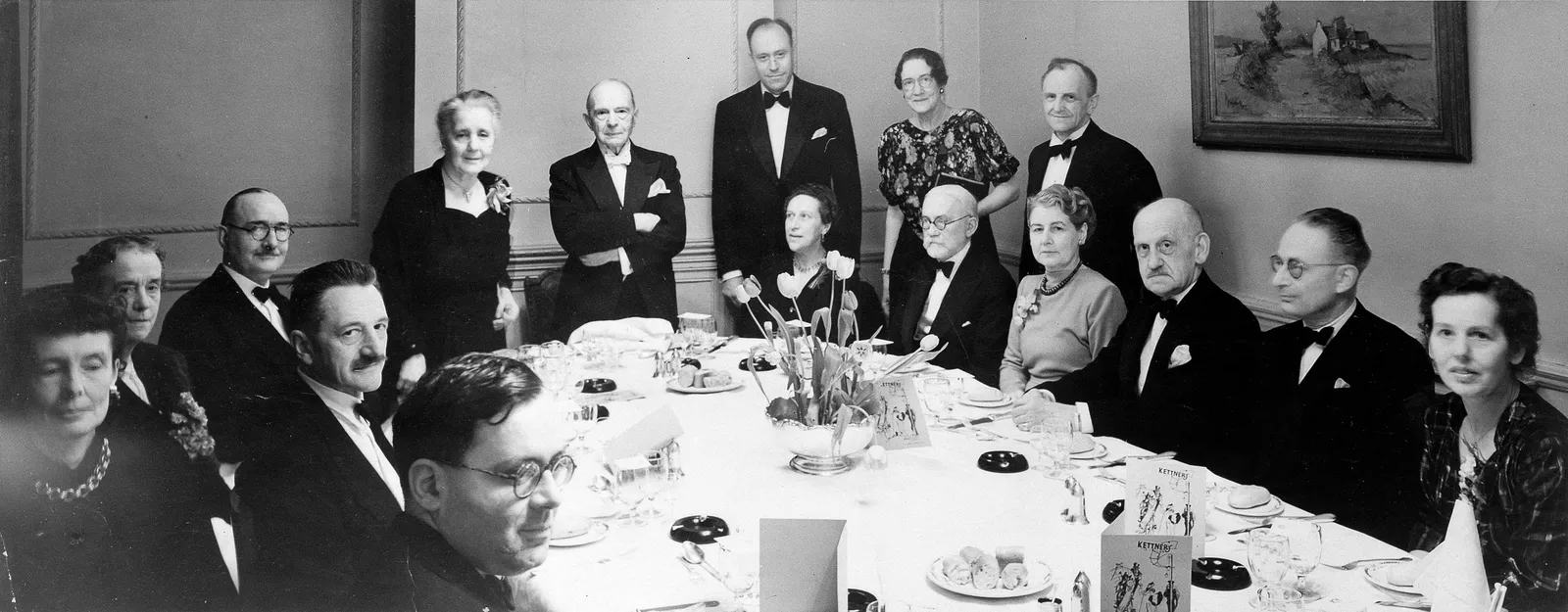
  • Michael Balint (seated, second from right, in glasses) at the dinner for Melanie Klein's 70th birthday, Kettner's, London, 1952; with Paula Heimann, James Strachey, Gwen Evans and Cyril Wilson seated to his right. Photographer unknown; Wellcome Collection
    Michael Balint (seated, second from right, in glasses) at the dinner for Melanie Klein's 70th birthday, Kettner's, London, 1952; with Paula Heimann, James Strachey, Gwen Evans and Cyril Wilson seated to his right. Photographer unknown; Wellcome Collection Image credit: Wellcome Library, London (Wellcome Images L0016246)CC BYWikimedia Commons

References

  1. The Doctor, His Patient and the Illness1957
  2. The Basic Fault: Therapeutic Aspects of Regression1968
  3. Early Developmental States of the Ego. Primary Object-Love1937
  4. The Final Goal of Psycho-Analytic Treatment1935
  5. Thrills and Regressions1959
  6. Primary Love and Psycho-Analytic Technique1952
Esc

↑ ↓ to move · Enter to go · Esc to close