Sándor Ferenczi (1873–1933) was a Hungarian psychoanalyst, for a quarter of a century one of Sigmund Freud's closest collaborators, and the founder of psychoanalysis in Budapest. A neurologist and psychiatrist who at first threw The Interpretation of Dreams1 aside, he later sought Freud out in Vienna, travelled with him to Clark University in 1909, proposed the founding of the International Psychoanalytical Association in 1910 and founded the Budapest psychoanalytic group in 1913. In Introjektion und Übertragung2 (Introjection and Transference, 1909) he coined the term introjection as the counterpart of projection, a term Freud and Melanie Klein later took up. In Entwicklungsstufen des Wirklichkeitssinnes3 (1913) he traced the child's passage from a feeling of omnipotence to the recognition of reality. In the 1920s he turned to technique. With Otto Rank he wrote The Development of Psychoanalysis4 (1924), which gave repetition in the relation to the analyst priority over remembering, and he experimented first with what Freud called an "active" therapy and, in his last years, with meeting a patient's needs. Among those he analysed were Ernest Jones, Melanie Klein, Michael Balint, Alice Balint and Clara Thompson. Ernest Jones attributed his drift away from Freud to failing mental health, a portrayal that later critics, Erich Fromm among them, contested. Michael Balint, his pupil and literary executor, carried his work forward in the theories of Primary love and of benign and malignant regression.
Person
Sándor Ferenczi
Hungarian analyst, Freud’s close collaborator and an innovator in technique.
Life and training
The earliest account of how Ferenczi came to psychoanalysis is Freud's own, in his tribute for Ferenczi's fiftieth birthday5, printed in 1923 in the Internationale Zeitschrift für Psychoanalyse over the signature of the editors. A few years after The Interpretation of Dreams appeared, Freud writes, a young doctor in Budapest who worked as a neurologist, a psychiatrist and an expert witness in the courts read the book and soon threw it aside, "es ist nicht bekannt, ob mehr gelangweilt oder angewidert" (it is not known whether more bored or repelled). Some time later he was drawn to Zurich, and from there he went to Vienna to meet the book's author. So began a friendship that Freud, in 1923, called long, intimate and still untroubled.
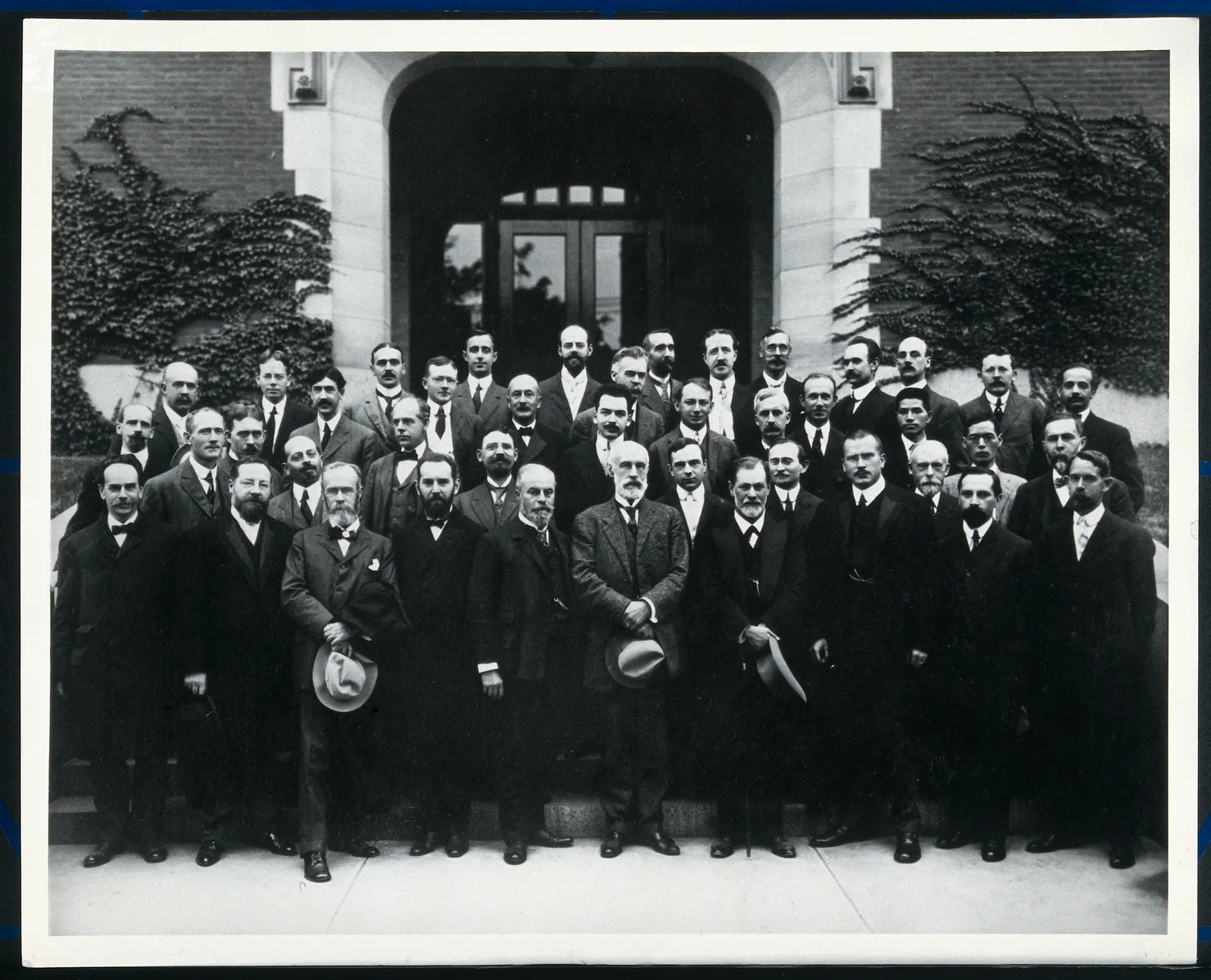
In 1909 Ferenczi travelled with Freud to the United States for the lectures at Clark University in Worcester, Massachusetts, and he appears in the group photograph of the conference's participants with Freud, Carl Gustav Jung and Jones.
Freud's tribute also sketches his character in psychoanalytic terms. As a middle child among many siblings, Ferenczi had had to contend with a strong brother complex. Analysis, in Freud's words, had made of him "ein tadelloser älterer Bruder, ein gütiger Erzieher und Förderer junger Talente" (a faultless elder brother, a kindly educator and promoter of young talent).
Ferenczi was himself analysed by Freud, in two brief periods in 1914 and 1916. By then he had analysands of his own. In 1913 he analysed Ernest Jones, a treatment that Jones, in his life of Freud6, described as perhaps the first analysis an analyst undertook for his own sake, before training analysis existed.
Career
In Freud's account Ferenczi was among the chief organisers of the psychoanalytic movement. At its second congress, at Nuremberg in 1910, he proposed the founding of the International Psychoanalytical Association, which was to defend analysis "gegen die Ächtung der Analyse durch die offizielle Medizin" (against its outlawing by official medicine). In 1912, as Jones tells it in his biography of Freud, Jones proposed a secret Committee of loyal followers to guard the basic tenets of psychoanalysis, and Ferenczi was among its founding members.
On 19 May 1913 Ferenczi founded the Budapest local group, with himself as chairman, Radó as secretary, and Hollós, Ignotus and Lévy as members. By 1923 he had led it for ten years. At the fifth congress, held in Budapest in September 1918, he was elected president of the International Association, with Anton von Freund as secretary. Freud wrote that, but for the political and personal catastrophes that followed, Budapest might have become the psychoanalytic capital of Europe. In October 1919, citing Hungary's isolation, Ferenczi resigned the presidency and handed it to Jones in London, and Freund fell ill and died in January 1920. During the Hungarian Soviet Republic Ferenczi lectured at the university, where, Freud reports, students crowded to hear him.
In the summer of 1922 he and Rank began the conversations from which The Development of Psychoanalysis grew. At the Berlin congress of September 1922 Freud set a prize question on how analytic technique and theory had influenced each other. The two authors adapted their text to it but withdrew from the competition. The book appeared in 1924, the same year as Rank's The Trauma of Birth7. According to E. James Lieberman's biography of Rank, Acts of Will8, Karl Abraham led the inner circle's opposition to both books.
Ferenczi's reach extended to America. When he lectured in New York in 1926, Harry Stack Sullivan heard him. Sullivan then urged Clara Thompson to be analysed by Ferenczi so that the two of them could learn his technique. Thompson went to Budapest for analysis with him, first in the summers from 1928 and then without interruption until his death in 1933. Thompson was also Sullivan's analyst, as Helen Swick Perry records in her biography of Sullivan, Psychiatrist of America9.
In Budapest Michael Balint became Ferenczi's pupil and his successor at the psychoanalytic polyclinic. After Ferenczi's death Balint was his literary executor, and he transcribed and translated Ferenczi's Clinical Diary. Balint also watched at close range the "grand experiment" of Ferenczi's last years, in which Ferenczi tried to meet one patient's every need.
Theory
Introjektion und Übertragung appeared in the first volume of the Jahrbuch für psychoanalytische und psychopathologische Forschungen in 1909, and as an offprint the following year. Ferenczi starts from the neurotic's readiness to transfer. He treats transference not as a peculiarity of the analytic situation but as a general neurotic mechanism and a special case of displacement, and the physician as no more than a catalyst for affects that are already present. Where the paranoiac expels what is unbearable onto the outside world, the neurotic draws as much of that world as possible into himself. Ferenczi named this process with a coinage: "Diesen Prozeß könnte man, im Gegensatze zur Projektion, Introjektion nennen" (this process might be called, in contrast to projection, introjection). A single sentence states the contrast: "Der Psychoneurotiker leidet an Erweiterung, der Paranoische an Schrumpfung des Ichs" (the psychoneurotic suffers from an enlargement of the ego, the paranoiac from its shrinking).
The second part of the essay applies the same idea to hypnosis and suggestion. The hypnotist, Ferenczi argues, succeeds by reviving the love and fear the subject once felt for the parents. Accordingly he distinguishes a paternal hypnosis, worked through fear, from a maternal hypnosis, worked through love. Suggestion is the unconscious transfer of an infantile "Neigung zu blindem Glauben und kritiklosem Gehorsam" (inclination to blind belief and uncritical obedience). The pleasure taken in such obedience links it with masochism: "Masochismus aber ist lustvolles Gehorchen" (masochism, however, is pleasurable obedience). The term he coined here had a long career. Freud took introjection up for mourning and melancholia and for the formation of the superego from the introjected parents. In Klein's work the interplay of introjection and projection from the first months of life builds up the inner world of good and bad objects.
Entwicklungsstufen des Wirklichkeitssinnes appeared in the first volume of the Internationale Zeitschrift für ärztliche Psychoanalyse in 1913. It starts from Freud's Formulations on the Two Principles of Mental Functioning10, in which the original pleasure principle gives way to adaptation to reality under the Reality principle. Ferenczi asks what becomes of the child's feeling of omnipotence in this passage. "Denn was ist Allmacht?" he asks (for what is omnipotence?), and answers that it is the feeling of having everything one wants, with nothing left to wish for.
Life in the womb is for Ferenczi the period of unconditional omnipotence. After birth comes a period of magical-hallucinatory omnipotence, to which he relates sleep as a return to the womb. Then come a period of omnipotence by means of magic gestures, an animistic period, which he connects with the origins of symbolism, and a period of magic thoughts and magic words. He groups the stages of omnipotence as stages of introjection, which give way to a stage of projection, the stage of reality proper. "Seinen Höhepunkt erlangt der Realitätssinn in der Wissenschaft" (the sense of reality reaches its height in science). The erotic life follows a parallel course: "Autoerotismus und Narzißmus sind also die Allmachtsstadien der Erotik" (autoerotism and narcissism are thus the omnipotence stages of erotism).
From this scheme Ferenczi draws a proposal about the choice of neurosis. Freud had held that it depends on the phase of ego and libido development at which the disposing inhibition occurred. Ferenczi suggests that the content of a neurosis's wishes depends on the phase of libido at the point of fixation, while its mechanism depends on the stage reached by the sense of reality. Hysterical conversion belongs to the stage of magic gestures. The obsessional patient's conviction of the omnipotence of his thoughts, feelings and wishes belongs to the stage of magic thoughts and words. Paranoia belongs to the stage of projection. A footnote records that the essay was finished before Ferenczi could take into account Freud's paper on animism, magic and the omnipotence of thoughts in Imago.
In The Development of Psychoanalysis, Ferenczi wrote the historical and critical part and Rank the section on the analytic situation, and the two revised the whole together. Ferenczi's part reviews techniques that had stalled at earlier stages of psychoanalytic knowledge. Among them are the collecting of associations, the dictionary-like translation of symbols, symptom analysis, "complex analysis", lecturing patients on theory, and calling every stall a resistance. He rejects both rigid passivity and "wild activity". He names the analyst's own narcissism as a source of error. And he argues that the unconscious proper, which was never experienced, can be relived only piece by piece in the present, as a "fractionated catharsis".
Together the authors give repetition priority over remembering, reversing the weighting of Freud's Remembering, Repeating and Working-Through11 and building on the Repetition compulsion of Beyond the Pleasure Principle12. What was never conscious can only be repeated in the relation to the analyst, so repetition, and with it Acting out in the treatment, is to be allowed and then turned into present memory. Free associations, on this view, only show where and how deep the operative affects lie. The authors see psychoanalysis passing from a phase of knowledge (Erkenntnisphase) to a phase of experience (Erlebnisphase). They hold that a training analysis should not differ from a therapeutic one. And they foresee psychoanalytic knowledge becoming common to all physicians and to therapists who are not physicians.
Freud's tribute of 1923 already counted among Ferenczi's recent work his first steps toward an "aktive" therapy. In his last years, according to Balint's The Basic Fault13, Ferenczi went on to try to meet one patient's every need. Balint treats this "grand experiment" as a cautionary case. He reads the disagreement between Freud and Ferenczi through his own distinction between kinds of regression: Freud generalised from malignant cases, Ferenczi from benign ones.
Influence and reception
Freud closed his tribute of 1923 with a reservation and a wish. Ferenczi's friends knew, he wrote, "daß Ferenczi noch mehr für sich behalten hat, als er sich mitzuteilen entschließen konnte" (that Ferenczi had kept still more to himself than he could bring himself to communicate). Freud wished him the mood, strength and leisure to carry out his plans in new work.
Jones's biography of Freud, for decades the standard life, attributed the dissolution of the Committee and the departures of Rank and Ferenczi chiefly to their failing mental health. Later critics, among them Erich Fromm, objected to its portrayal of Rank and Ferenczi as mentally disturbed. Fromm's sympathy went further. From his essay of 1935 on the social determination of psychoanalytic therapy onward, he sided with Ferenczi's call for an analyst who offers the patient warmth and unconditional affirmation, against what he saw as Freud's patricentric reserve.
The most direct continuation of Ferenczi's work came from the Budapest school. In Das Endziel der psychoanalytischen Behandlung14 (1935), Balint counts the full reliving of the Oedipal relation, as proposed by Ferenczi and Rank, among the "romantic" definitions of the goal of treatment, which he finds too general or too narrow. Yet to explain the New beginning he observed near the end of analyses, he turns to Ferenczi's theory of the erotic sense of reality. On that basis he argues that every drive is bound to an object from the first and has a passive aim, to be loved and satisfied.
In Frühe Entwicklungsstadien des Ichs. Primäre Objektliebe15 (1937), Balint presents the Budapest group of Alice Balint, Imre Hermann and himself as working in Ferenczi's line. The group treats the recurring formal features of the analytic situation as transference and as traces of the earliest experiences. From this work Balint draws the concept of primary object love, against the hypothesis of primary narcissism. In The Basic Fault (1968) he returns to Ferenczi once more, both as the author of the cautionary experiment and as the analyst who generalised from benign regression.
Ferenczi's analysands and listeners spread his influence well beyond Budapest. Klein began her analysis with him in Budapest in 1914. Margaret Mahler first met psychoanalysis as a schoolgirl in Budapest through Ferenczi and his circle. René Spitz attended his lectures as a young man and went to Freud for analysis at his urging. In America, Sullivan's response to the lectures of 1926 and Thompson's years in Budapest carried his technique into the circle around Sullivan.
Selected works
Freud's tribute of 1923 surveys the writings of Ferenczi's first fifteen years in psychoanalysis. The clinical papers include "Ein kleiner Hahnemann" and the reports from analytic practice. Among the critical writings are reviews of Jung's Wandlungen und Symbole der Libido and of Régis and Hesnard, and polemics with Eugen Bleuler on the alcohol question and with Putnam on psychoanalysis and philosophy. The theoretical papers include Introjektion und Übertragung2 (1909), the theory of hypnosis, Entwicklungsstufen des Wirklichkeitssinnes3 (1913) and the papers on symbolism. Later came the writings on the war neuroses, Hysterie und Pathoneurosen (1919), and a study of paralytic mental disorder written with Hollós.
Jones translated a selection of his papers as Contributions to Psycho-Analysis (1916), and his Populäre Vorträge über Psychoanalyse appeared in 1922 as the thirteenth volume of the Internationale Psychoanalytische Bibliothek. With Rank he wrote Entwicklungsziele der Psychoanalyse4 (1924; in English, The Development of Psychoanalysis, 1925). His collected papers began to appear in German as Bausteine zur Psychoanalyse in 1927, in volumes on theory and on practice. His Clinical Diary of his last years was transcribed and translated by Balint, his literary executor.
Ideas
- 1909 introduced Introjection
Ferenczi coined introjection in 1909 for the neurotic's drawing of the outer world into the ego, the counterpart of the paranoiac's projection: the psychoneurotic suffers from an enlargement of the ego, the paranoiac from its shrinking.
- 1924 reworked Acting out
With Rank, Ferenczi reverses the weighting of Freud's 'Remembering, Repeating and Working-Through' (1914), which treated the wish to relive in place of remembering as resistance: what cannot be remembered can only be repeated in the treatment, so repetition, actively encouraged and then turned into present memory, is given the main role in technique.
- 1924 reworked Free association
With Rank, Ferenczi rejects analyses that collect associations and translate them one by one, as if they were the substance of the work. Associations only show where, and how deep, the operative affects lie. An analyst who merely lets the patient associate and interprets each association reduces the analysis to an association experiment.
- 1924 developed Repetition compulsion
With Rank, Ferenczi makes the repetition compulsion the ground of analytic technique. The decisive material was never conscious and can only be repeated, so repetition in the analytic situation is to be allowed and even provoked, then turned into present memory. Remembering itself is treated as one form of the repetition compulsion.
Influence
Affinity
collaborated with
- 1912 Ernest Jones
The Committee grew out of this conversation; Jones and Ferenczi were among its founding members.
- 1924 Otto Rank
Rank and Ferenczi co-wrote Entwicklungsziele der Psychoanalyse (1924), which argued for an analysis centred on present experience in the transference.
influenced
- 1926 Harry Stack Sullivan
After hearing Ferenczi lecture in New York in 1926, Sullivan urged Clara Thompson to be analysed by him so that the two of them could learn his technique.
- 1937 Michael Balint
Balint traces the shared starting point of the Budapest school's work on early object relations straight back to Ferenczi, and through him to Freud. He was Ferenczi's pupil and successor at the Budapest polyclinic, and after his death his literary executor, who transcribed and translated the Clinical Diary.
- Erich Fromm
From his 1935 essay on the social determination of psychoanalytic therapy onward, Fromm sided with Ferenczi's call for an analyst who offers the patient warmth and unconditional affirmation, against what he saw as Freud's patricentric reserve.
- Margaret Mahler
Mahler first met psychoanalysis as a schoolgirl in Budapest, through Ferenczi and his circle, and he made a strong impression on her. The influence was formative, not a matter of doctrine.
- René Spitz
As a young man in Budapest Spitz attended Ferenczi's lectures, and it was at Ferenczi's urging that he went to Freud for analysis.
Lineage
- 1913 analysed Ernest Jones
Jones described this as perhaps the first analysis an analyst undertook for his own sake, before training analysis existed.
- 1924 analysed Michael Balint
After leaving Sachs, Balint finished his training analysis with Ferenczi in Budapest from the mid-1920s, and went on to become his pupil and closest successor.
- 1924 analysed Alice Balint
Like her husband, Alice Balint finished her analysis with Ferenczi after returning to Budapest.
- analysed Clara Thompson
Thompson went to Budapest for analysis with Ferenczi, first in summers from 1928 and then continuously until his death in 1933.
Works
- 1909
Introjection and Transference is a two-part study by Sándor Ferenczi, published in 1909 in the first volume of the Jahrbuch für psychoanalytische und psychopathologische Forschungen and issued as an offprint by Deuticke in 1910. Its subject is the neurotic's readiness to transfer. The first part treats transference as a general mechanism of the psychoneuroses, a special case of displacement, by which the neurotic draws the outer world into the ego. Ferenczi names this process introjection and sets it against the projection of the paranoiac. In treatment, on this view, the physician does not create the patient's feelings but acts as a catalyst for affects that are already present. The second part reads hypnosis and suggestion as a transference onto the hypnotist of the child's love for its parents and fear of them, and distinguishes a paternal hypnosis, which works through fear, from a maternal hypnosis, which works through love. The paper is the source of the term introjection.
- 1913
Stages in the Development of the Sense of Reality
In this 1913 paper Sándor Ferenczi traces how the child passes from a feeling of omnipotence to the recognition of reality. He describes the sense of reality as developing through a series of stages: an unconditional omnipotence in the womb, then a magical-hallucinatory omnipotence, omnipotence by means of magic gestures, an animistic period, and a period of magic thoughts and magic words, until the sense of reality reaches its height in science. He then applies this scheme to the neuroses, proposing that the wish-content of a neurosis depends on the stage of libido development at which it is fixated, while its mechanism depends on the stage the sense of reality has reached.
- 1924
The Development of Psychoanalysis
Entwicklungsziele der Psychoanalyse (1924; in English, The Development of Psychoanalysis, 1925) is a short programmatic book by Sándor Ferenczi and Otto Rank, issued as the first number of Freud's series Neue Arbeiten zur ärztlichen Psychoanalyse. According to its preface, it grew out of conversations in the summer of 1922: Ferenczi drafted the critical part and Rank the positive section on the analytic situation. The two revised the whole together after Freud, at the Berlin congress of September 1922, set a prize question on how analytic technique and theory had influenced each other. They adapted the text to that question but withdrew from the competition. The book argues that psychoanalysis had grown from a therapeutic procedure into a vast body of theory while its technique lagged behind, leaving many analysts disoriented and too closely bound to Freud's few technical papers. Starting from Freud's "Remembering, Repeating and Working-Through" (1914) and the repetition compulsion of Beyond the Pleasure Principle, the authors give repetition, rather than remembering, the leading role in treatment: the decisive unconscious material was never conscious, so it can only be reproduced in the relation to the analyst, where it must be understood and turned into present memory. Rank's section describes analysis as a time-limited process of libidinal flow, set going and carried by transference. The analyst stays largely passive and intervenes, like a catalyst, where resistance marks a neurotic deviation. Ego resistances give way to a transference in which the clinical neurosis is converted into a transference neurosis that revives the Oedipal "primal neurosis". Frustration keeps affects from discharging prematurely and drives the libido back to its points of fixation. A final phase of "weaning" dissolves the transference, and for it the analyst sets a fixed end date. Abreaction remains the healing agent, but its affects now run their course in the relation to the analyst rather than being tied to recovered memories. Ferenczi's historical-critical section reviews techniques that had stalled at earlier stages of psychoanalytic knowledge: collecting associations, dictionary-like translation of symbols, symptom analysis, "complex analysis", mechanically uncovering the stages of libido theory, speculative, phylogenetic and anagogic interpretation, lecturing patients, calling every stall a resistance, and both rigid passivity and "wild activity". It names the analyst's own narcissism as a source of error, and holds that the unconscious proper, never experienced, can only be relived piecemeal in the present, as a "fractionated catharsis". A chapter on theory and practice distinguishes intellectual knowledge from conviction gained through experience, and presents Freud's work as a "circulus benignus" in which each corrects the other. The authors see psychoanalysis moving from a phase of knowledge (Erkenntnisphase) to a phase of experience (Erlebnisphase). They conclude that a training analysis should not differ from a therapeutic one, that the patient's excess of knowledge should give way to the analyst's greater knowledge, and that technique will grow simpler, perhaps even readmitting hypnosis and suggestion, while psychoanalytic knowledge becomes common to all physicians and to therapists who are not physicians. Published in the same year as Rank's The Trauma of Birth, the book became a point of contention within Freud's inner circle.
Gallery
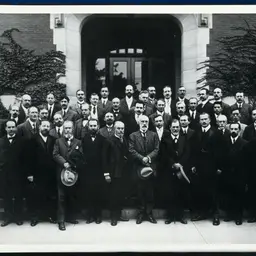
Participants in the Clark University conference, Worcester, Massachusetts, September 1909, among them Sándor Ferenczi (third row), Sigmund Freud, Carl Jung, Ernest Jones and A. A. Brill; photographer unknown 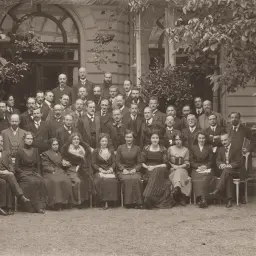
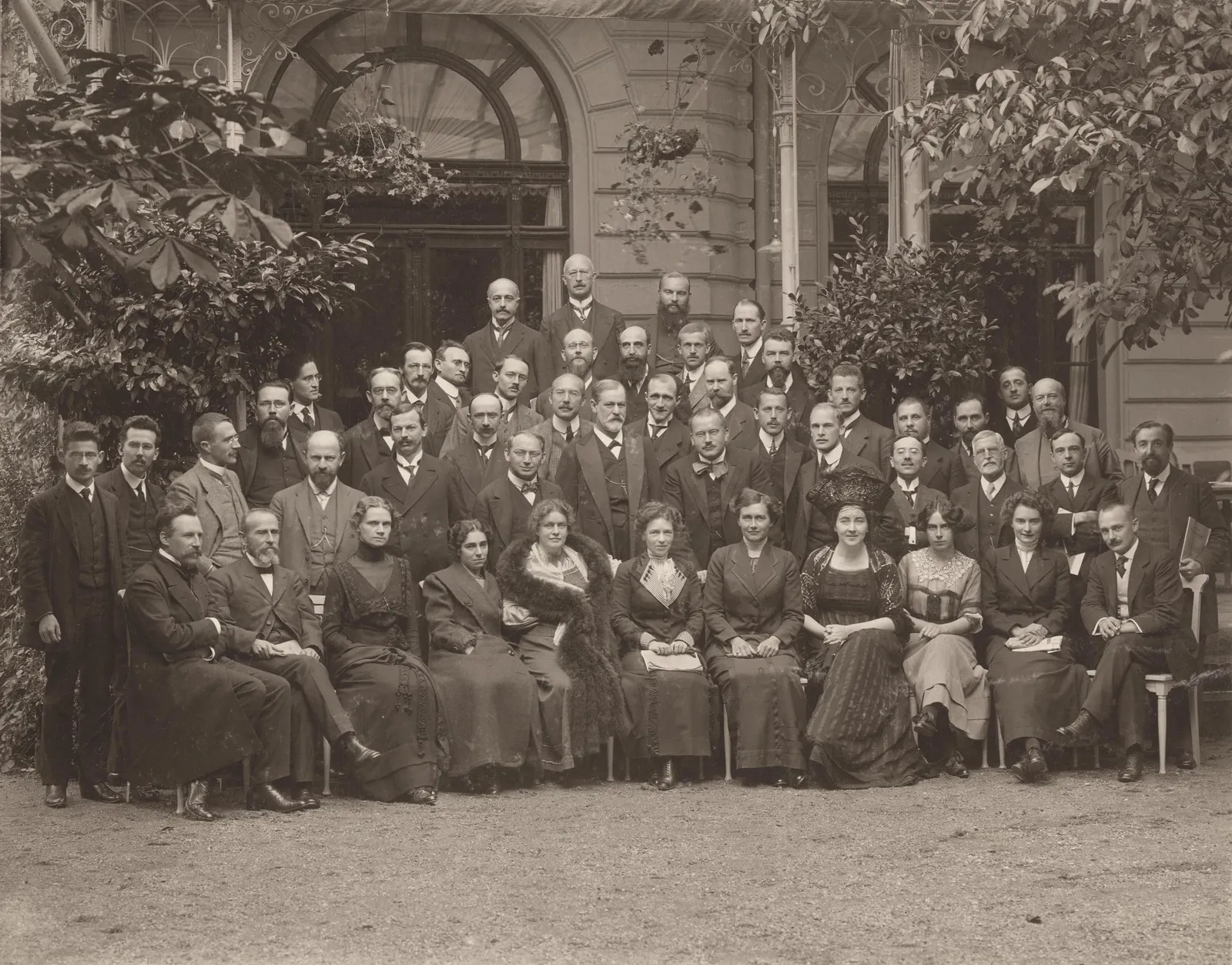
The International Psychoanalytic Congress at Weimar, 21 September 1911, with Sándor Ferenczi standing beside Sigmund Freud in the second row; photographed by Franz Vältl
References
- The Interpretation of Dreams1900
- Introjection and Transference1909
- Stages in the Development of the Sense of Reality1913
- The Development of Psychoanalysis1924
- Dr. Sándor Ferenczi (On His 50th Birthday)1923
- The Life and Work of Sigmund Freud1953
- The Trauma of Birth1924
- Acts of Will: The Life and Work of Otto Rank1985
- Psychiatrist of America: The Life of Harry Stack Sullivan1982
- Formulations on the Two Principles of Mental Functioning1911
- Remembering, Repeating and Working-Through1914
- Beyond the Pleasure Principle1920
- The Basic Fault: Therapeutic Aspects of Regression1968
- The Final Goal of Psycho-Analytic Treatment1935
- Early Developmental States of the Ego. Primary Object-Love1937